
Exposed Beam Installation: Box Beams vs. Solid Timbers for Modern Homes
The rustic charm and architectural grandeur of exposed beams have captivated homeowners for centuries, bringing warmth, character, and a touch of the outdoors into interior spaces. In modern homes, this design element continues to be highly sought after, but the choice between box beams and solid timbers for your exposed beam installation can significantly impact the aesthetics, structural integrity, and budget of your project. As an expert SEO content strategist and senior editor, I often encounter this dilemma, and in 2026, the discussion around “Exposed Beam Installation: Box Beams vs. Solid Timbers for Modern Homes” is more relevant than ever. This comprehensive guide will delve into the nuances of each option, helping you make an informed decision that perfectly complements your home’s design and your practical needs.
Key Takeaways
- Structural vs. Decorative: Solid timbers are load-bearing and structural, while box beams are purely decorative and cannot support weight [1].
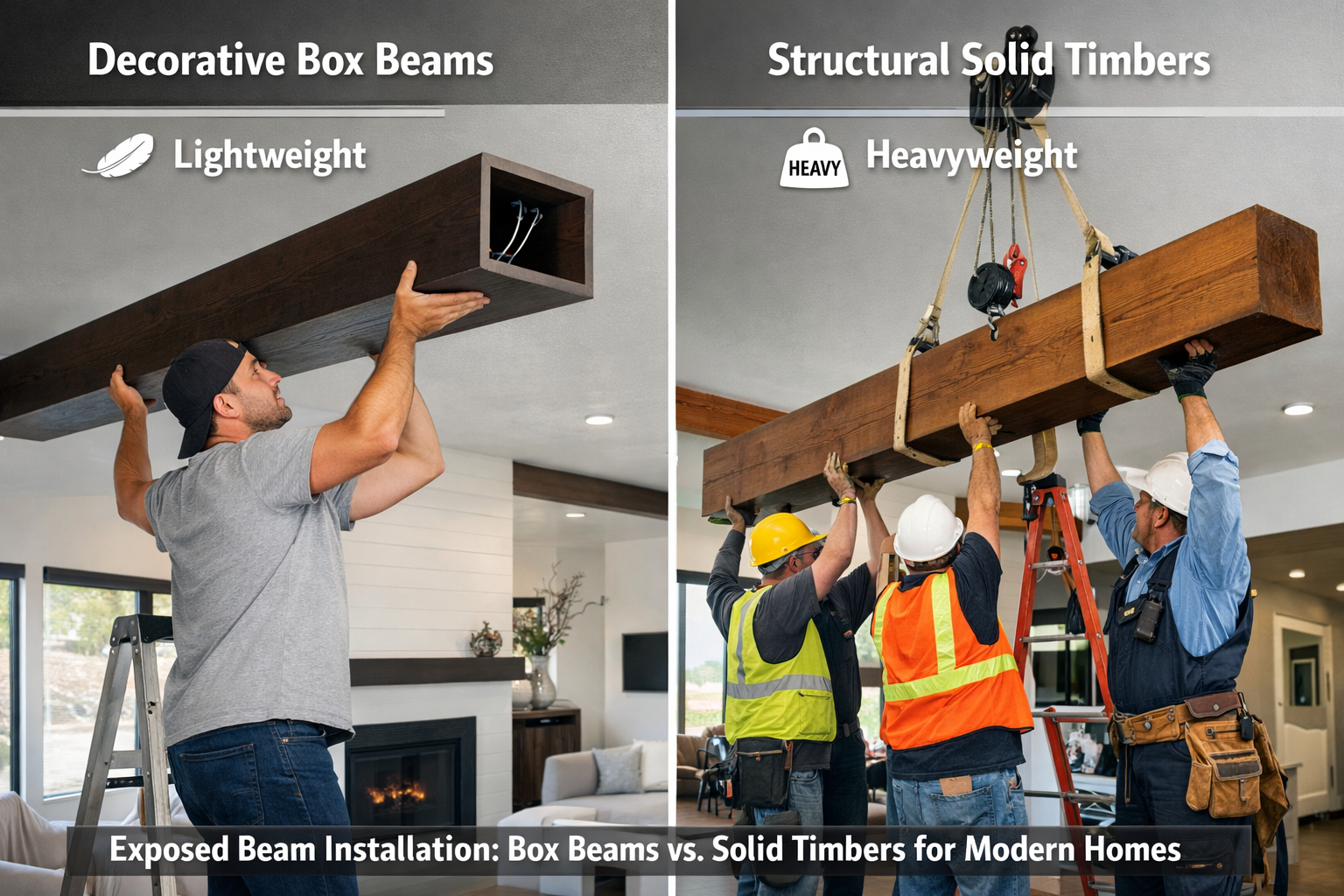
- Installation & Weight: Box beams are lightweight and often suitable for DIY installation, requiring no extra structural support. Solid timbers are heavy, demanding professional installation and significant structural reinforcement [1].
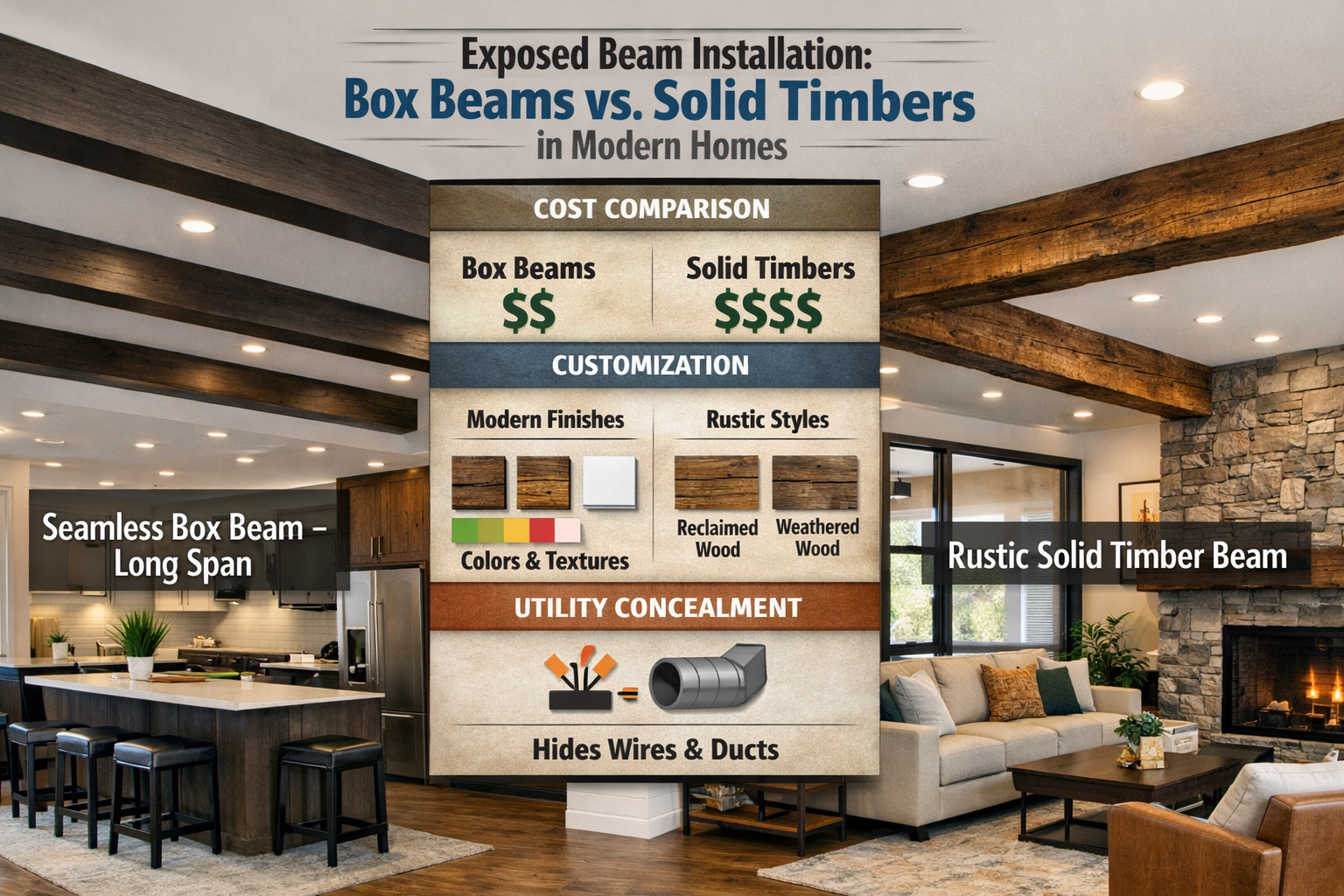
- Cost & Customization: Box beams are generally more affordable due to less material and easier installation. They offer limitless customization in size, finish, and texture, unlike solid timbers which are restricted by natural wood availability [1].
- Renovation Versatility: Box beams are ideal for renovations where existing structures may not support the weight of solid timbers. They also excel at concealing utilities [2].
- Aesthetic & Seams: Solid timbers offer a seamless look for long spans. Box beams may have visible seams, though expert craftsmanship can minimize them. Solid beams lean towards rustic, while box beams fit clean, transitional designs [2].
Understanding Exposed Beam Installation: Box Beams vs. Solid Timbers
When embarking on an exposed beam installation project, one of the first critical decisions you’ll face is whether to use box beams or solid timbers. While both achieve a similar visual effect, their underlying construction, capabilities, and installation requirements differ vastly. Let’s break down the fundamental distinctions.
Solid Timbers: The Authentic Structural Statement
Solid timbers are exactly what they sound like: beams cut from a single, continuous piece of wood. They embody authenticity and strength, often showcasing the natural grain, knots, and imperfections that give wood its unique character. Historically, these were the beams that held homes together, and in many cases, they still do.
Structural Integrity and Weight
The most significant characteristic of solid timbers is their structural capability. They can support substantial weight and are often integral to a building’s load-bearing framework [1]. This means if you’re looking to add structural support or if your design truly requires a beam to carry a load, solid timbers are the definitive choice. However, this strength comes with considerable weight. A large solid timber beam can be incredibly heavy, requiring specialized equipment and multiple professionals for installation. The existing structure of your home must be able to support this added weight, often necessitating additional structural reinforcement, which adds complexity and cost to the project [1].
Aesthetic and Material Considerations
Solid timbers offer an unparalleled natural aesthetic. The sheer size and genuine nature of a solid beam create a powerful visual impact. For long spans, solid beams entirely eliminate the problem of visible seams, providing a continuous, uninterrupted line [2]. Douglas Fir is a dominant species in this category, renowned for its structural strength and beautiful grain [2]. Other popular choices include oak, cedar, and reclaimed wood, each offering a distinct look and feel.
The availability of solid timbers in very large dimensions can be a limiting factor, as they depend on the size of the trees harvested. While they can be finished in various ways, their natural form largely dictates their final appearance. Solid beams lend themselves beautifully to rustic, farmhouse, or traditional design aesthetics [2].
Installation Realities and Cost
Installing solid timbers is not a DIY project for the faint of heart. Due to their immense weight and structural role, professional expertise is almost always required. This often involves structural engineers to assess load-bearing capacity and skilled carpenters to ensure precise and safe installation. The cost of solid timbers themselves can be higher, and when you factor in the labor, equipment, and potential structural modifications, the overall expense can be substantial [1]. In renovation projects, incorporating solid timbers can be particularly challenging because older structures were typically not engineered to support such heavy additions [2].
Box Beams: The Decorative and Versatile Alternative
Box beams, often referred to as hollow beams or faux beams, are constructed from multiple pieces of wood (or other materials) to form a hollow, box-like structure. They are designed to replicate the appearance of solid timbers without the associated weight or structural demands.
Decorative Nature and Lightweight Design
Crucially, box beams are purely decorative. They are not designed to bear any structural load [1]. Their primary purpose is to enhance the aesthetic of a space by mimicking the look of solid timbers. This decorative nature is also their biggest advantage in terms of installation. Box beams are significantly lighter than solid timbers, making them much easier to handle and install [1]. In many cases, they can be installed by homeowners with basic woodworking skills, without the need for heavy machinery or extensive structural modifications. This ease of installation also contributes to their lower overall cost.
Customization and Utility Concealment
One of the most appealing aspects of box beams is their incredible customization flexibility. Since they are fabricated, they can be made to virtually any dimension, stain, or texture imaginable [1]. This allows for precise matching with existing décor or the creation of a truly unique design statement. Whether you desire a smooth, modern finish or a distressed, reclaimed look, box beams can deliver.
Beyond aesthetics, box beams offer a practical advantage that solid timbers cannot: the ability to conceal utilities. Their hollow core makes them perfect for running electrical wiring, plumbing, or even audio-visual cables, providing a clean and integrated solution for modern homes [2]. This feature is particularly valuable in renovation projects where opening up walls might be impractical or costly.
Installation and Seam Considerations
While installation is generally simpler for box beams, especially engineered varieties that use multi-layer veneer processes to prevent warping and cracking [4], there are considerations. For very long spans (beyond 14-16 feet), box beams will typically require visible seams where sections are joined [2]. While skilled craftsmen can miter these seams expertly to minimize their appearance, they may still be detectable upon close inspection.
Box beams are a masterclass in fabrication and represent a distinct market segment for modern homes seeking lighter installation and utility concealment, a trend that is only growing in 2026 [5].
Exposed Beam Installation: Box Beams vs. Solid Timbers for Modern Homes – A Detailed Comparison
Now that we’ve explored each type individually, let’s conduct a direct comparison, focusing on the factors most relevant to modern home design and construction in 2026. This will help clarify which option aligns best with your specific project goals.
Structural vs. Decorative: The Fundamental Difference
| Feature | Box Beams | Solid Timbers |
|---|---|---|
| Structural Role | Purely decorative; cannot bear load [1] | Load-bearing; structural component [1] |
| Weight | Lightweight, hollow | Very heavy, solid |
| Installation Ease | Easier, often DIY-friendly | Requires professional installation, heavy lifting |
| Structural Support | No additional support typically needed | Often requires significant structural reinforcement [1] |
This table clearly illustrates the core difference: if you need a beam to do something structurally, solid timber is the only way to go. If the goal is purely aesthetic, box beams offer flexibility and ease.
Cost, Customization, and Aesthetics
When considering the visual impact and financial outlay, the choice becomes even more nuanced.
Cost-Effectiveness
Box beams are almost always the more affordable option. This is due to several factors:
- Less Material: They use less actual wood compared to solid timbers of the same dimensions [1].
- Easier Manufacturing: The fabrication process can be more controlled and efficient.
- Reduced Installation Costs: The lighter weight reduces labor costs, equipment rental, and the need for expensive structural modifications [1].
Solid timbers, conversely, can be quite costly. The price is driven by the scarcity of large, straight pieces of wood, the labor-intensive harvesting and milling, and the specialized, often structural, installation requirements [1]. For a more detailed look at wood types and their costs, you might find our guide on Rough Cut Lumber Flooring: A Comprehensive Guide to Installation and Finishing insightful, as material costs can sometimes overlap.
Customization and Design Versatility
This is where box beams truly shine for modern homes. They can be custom-fabricated to precise specifications regarding:
- Dimensions: Any length, width, or height.
- Wood Species: While often made from veneer over a core, they can mimic any wood species.
- Finish: Virtually any stain, paint, distressing, or texture can be applied [1]. This allows for seamless integration into various design styles, from ultra-modern and minimalist to transitional.
- Clean Lines: Box beams often align better with the clean-lined, transitional design aesthetics favored in many modern homes [2].
Solid timbers, while beautiful, are limited by nature. Their dimensions are restricted by the size of the tree, and while they can be finished, their inherent character dictates much of the final look. They typically suit rustic or antiqued aesthetics more naturally [2]. However, a beautifully finished solid beam can be a stunning focal point in any home, regardless of style. For those exploring different finishing techniques, our articles on wood finishing techniques or oak wood finishing techniques could provide valuable insights.
Seam Visibility
This is an important aesthetic consideration. For spans exceeding 14-16 feet, box beams will likely have visible seams where sections are joined [2]. While skilled craftsmanship can minimize these, they may still be noticeable. Solid timbers, being one continuous piece, offer a completely seamless appearance for long spans, which many homeowners find superior for an authentic look.
Practical Considerations: Renovation, Utilities, and Climate
Beyond aesthetics and cost, practical aspects often tip the scales in favor of one beam type over another.
Renovation Projects
For existing homes, especially those undergoing significant remodels, box beams are often the only viable option. Existing structures are rarely engineered to support the immense weight of new solid timber beams without extensive and costly structural modifications [2]. Box beams, being lightweight, can typically be installed without concern for additional structural load, making them a homeowner’s and builder’s favorite for adding character to an existing space.
Utility Integration
As mentioned, the hollow nature of box beams makes them exceptionally useful for concealing utilities. Running electrical wires for lighting, ceiling fans, or recessed speakers, or even small plumbing lines, can be cleanly and discreetly done within a box beam [2]. This capability can save significant time and money during renovations, avoiding the need to open up walls or ceilings for new wiring. Solid timbers, being solid, offer no such utility integration benefits.
Climate and Environmental Factors
Climate plays a role, especially for box beams. In humid climates or areas with significant temperature fluctuations, box beams made from standard construction methods can be prone to expansion and separation, leading to visible seams or warping if not properly engineered and installed [2]. This is less of an issue for solid timbers, which generally perform well in both indoor and outdoor conditions due to their dense, continuous structure [2]. However, even solid timbers can crack or check over time, a natural process known as “checking,” which some consider part of their rustic appeal. Engineered box beams, leveraging multi-layer veneer processes, offer greater stability and resistance to warping and cracking compared to traditionally constructed box beams [4].
Choosing the Right Beam for Your Modern Home
The decision between box beams and solid timbers ultimately comes down to a balance of your design vision, practical needs, and budget.
Opt for Solid Timbers if:
- You require a load-bearing structural element.
- Authenticity and a completely seamless look are paramount, especially for long spans.
- Your budget allows for higher material, labor, and potential structural modification costs.
- You prefer a truly rustic or grand aesthetic.
- You are building a new home where structural integration is planned from the outset.
Consider Box Beams if:
- Your primary goal is aesthetic enhancement without structural requirements.
- You are renovating an existing home where structural limitations prevent heavy additions [2].
- Concealing electrical wiring, plumbing, or other utilities is a priority [2].
- Budget is a significant concern, as they are generally more affordable [1].
- You desire maximum customization in terms of size, finish, and texture [1].
- You prefer a clean-lined, transitional, or contemporary aesthetic [2].
- You plan for a DIY-friendly installation.
Expert Insight for 2026
In 2026, the trend of maximizing both aesthetic appeal and functionality continues to drive innovation in home design. Box beams, particularly engineered versions, are gaining traction for their versatility and ability to meet modern demands. “Box beams are a masterclass in fabrication, representing a distinct market segment for modern homes seeking lighter installation and utility concealment,” notes one industry trend report [5]. This underscores their growing popularity as a smart choice for contemporary interiors. For specific projects like a woodworking bedroom or adding character to a living space, the ease of installation and design flexibility of box beams can be a significant advantage.
Installation Tips and Best Practices
Regardless of your choice, proper installation is key to both safety and aesthetic success.
For Solid Timbers:
- Professional Assessment: Always consult with a structural engineer to ensure your existing structure can support the weight or to design necessary reinforcements.
- Skilled Craftsmen: Hire experienced professionals for handling and installation. This is not a task for novices.
- Material Sourcing: Work with reputable lumber suppliers for high-quality, appropriately dried timbers to minimize future warping or cracking.
For Box Beams:
- Accurate Measurements: Precision is crucial for seamless joins and a professional look.
- Proper Fastening: Use strong adhesives and appropriate fasteners (screws, lag bolts into ceiling joists) to secure the beams firmly. For larger beams or those housing heavy utilities, consider additional blocking.
- Finishing Touches: Pay attention to seams. While expert mitering helps, wood fillers and matching stains can further obscure joins.
- DIY Considerations: If you’re tackling the installation yourself, ensure you have the right tools, including a miter saw for precise cuts, a good level, and safety gear. For specific woodworking tools and techniques, resources like our guide on Miter Saw Table Height: Importance, Guidelines, and Tips can be invaluable.
Conclusion
The choice for exposed beam installation in your modern home—box beams vs. solid timbers—is a significant one that impacts not just the visual appeal but also the structural integrity and practical functionality of your space. While solid timbers offer unparalleled authenticity and load-bearing strength, they come with substantial weight, higher costs, and complex installation requirements. Box beams, on the other hand, provide an incredibly versatile, cost-effective, and lightweight alternative, excelling in customization, utility concealment, and ease of installation, making them particularly well-suited for renovations and contemporary design aesthetics in 2026.
Ultimately, by carefully weighing your project’s specific needs, aesthetic desires, budget, and structural limitations, you can make an informed decision that brings the timeless beauty of exposed beams into your modern home. Whether you opt for the grandeur of solid wood or the ingenious versatility of box beams, your space is sure to gain character and a touch of architectural elegance.
Actionable Next Steps:
- Define Your Needs: Determine if your beams need to be structural or purely decorative.
- Assess Your Structure: For solid timbers, consult a structural engineer immediately.
- Set Your Budget: Get quotes for both material types and installation methods.
- Explore Design Options: Consider the finish, species, and dimensions that best suit your home’s aesthetic.
- Seek Professional Advice: Even if leaning towards DIY box beam installation, a consultation with a contractor or experienced carpenter can offer valuable insights.
References
[1] Box Beams Vs Solid Beams Which One Is Right For Your Project – https://vintagewoodfloors.com/blogs/vintageblogs/box-beams-vs-solid-beams-which-one-is-right-for-your-project
[2] Solid Beams Vs Box Beams – https://www.simsbuilders.com/blog/solid-beams-vs-box-beams
[4] Better Than Solid Beams – https://theoldemill.com/better-than-solid-beams/
[5] 2026 Trends To Watch In Custom Woodworking And Design – https://www.atlantawoods.com/post/2026-trends-to-watch-in-custom-woodworking-and-design
Meta Title: Box Beams vs. Solid Timbers: Modern Exposed Beam Installation
Meta Description: Explore exposed beam installation for modern homes in 2026. Compare box beams and solid timbers for aesthetics, cost, and structural needs.