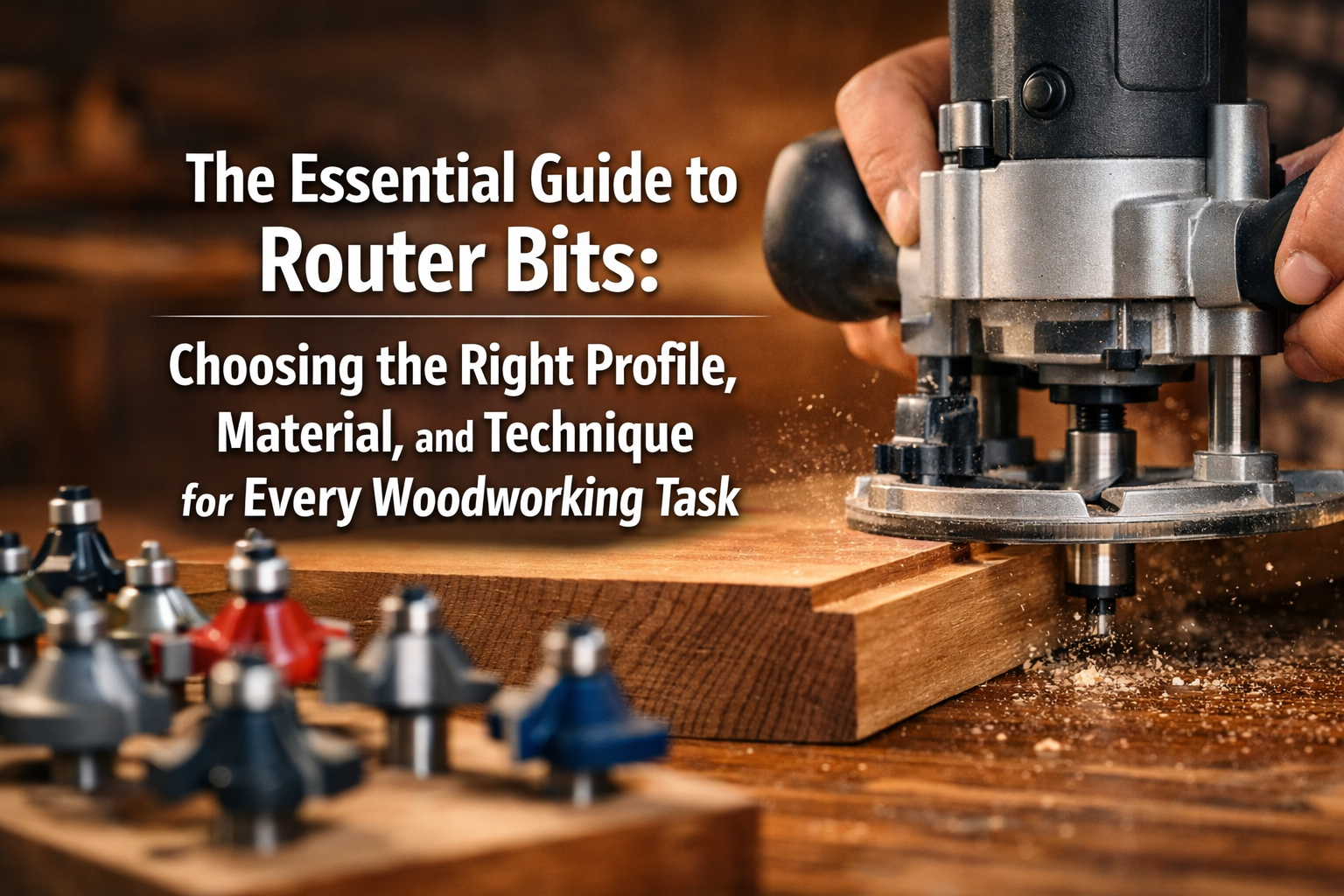

The router, a versatile cornerstone of the modern woodworking shop, is only as effective as the bit spinning within its chuck. For many, navigating the sheer variety of router bits can feel overwhelming, a dizzying array of shapes, sizes, and materials. But fear not! This comprehensive article serves as The Essential Guide to Router Bits: Choosing the Right Profile, Material, and Technique for Every Woodworking Task. By demystifying the vast world of router bits, you’ll learn how to select and effectively use different profiles for joinery, decorative edges, dadoes, and much more, ultimately elevating your routing precision and unlocking new levels of craftsmanship in 2026.
Key Takeaways
- Profile is paramount: Understanding the function of different bit profiles (e.g., straight, roundover, chamfer) is crucial for achieving desired woodworking results, from basic cuts to intricate joinery.
- Material matters: The bit’s material (High-Speed Steel, Carbide-Tipped, Solid Carbide) directly impacts its durability, sharpness, and suitability for various wood types and project demands.
- Technique ensures success: Proper routing techniques, including feed rate, depth of cut, and climb vs. conventional cutting, are vital for safety, cut quality, and bit longevity.
- Safety first: Always prioritize safety by wearing appropriate personal protective equipment (PPE) and following machine guidelines when operating a router.
- Maintenance extends life: Regular cleaning and sharpening of router bits significantly prolong their lifespan and maintain cutting performance.
Understanding Router Bit Profiles: The Essential Guide to Router Bits
The profile of a router bit defines the shape it carves into the wood. Selecting the correct profile is the first and most critical step in any routing operation. Let’s explore the most common types and their applications.

Basic Cutting Profiles
These are the workhorses of any shop, indispensable for fundamental cuts.
- Straight Bits: Used for cutting straight grooves, dadoes, rebates (rabbets), and mortises. They are available in various diameters and lengths. Think of them as the foundation for much of your joinery.
- Dado Bits: Essentially wide straight bits, specifically designed for cutting dadoes – grooves across the grain – often used for shelving or cabinet construction.
- Spiral Bits (Up-cut, Down-cut, Compression): These bits have a helical flute, similar to a drill bit.
- Up-cut: Pulls chips upwards, excellent for deep cuts and chip evacuation, but can cause tear-out on the top surface.
- Down-cut: Pushes chips downwards, creating a clean top edge, ideal for veneer or laminate, but can pack chips in deeper cuts.
- Compression: A combination of both, with up-cut flutes on the bottom and down-cut on the top, perfect for clean cuts on both sides, especially in plywood or laminated panels.
- Mortising Bits: Specialized straight bits, often with a plunging tip, designed for cutting mortises for traditional joinery.
Decorative Edge Profiles
These bits transform a simple edge into a visually appealing feature.
- Roundover Bits: Create a smooth, rounded edge. Available in various radii, they are popular for softening edges on tabletops, shelves, and furniture components.
- Chamfer Bits: Cut a consistent, angled bevel on an edge. Common angles are 45 degrees, providing a crisp, modern look.
- Ogee Bits: Produce an S-shaped profile, a classic and elegant decorative edge often seen on traditional furniture and moldings.
- Cove Bits: Cut a concave, rounded profile, the opposite of a roundover.
- Beading Bits: Similar to roundover bits but add a small fillet (a flat shoulder) above the rounded profile, creating a decorative bead.
Joinery and Specialty Profiles
For more advanced construction and specialized tasks, these bits are invaluable.
- Dovetail Bits: Essential for cutting dovetail joints, renowned for their strength and beauty, often used in drawer construction. To master intricate joinery, consider exploring resources on Mastering Modern Hand-Cut Joinery: Adapting Classics for Live Edge and Modular Furniture.
- Rabbeting Bits: Cut a rabbet, which is a step or recess along the edge of a board, commonly used for back panels or door frames. Many come with interchangeable bearings for different rabbet depths.
- Panel Raising Bits: Used to create the decorative beveled or profiled edge on the raised panels of cabinet doors. These are often large-diameter bits and require a router table.
- Tongue and Groove Bits: Used in pairs (or a reversible single bit) to create interlocking tongue and groove joints, ideal for flooring, paneling, or cabinet backs.
- Keyhole Bits: Cut a T-shaped slot for hanging items flush against a wall.
- Slotting Cutter Bits: Create slots or grooves for T-molding, splines, or biscuits.
“Choosing the right router bit profile is like selecting the perfect brush for a painting – each stroke, or cut, requires a specific tool to achieve the desired artistic vision in wood.”
Router Bit Materials and Construction: Material, and Technique for Every Woodworking Task
Beyond the profile, the material and construction of a router bit significantly impact its performance, durability, and cost. Understanding these aspects is crucial for making informed choices for The Essential Guide to Router Bits: Choosing the Right Profile, Material, and Technique for Every Woodworking Task.
Shank Diameter
Router bits typically come with 1/4-inch or 1/2-inch shanks.
- 1/4-inch shanks: Common for smaller routers and less demanding tasks. They are more prone to deflection and vibration in heavier cuts.
- 1/2-inch shanks: Offer greater stability, less vibration, and are preferred for larger bits, deeper cuts, and router table applications. Always use a 1/2-inch shank bit if your router can accommodate it, especially when making Building Statement Furniture Pieces: Designing and Constructing Coffee Tables, Benches, and Console Tables That Sell for $500 in 2026.
Bit Materials
The cutting edge material determines how long the bit stays sharp and which materials it can cut effectively.
High-Speed Steel (HSS):
- Pros: Less expensive, can be sharpened, good for softwoods and light cuts.
- Cons: Dulls quickly in hardwoods, generates more heat, not suitable for abrasive materials.
- Best For: Occasional use in softwoods, simple tasks.
Carbide-Tipped (TC):
- Pros: Much harder and more durable than HSS, holds a sharp edge longer, excellent for hardwoods, composites (plywood, MDF). Most common type of bit.
- Cons: More expensive than HSS, sharpening requires specialized equipment, brittle – can chip if dropped.
- Best For: General woodworking, daily use, hardwoods, sheet goods. This is the standard for most workshops.
Solid Carbide:
- Pros: Extremely hard, longest lasting sharpness, ideal for very hard woods, abrasive materials, and CNC applications. Excellent for precision work like DIY Wooden Wall Clocks: Precision Joinery and Modern Designs.
- Cons: Most expensive, very brittle, requires careful handling.
- Best For: Professional shops, CNC machining, extended use in demanding materials.
Bearings
Many router bits incorporate a bearing to guide the cut.
- Purpose: The bearing rides against the workpiece or a template, controlling the depth or position of the cut.
- Applications: Essential for flush trimming, pattern routing, edge profiling (roundovers, chamfers), and replicating shapes using a template.
- Types: Ball bearings are most common, often replaceable. Some bits have smaller or larger bearings for different cutting needs.
Coatings
Some premium bits feature coatings like titanium nitride (TiN) or proprietary ceramic coatings.
- Benefits: These coatings reduce friction, dissipate heat, prevent pitch buildup, and can extend bit life, especially in sticky woods or extended routing sessions. While not strictly necessary for all tasks, they add value for heavy users.
Mastering Routing Techniques: The Right Profile, Material, and Technique for Every Woodworking Task
Having the right bit is only half the battle; knowing how to use it safely and effectively is paramount. This section delves into essential routing techniques that complement The Essential Guide to Router Bits: Choosing the Right Profile, Material, and Technique for Every Woodworking Task.
Router Safety First! 👷♂️
Before any cut, always prioritize safety:
- PPE: Always wear safety glasses and hearing protection. A dust mask is also advisable, especially when routing MDF.
- Secure Workpiece: Ensure your material is firmly clamped or held. Never freehand a cut unless the specific technique (e.g., edge routing with a guide bearing) allows it with proper control.
- Correct Bit Insertion: Insert the bit fully into the collet, then pull it back out about 1/8 to 1/4 inch before tightening. This ensures maximum grip and minimizes wobble.
- Router Table vs. Handheld: Understand when to use a router handheld and when a router table is safer and more precise. For intricate work or small pieces, a router table often provides better control, useful for projects like Building Wooden Spice Racks: Wall-Mounted and Rotating Designs for Efficient Kitchens.
Feed Rate and Direction
- Feed Rate: The speed at which you move the router through the material.
- Too fast: Can lead to tear-out, burnt wood, excessive strain on the router, and a dull bit.
- Too slow: Can cause burning, glazing of the wood, and unnecessary heat buildup.
- Optimal: A smooth, consistent feed rate where the router sounds like it’s working but not struggling, and chips are being expelled cleanly. Let the bit do the work.
- Direction of Cut (Climb vs. Conventional):
- Conventional Cut (Recommended): The bit rotates against the direction of feed. This provides better control as the router tries to push away from you, making it safer.
- Climb Cut (Use with Caution): The bit rotates with the direction of feed. The router will try to pull itself through the wood, which can be dangerous and lead to loss of control. Climb cuts are sometimes used for very light finishing passes to reduce tear-out in difficult grain or to prevent blowout when routing across end grain, but always with extreme caution and very shallow depths.
Depth of Cut 📏
- Multiple Passes: Never try to achieve a deep profile or dado in a single pass, especially in hardwoods. This puts excessive strain on the bit and router, causes burning, and can be unsafe.
- Gradual Approach: Make multiple shallow passes, increasing the depth slightly with each pass. This results in cleaner cuts, less tear-out, and prolongs bit life. For example, a 1/2-inch deep dado might require 3-4 passes.
Essential Routing Techniques
- Edge Routing: When routing an edge, always keep the bearing (if present) or fence firmly against the workpiece. For external edges, move counter-clockwise. For internal edges, move clockwise.
- Dadoes and Grooves: Use a straight edge or a router guide for perfectly straight dadoes or grooves. Ensure the bit is perfectly perpendicular to the base. Remember, for cutting a dado across the grain, use a sled or a clamp-on fence to ensure accuracy.
- Plunge Routing: For stopped dadoes or mortises, a plunge router is invaluable. Lower the spinning bit gradually into the wood.
- Template Routing: Use a bearing on the bit (top or bottom) or a guide bushing on your router base to follow a template. This is ideal for replicating shapes or creating precise inlays. For techniques to Joining Plywood Edges: Techniques for a Perfect Finish, precise routing with templates can be very helpful.
Maintaining Your Router Bits 🧼
Proper care ensures your bits perform their best and last longer:

- Clean Regularly: Pitch and resin buildup can cause friction, burning, and dulling. Clean bits after each use with a specialized router bit cleaner or a solvent like mineral spirits. A brass brush can help remove stubborn residue.
- Inspect for Damage: Before and after use, check for chipped carbide, bent shanks, or excessive wear. A damaged bit is unsafe and will produce poor results.
- Store Properly: Store bits in protective cases or a bit organizer to prevent damage to the delicate cutting edges.
- Sharpening: Carbide-tipped bits can be professionally sharpened, though this might not always be cost-effective for smaller bits. HSS bits can be sharpened by hand or machine.
By integrating these techniques and maintenance practices, you’ll not only achieve superior results but also ensure your router bits remain sharp and reliable for all your woodworking adventures in 2026.
Conclusion
Mastering the art of routing goes far beyond simply turning on a machine. It requires a nuanced understanding of router bit profiles, the materials they’re made from, and the precise techniques for their application. This Essential Guide to Router Bits: Choosing the Right Profile, Material, and Technique for Every Woodworking Task has equipped you with the knowledge to navigate the vast world of router bits, empowering you to make informed decisions for every project.
Remember, the right bit profile dictates the shape, the material ensures durability, and the proper technique guarantees safety and a flawless finish. By adhering to safe practices, maintaining your tools, and continuously refining your skills, you’ll unlock the full potential of your router and elevate your woodworking craftsmanship to new heights. Happy routing in 2026!
Next Steps:
- Start by identifying the most common profiles you’ll need for your current projects.
- Invest in quality carbide-tipped bits for general use, prioritizing 1/2-inch shanks where possible.
- Practice various techniques on scrap wood before moving to your final project pieces.
- Always prioritize safety!