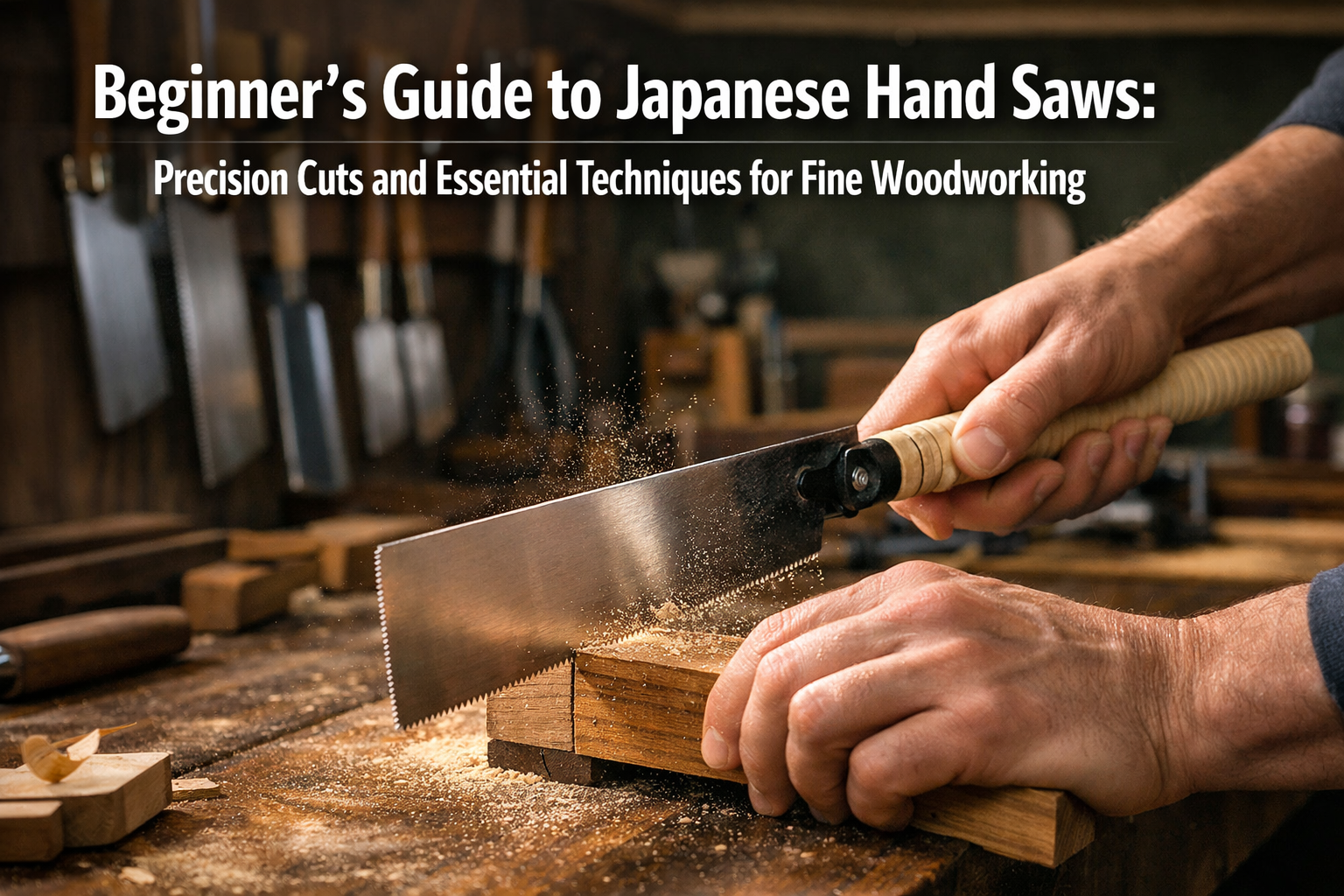

In the world of fine woodworking, precision is paramount. Achieving razor-sharp, accurate cuts is the hallmark of a skilled craftsman, and for many, this mastery begins with the Japanese hand saw. Unlike their Western counterparts, Japanese saws operate on a pull stroke, offering unparalleled control and efficiency. This unique design allows for thinner blades, finer teeth, and ultimately, cleaner cuts that are essential for intricate joinery and delicate work.
This Beginner’s Guide to Japanese Hand Saws: Precision Cuts and Essential Techniques for Fine Woodworking is designed to demystify these revered tools. It will equip aspiring woodworkers with the knowledge and confidence to choose the right saw, understand its mechanics, and apply fundamental techniques to elevate their craft in 2026. Prepare to transform your woodworking journey with tools that are as elegant as they are effective.

Key Takeaways
- Japanese saws cut on the pull stroke, providing superior control and thinner, more precise kerfs.
- Understanding the different types of Japanese saws (Ryoba, Dozuki, Kataba) is crucial for selecting the right tool for specific tasks.
- Proper grip and body mechanics are essential for accurate and efficient cutting, reducing fatigue and improving results.
- Maintenance involves regular cleaning and oiling to prevent rust and ensure the longevity of these delicate blades.
- Starting with simple projects and practicing basic cuts will build confidence and proficiency with Japanese hand saws.
Understanding the Fundamentals: Why Japanese Saws Are Different
Japanese hand saws, often referred to as nokogiri, represent a significant departure from the push-stroke saws commonly found in Western workshops. This fundamental difference in cutting action is the cornerstone of their precision and efficiency. Western saws cut on the push stroke, which requires a thicker blade to prevent buckling under compression. Japanese saws, however, cut on the pull stroke. This puts the blade under tension, allowing it to be much thinner and more flexible without bending, resulting in a significantly finer kerf (the width of the cut) and less material removal.
This pull-stroke action translates into several distinct advantages for fine woodworking:
- Precision and Control: The act of pulling the saw allows for greater control over the cut, as the blade is being drawn towards the body. This makes it easier to start a cut accurately and maintain a straight line, especially in delicate operations like cutting dovetails or tenons.
- Finer Kerf: Thinner blades mean less material is removed with each pass. This is crucial for tight-fitting joinery where even a small amount of lost material can compromise the fit.
- Less Effort: The pull stroke is generally less fatiguing and feels more natural, as it utilizes larger back muscles rather than relying solely on arm strength.
- Cleaner Cuts: The finely sharpened teeth are designed to slice wood fibers cleanly on the pull, minimizing tear-out, especially on the exit side of the cut.
Let’s explore the primary types of Japanese saws a beginner should consider:
The Essential Japanese Hand Saws for Beginners
Choosing the right saw for the job is a critical step in mastering Precision Cuts and Essential Techniques for Fine Woodworking. Here are the three most common types you’ll encounter:
1. Ryoba Saw (両刃鋸) – The Versatile Workhorse
The Ryoba is arguably the most versatile Japanese saw and an excellent starting point for any beginner. Its defining feature is a double-edged blade, with rip teeth on one side and crosscut teeth on the other.
- Rip Teeth: Designed for cutting with the grain of the wood, these teeth resemble tiny chisels, efficiently clearing chips.
- Crosscut Teeth: Designed for cutting across the grain, these teeth are shaped like knife points, scoring and severing wood fibers for a clean cut.
This dual functionality makes the Ryoba suitable for a wide range of tasks, from breaking down larger stock to cutting joinery components.
2. Dozuki Saw (胴付鋸) – The Joinery Specialist
The Dozuki saw is the Japanese equivalent of a Western back saw, featuring a stiffening rib along the top edge of the blade. This backer prevents the thin blade from flexing, ensuring exceptionally straight and accurate cuts.
- Fine Teeth: Dozukis typically have very fine teeth, making them ideal for delicate, precise cuts in joinery, such as dovetails and tenons.
- Shallow Kerf: The fine teeth and thin blade produce an incredibly narrow kerf, perfect for tight-fitting joints where minimal material removal is desired.
For anyone serious about learning hand tool joinery for visible wood joints, a Dozuki is an indispensable tool.
3. Kataba Saw (片刃鋸) – The Single-Edged All-Rounder
A Kataba is a single-edged saw without a stiffening backer, similar to one side of a Ryoba. It’s often used for deeper cuts that a Dozuki’s backer would obstruct.
- Deeper Cuts: Without the spine, Kataba saws can make through-cuts that are deeper than those possible with a Dozuki.
- Variety: Kataba saws come with various tooth configurations, specializing in rip, crosscut, or even universal cutting.
Many carpenters use Katabas for general framing or timber work, but finer-toothed versions are also valuable for furniture making.
 {{IMG_SLOT_1}}
Mastering Essential Techniques: Grip, Stance, and Cutting Action
Using Japanese hand saws effectively requires a slight shift in technique compared to Western saws. The emphasis is on control, fluidity, and light pressure. This section covers the fundamental principles that will help you achieve Precision Cuts and Essential Techniques for Fine Woodworking right from the start.
Proper Grip and Stance
The way you hold the saw and position your body significantly impacts the accuracy and ease of your cuts.

- Grip: For most cuts, especially with a Ryoba or Kataba, use a two-handed grip. Your dominant hand grips the handle firmly but not rigidly, with your index finger often extended along the spine of the handle for added control. Your non-dominant hand lightly supports the forward part of the handle or the blade itself, acting as a guide and stabilizing force. For Dozuki saws, a single-handed grip is common, often with the thumb or index finger pressing against the blade for lateral stability.
- Stance: Stand comfortably with your feet shoulder-width apart, slightly angled towards your workpiece. Your body should be relaxed, allowing your arm and shoulder to move freely. Position yourself so the saw stroke is aligned with your body, not perpendicular to it. This allows for a more natural, powerful pull.
- Workpiece Stability: Always ensure your workpiece is firmly clamped or secured. Any movement during the cut will compromise accuracy and can be dangerous. Consider using a bench hook or a specialized sawing vise.
Starting the Cut (Kerfing)
This is perhaps the most critical step for a clean, accurate cut.
- Marking: Use a sharp pencil or, even better, a marking knife to clearly define your cut line. A marking knife creates a fine groove that the saw teeth can register in.
- Initial Contact: Place the saw blade on your mark. For crosscuts, start with the toe (front) of the blade. For rips, you might start with the entire length of the blade.
- Gentle Pull: With very light pressure, make one or two short, gentle pull strokes to create a shallow kerf. Use your non-dominant thumb or knuckle as a guide against the blade to ensure it starts exactly on your line. Do not force it.
- Confirm Alignment: Once a shallow kerf is established, remove your guide hand and visually confirm the blade is tracking perfectly on your line. Adjust if necessary.
The Pull Stroke
Once the kerf is established, the actual cutting begins.
- Light Pressure: Unlike Western saws, Japanese saws require very little downward pressure. The sharpness of the teeth and the tension of the blade do most of the work. Let the saw’s weight do its job.
- Smooth, Controlled Pull: Draw the saw towards you in a smooth, continuous motion. Focus on keeping the blade straight through the cut. Avoid jerky movements or excessive speed, especially when learning.
- Return Stroke: On the push (return) stroke, lift the saw slightly off the wood to avoid dragging the teeth. The blade is not designed to cut on this stroke.
- Full Blade Engagement: Try to use as much of the blade’s length as possible with each stroke. This makes the cut more efficient and helps keep the blade tracking straight.
- Focus: Keep your eyes on the cut line, particularly the line on the far side of the wood, to ensure the blade isn’t drifting.
“Using a Japanese saw is like drawing a line with a fine pen; the control comes from the pull, not the push.”
For detailed guidance on other essential hand tools that complement Japanese saws, consider exploring Hand Tool Mastery for Detail Work: Chisels, Hand Planes, and.
{{IMG_SLOT_2}}
Care and Maintenance for Longevity and Performance
Proper care and maintenance are crucial for ensuring your Japanese hand saws maintain their sharpness, precision, and longevity. These tools are often delicate, with fine teeth that can be easily damaged if not handled and stored correctly. Investing a little time in maintenance will pay dividends in consistent, high-quality results for your Beginner’s Guide to Japanese Hand Saws: Precision Cuts and Essential Techniques for Fine Woodworking.
Cleaning After Each Use
Sawdust, especially from resinous woods, can accumulate on the blade and hinder performance.
- Brush Away Sawdust: Use a stiff brush (like an old toothbrush) or compressed air to remove all sawdust from the blade and teeth immediately after use.
- Wipe Down: For resinous woods, a cloth dampened with mineral spirits or a specialized saw cleaner can be used to remove sticky residue. Ensure the blade is thoroughly dried afterward.
- Rust Prevention: After cleaning, apply a thin coat of camellia oil (often sold specifically for Japanese tools) or a light machine oil to the entire blade. This protects against rust, which can quickly degrade the cutting edge.
Sharpening and Tooth Repair
Most modern Japanese saw blades are impulse-hardened, meaning their teeth are extremely hard and cannot be easily sharpened with traditional files. When they dull, the blades are typically replaced. However, some traditional or higher-end blades can be resharpened by a specialist.
- Avoid Damage: The best way to maintain sharpness is to prevent damage. Be mindful of dropping the saw, hitting metal (like nails or screws in wood), or forcing the blade through a knot.
- Replace Blades: For replaceable blade saws, when performance noticeably degrades or teeth are extensively damaged, it’s more cost-effective and practical to simply purchase a new blade. This is a common and accepted practice.
- Gentle Cleaning: If you notice any small burrs or minor issues, a very fine diamond file or ceramic stone can be gently used to smooth the tooth line, but this requires extreme caution to avoid altering the tooth geometry.
Proper Storage
Storing your Japanese saws correctly prevents damage and keeps them ready for use.
- Blade Protection: Many Japanese saws come with a plastic or cardboard sheath to protect the teeth. Always use this sheath when the saw is not in use. If no sheath is provided, a DIY one from thin wood or PVC can be made.
- Hang or Lay Flat: Store saws either by hanging them from a pegboard or rack, or by laying them flat in a drawer or tool cabinet. Avoid leaning them where they could fall or have other tools piled on top, which could damage the delicate teeth.
- Climate Control: Store saws in a dry environment to prevent rust. If you live in a humid climate, consider using desiccants (silica gel packets) in your tool cabinet.
- Separate Storage: Avoid storing your Japanese saws where their blades can come into contact with other metal tools, which could nick or dull the teeth.
By adhering to these maintenance practices, your Japanese hand saws will remain precise, effective tools for many years, enabling you to produce exceptional woodworking projects, whether it’s building robust floating shelves or crafting intricate wooden bookends.
{{IMG_SLOT_3}}
Conclusion: Your Journey to Precision Woodworking Begins
The Beginner’s Guide to Japanese Hand Saws: Precision Cuts and Essential Techniques for Fine Woodworking has unveiled a different, often superior, approach to cutting wood. By understanding the pull-stroke mechanism, distinguishing between the various saw types like the versatile Ryoba, the precise Dozuki, and the deep-cutting Kataba, you are now equipped with foundational knowledge. Mastering the proper grip, stance, and a light, controlled pull stroke will transform your woodworking accuracy and efficiency. Furthermore, diligent care and maintenance will ensure your valuable tools remain in peak condition for countless projects to come.

Embracing Japanese hand saws is more than just adding a tool to your kit; it’s adopting a philosophy of precision and thoughtful craftsmanship. Start with simple projects, practice your cuts, and gradually move on to more complex joinery. The crisp, clean lines and tight-fitting joints you achieve will be a testament to your newfound skill and the exceptional capabilities of these remarkable tools.
Actionable Next Steps:
- Invest in a Quality Saw: Consider starting with a Ryoba for its versatility, or a Dozuki if you plan to jump straight into joinery. Look for saws with replaceable blades for easier maintenance.
- Practice on Scrap Wood: Before tackling a project, spend time practicing straight cuts, crosscuts, and rip cuts on various types of scrap wood to get a feel for the saw and its feedback.
- Learn Marking Techniques: Hone your marking skills with a marking knife to ensure your saw has a precise line to follow.
- Watch Demonstrations: Seek out videos and experienced woodworkers demonstrating Japanese saw techniques to refine your own methods.
- Clean and Oil Regularly: Make saw maintenance a habit after every use to prevent rust and preserve blade sharpness.
Your journey into the world of fine woodworking with Japanese hand saws is just beginning. Enjoy the precision and satisfaction these tools bring to your craft!
References
- Saito, Y. (2012). The Japanese Woodworker: A New Perspective on Tools and Techniques. Taunton Press.
- Schwarz, C. (2009). The Anarchist’s Tool Chest. Lost Art Press.
- Tashiro, K. (1990). Japanese Woodworking Tools: Their Tradition, Spirit, and Use. Linden Publishing.