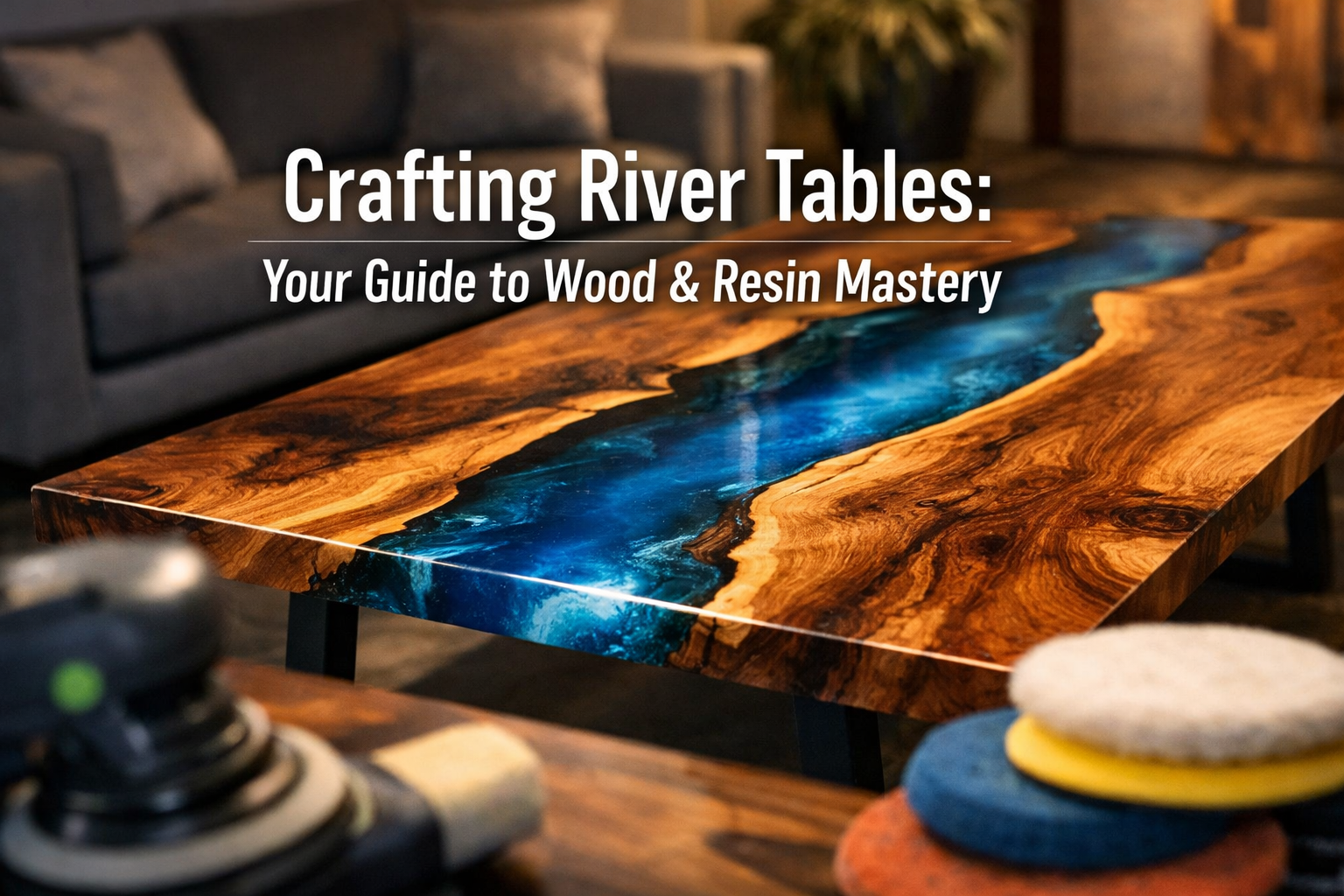

The allure of a wood and resin river table is undeniable. These stunning pieces of furniture, characterized by their captivating epoxy “river” flowing between natural wood slabs, have transformed modern interior design. For both aspiring and experienced craftspeople, the prospect of Building a Modern Wood and Resin River Table: Techniques for Beginners and Intermediate Makers offers a unique blend of woodworking skill and artistic expression. This comprehensive guide will navigate you through every crucial step, from selecting your materials to achieving that coveted glass-like finish, ensuring you can confidently embark on this rewarding journey in 2026.
River tables are more than just furniture; they are functional art. The contrast between organic wood forms and the translucent, often vibrant, epoxy resin creates a visual masterpiece that serves as a focal point in any room. While they may appear complex, the process is approachable with the right knowledge and patience. This article breaks down the journey into manageable stages, providing practical tips and insights to help you achieve professional-level results.

Key Takeaways
- Material Selection is Crucial: Choose kiln-dried, stable wood slabs and high-quality, clear-casting epoxy resin for optimal results.
- Preparation Prevents Problems: Thoroughly clean, level, and seal your wood slabs before pouring to avoid common issues like leaks and bubbles.
- Precision in Pouring: Follow resin mixing ratios meticulously, pour in thin layers, and use a heat gun to eliminate air bubbles effectively.
- Sanding is Essential: Gradual sanding through multiple grits is vital for achieving a perfectly smooth, blemish-free surface on both wood and resin.
- Finishing Defines Quality: Apply a durable topcoat to protect your table and enhance its aesthetic appeal, bringing out the depth of the wood and the clarity of the resin.
I. Foundation First: Selecting Wood and Preparing for Resin
The success of your river table project hinges on the quality of your materials and the meticulousness of your initial preparation. This section focuses on selecting the right wood slabs and preparing them to receive the resin.
Choosing Your Wood Slabs
The most critical component of a river table is, of course, the wood. Live-edge slabs are highly favored for their natural, organic contours that beautifully define the “banks” of your resin river.
- Species Selection: Common choices include Walnut, Maple, Oak, Pecan, and Black Limba. These woods offer attractive grain patterns and good stability. Consider the aesthetic you want to achieve – lighter woods like Maple contrast well with darker resins, while darker woods like Walnut provide a rich, luxurious base.
- Moisture Content: This is paramount. Ensure your wood slabs are thoroughly kiln-dried with a moisture content of 6-8%. High moisture content can lead to warping, cracking, and issues with resin adhesion and curing. A moisture meter is an indispensable tool here.
- Slab Thickness and Size: For a dining table, slabs typically range from 1.5 to 2.5 inches thick. The overall dimensions will depend on your desired table size. Remember to account for some material loss during milling and sanding.
- Character and Defects: Look for slabs with interesting grain patterns, knots, or small voids. These “imperfections” often enhance the natural beauty and uniqueness of your river table. However, avoid slabs with deep cracks or rot that might compromise structural integrity or be difficult to fill.
- Sourcing: Reputable sawmills, specialty lumber yards, or even local arborists are excellent sources for live-edge slabs. For more insights on ethical sourcing, explore Sustainable Wood Sourcing for the Modern Woodworker.
 {{IMG_SLOT_1}}
Preparing the Wood Slabs
Once you have your chosen slabs, careful preparation is vital for Building a Modern Wood and Resin River Table: Techniques for Beginners and Intermediate Makers.
- Flattening and Jointing: Your slabs must be perfectly flat and square where they will meet the resin.
- Rough Flattening: If starting with very rough slabs, a slab flattening mill (router sled) or a large planer is often necessary. This brings the surfaces close to flat.
- Edge Jointing: The edges that will form the “river banks” need to be square and free of loose bark or debris. Use a straight edge and a router or track saw to create a clean, consistent edge. Preserve the live edge character as much as possible, removing only what’s necessary for stability.
- For detailed guidance on slab preparation, refer to Live Edge Slab Selection and Milling.
- Cleaning and Stabilizing:
- Remove Bark: Carefully remove any loose or punky bark from the live edges. A wire brush, chisel, or even a pressure washer (followed by thorough drying) can be used.
- Fill Voids and Cracks: Use clear epoxy or a compatible wood filler to stabilize any small knots, cracks, or natural voids that are not part of your intended river channel. This prevents resin from seeping into unwanted areas.
- Vacuum Thoroughly: Remove all sawdust, dirt, and debris from the surfaces and especially the live edges. Even small particles can create bubbles or imperfections in the resin.
- Building the Mold:
- Material: Melamine-faced particleboard is the go-to material for molds due to its smooth surface and ease of cleaning. Use 3/4-inch thick material for rigidity.
- Construction: Create a box-like mold slightly larger than your table dimensions. Ensure the sides are perfectly square and taller than your desired resin depth.
- Sealing: This is CRITICAL. Seal all internal seams of the mold with clear silicone caulk. Apply a generous bead and smooth it out. Allow it to cure completely before placing your wood. Leaks can be disastrous!
- Release Agent: Apply a mold release agent (such as Tyvek tape, tuck tape, or a dedicated mold release spray) to the bottom and sides of your mold. This prevents the resin from permanently bonding to the mold, making demolding much easier.
- Positioning the Wood:
- Place your prepared wood slabs into the mold, arranging them to create your desired river channel. Use spacers or clamps to maintain an even gap.
- Secure the Wood: Clamp the wood slabs down firmly to the bottom of the mold. This prevents them from floating when the resin is poured, especially with lighter wood species. Use cauls across the top of the slabs, clamping them down to the mold base.
II. The Art of the Pour: Mixing, Coloring, and Casting Epoxy Resin
With your wood prepared and mold ready, the exciting phase of resin work begins. Mastering the pour is key to achieving that pristine, glassy finish for your river table.
Understanding Epoxy Resin
Not all epoxy resins are created equal. For river tables, you need a deep pour epoxy resin specifically formulated for thick pours (typically 1-2 inches or more per layer). These resins have a longer pot life and cure time, which minimizes heat buildup and allows bubbles to escape.
- Mixing Ratios: Always, always, always follow the manufacturer’s mixing ratios precisely. Most deep pour resins are a 2:1 ratio by volume. Using an inaccurate ratio will result in a soft, tacky, or improperly cured resin. Use separate, clear measuring containers for Part A (resin) and Part B (hardener).
- Pot Life and Cure Time: Be aware of these. Pot life is the time you have to work with the mixed resin before it starts to gel. Cure time is how long it takes for the resin to fully harden. Deep pour resins typically have a pot life of 30-60 minutes and a full cure time of 3-7 days.
- Temperature: Work in a temperature-controlled environment, ideally between 70-75°F (21-24°C). Temperature affects resin viscosity, cure time, and bubble release. Colder temperatures make the resin thicker and slower to cure, while hotter temperatures can accelerate curing and cause excessive heat.
The Pouring Process
Building a Modern Wood and Resin River Table: Techniques for Beginners and Intermediate Makers requires patience and a methodical approach during the pour.
- Calculating Volume: Accurately calculate the amount of resin needed. Measure the length, width, and desired depth of your river channel.
- Formula: Length (inches) x Width (inches) x Depth (inches) / 231 = Gallons of Resin (or use an online calculator). Always mix a little extra to be safe.
- Mixing the Resin:
- Pour Part B (hardener) into a large, clean mixing bucket.
- Add Part A (resin) according to the ratio.
- Mix Slowly and Thoroughly: Stir for 5-7 minutes, scraping the sides and bottom of the bucket frequently. Slow stirring minimizes air introduction. Use a dedicated mixing paddle and a drill on a low speed.
- Double Bucket Method: For best results, after initial mixing, pour the resin into a second clean bucket and mix for another 2-3 minutes. This ensures complete blending and prevents uncured spots.
- Coloring (Optional):
- If adding color, do so after thoroughly mixing Part A and B.
- Use liquid resin pigments, mica powders, or alcohol inks specifically designed for epoxy resin. Start with a very small amount and add more gradually until you achieve your desired hue.
- Popular colors for river tables include blues, greens, black, or metallic tones. For a natural look, use a clear resin.
- Sealing Coat (Optional but Recommended):
- Before your main pour, consider applying a thin “sealing coat” of clear resin to the wood surfaces that will be in contact with the river. This helps seal any remaining micro-voids in the wood and prevents bubbles from migrating into your main river pour.
- Brush or roll on a thin layer and allow it to tack up or partially cure before your main pour.
- Pouring the River:
- Slowly and carefully pour the mixed resin into your mold, filling the river channel. Pouring in thin layers (e.g., 1 inch at a time) is best for deep pours, allowing each layer to partially cure before adding the next. This helps control heat and bubble release.
- Bubble Removal: Immediately after pouring, use a heat gun (on a low setting, moving constantly) or a small propane torch (briefly wafting over the surface) to bring bubbles to the surface and pop them. Do not overheat the resin. Repeat this process every 15-20 minutes for the first hour or two as the resin off-gasses.
- Cover the table to protect it from dust while it cures.
- Allow each layer to cure to a gel-like state (usually 12-24 hours, depending on the resin and temperature) before pouring the next. This ensures proper adhesion between layers.
 {{IMG_SLOT_2}}
III. The Grand Reveal: Flattening, Sanding, and Finishing
After the resin has fully cured, the next stages involve removing the table from the mold and transforming it into a polished, usable piece of furniture. This is where the true beauty of your Building a Modern Wood and Resin River Table: Techniques for Beginners and Intermediate Makers project will shine through.
Demolding and Initial Flattening
- Demolding: Once the resin is fully cured (check manufacturer’s guidelines, typically 3-7 days), carefully remove the mold sides. The release agent should make this easy. Any silicone residue can be scraped off with a plastic scraper.
- Removing Excess Resin: There will likely be some resin overflow (“flash”) on the bottom edges of your table. Use a router with a flush trim bit to carefully remove this excess, creating clean, sharp edges.
- Final Flattening: Even with a flat mold, some slight imperfections or cupping can occur, and the resin surface might not be perfectly level with the wood.
- Router Sled (preferred): A router sled is the most effective way to achieve a perfectly flat top and bottom surface. This ensures uniform thickness and a professional finish.
- Planer (with caution): If you have a wide-belt planer, it can be used for the wood sections, but exercise extreme caution with the resin. Some resins can chip. Always take very shallow passes.
- Belt Sander (for smaller tables): A wide belt sander can also be used for flattening, but it requires skill to keep the surface truly flat.
The Art of Sanding
Sanding is perhaps the most laborious but critical step in achieving a glass-like finish on your river table. This process requires patience and attention to detail.
- Start Coarse, Go Fine: Begin with a relatively coarse grit sandpaper (e.g., 80 or 100 grit) to remove machining marks and level the surface. Work your way up through progressively finer grits, such as 120, 150, 180, 220, 320, 400, 600, and even 800-1000 grit for an extremely smooth finish.
- Dust Control: Use a sander with dust extraction or work in a well-ventilated area with proper respiratory protection. Resin dust can be particularly fine and irritating.
- Orbital Sander: An random orbital sander is ideal for large surfaces. Ensure you overlap your passes by about 50% and avoid stopping in one spot to prevent divots.
- Wet Sanding (Optional): For the highest gloss on the resin, consider wet sanding with very fine grits (1000+). This helps eliminate micro-scratches and produces an incredibly smooth surface.
- Edge Sanding: Don’t forget to sand and slightly break the sharp edges of the table for comfort and aesthetics.
Finishing for Durability and Beauty
The final finish protects your table and enhances its visual appeal, bringing out the depth of the wood grain and the clarity of the resin.
- Cleaning: After sanding, thoroughly clean the entire surface to remove all dust. Use compressed air, a tack cloth, or denatured alcohol to wipe down the surface before applying any finish.
- Topcoat Options:
- Oil-Based Polyurethane: Offers excellent durability and a warm amber tone. Apply in multiple thin coats, sanding lightly between coats.
- Water-Based Polyurethane: Dries clear, making it a good choice for lighter woods or if you want to maintain the true color of your resin. Less durable than oil-based but easier cleanup.
- Hardwax Oils (e.g., Rubio Monocoat, Osmo Polyx-Oil): These finishes penetrate the wood, offering good protection and a natural, matte to satin look. They are typically one-coat applications for wood, though some brands offer resin-compatible versions. They are popular for enhancing the wood’s natural feel.
- Gloss Epoxy Topcoat: For the ultimate high-gloss, mirror-like finish, a final thin flood coat of a self-leveling epoxy (a different type than the deep pour, typically a “tabletop epoxy”) can be applied. This requires careful pouring in a dust-free environment.
- Buffing and Polishing (for clear resin): If you desire an ultra-high gloss on the resin, after your final fine sanding, you can use automotive polishing compounds with a buffing wheel on a drill or rotary polisher. This removes any remaining haze and brings out a spectacular shine.
- Application: Apply your chosen finish according to the manufacturer’s instructions. Usually, multiple thin coats are better than one thick coat. Allow adequate drying time between coats and light scuff sanding with fine grit (e.g., 320-400 grit) to promote adhesion.
- Base Attachment: Once your finish is cured, attach your table base. This could be steel legs, a custom wooden base, or another design. Ensure it’s securely fastened with appropriate hardware. Check out High-Demand Woodworking Projects for 2026: Coffee Tables, Wine Racks, and Clocks for inspiration on popular designs that might complement your river table.
 {{IMG_SLOT_3}}
Common Mistakes to Avoid
- Inaccurate Resin Mixing: The number one cause of sticky or uncured resin. Always measure precisely.
- Insufficient Mold Sealing: Leads to frustrating leaks and wasted resin. Triple-check those seams!
- Pouring Too Thick: Using regular epoxy for deep pours will cause excessive heat, yellowing, and cracking. Use deep pour resin for thick sections.
- Poor Dust Management: Dust particles settling in wet resin will ruin your finish.
- Rushing Sanding: Skipping grits or not fully removing previous grit scratches will be visible in your final finish.
- Ignoring Temperature: Too cold, and your resin won’t cure properly; too hot, and it can flash cure or yellow.
Conclusion
Building a Modern Wood and Resin River Table: Techniques for Beginners and Intermediate Makers is a challenging yet incredibly rewarding endeavor. By carefully selecting your materials, meticulously preparing your wood, understanding the nuances of epoxy resin, and dedicating time to proper sanding and finishing, you can create a stunning, unique piece of furniture that will be admired for years to come. Remember that patience, attention to detail, and a willingness to learn are your most valuable tools. Embrace the process, and soon you’ll have a functional work of art that beautifully marries the raw elegance of nature with modern craftsmanship.
Actionable Next Steps:
- Research & Plan: Decide on your table’s size, wood species, and resin color. Sketch your design.
- Source Materials: Locate a reputable supplier for kiln-dried live-edge slabs and deep pour epoxy resin.
- Gather Tools: Ensure you have essential tools like a moisture meter, level, clamps, router sled (or access to a large planer), sanders, and safety equipment. For specific tool recommendations, consider exploring Choosing and Using Router Tables and Mastering the Band Saw.
- Practice Small: If you’re a beginner, consider practicing with a smaller river project, like a serving tray or a coaster set, to get comfortable with resin mixing and pouring before tackling a large table.
- Start Building: Take it one step at a time, referring back to this guide as needed. Enjoy the creative journey!
References
- P. E. (2020). The Epoxy Resin Handbook. Fox Chapel Publishing.
- S. W. (2019). Woodworking for Dummies. For Dummies.
- F. H. (2021). Ultimate Guide to Woodworking: A Complete Course on Woodworking Skills. Creative Publishing international.