
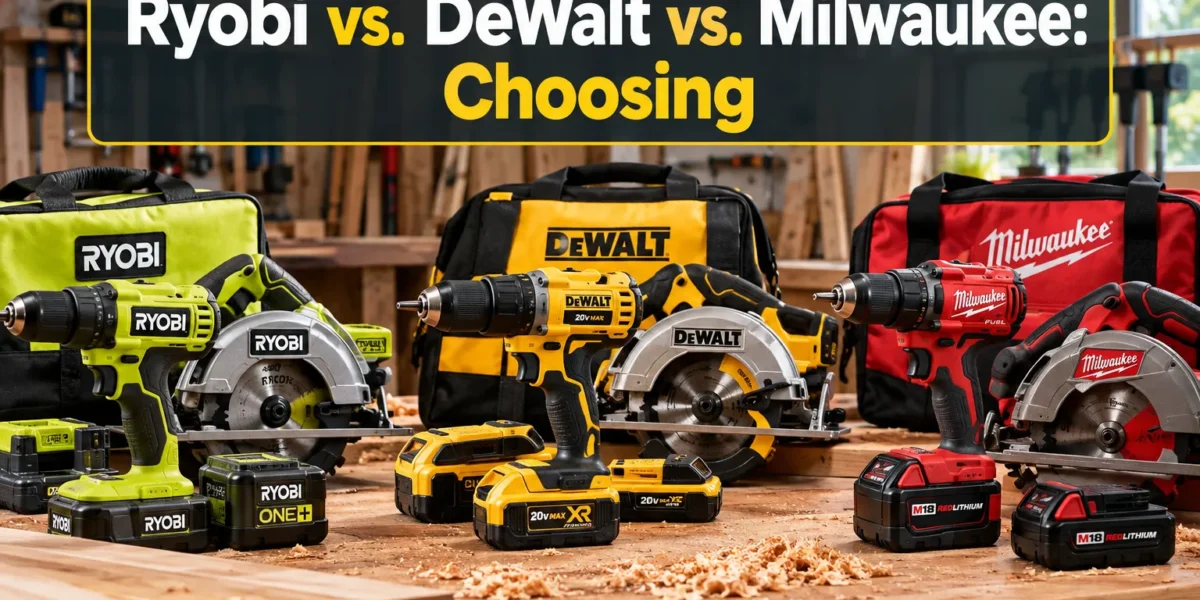
} For dedicated woodworkers, the challenge of selecting the right cordless power tool system often boils down to a critical decision: Ryobi vs. DeWalt vs. Milwaukee. This choice isn’t merely about picking a drill; it’s about committing to an entire battery ecosystem that will support your projects for years, influencing everything from the efficiency of your workshop to the quality of your finished pieces. As woodworking projects evolve in 2026, from intricate furniture builds to ambitious workshop upgrades, the demand for reliable, versatile, and high-performance cordless tools has never been greater. Understanding the distinct strengths and weaknesses of these three market leaders is essential for any woodworker looking to optimize their craft.
Key Takeaways
- Ryobi excels in affordability and breadth for hobbyists, offering a vast 18V ONE+ system suitable for occasional and general woodworking tasks.
- DeWalt provides robust, jobsite-ready performance, making its 20V MAX and FLEXVOLT systems ideal for serious DIYers and professionals who demand power and durability for diverse woodworking.
- Milwaukee leads with innovation and heavy-duty capabilities, with its M12 and M18 FUEL lines offering advanced technology and specialized tools for demanding and intricate woodworking projects.
- Battery platform consistency is crucial, as investing in one system locks you into its battery format for all compatible tools, influencing future expansion and cost of ownership.
- Consider tool range, power, ergonomics, and cost when evaluating which brand best suits your specific woodworking needs and project ambitions in 2026.
Ryobi vs. DeWalt vs. Milwaukee: Understanding Each Brand’s Niche for Woodworking
Choosing the best cordless system for your woodworking projects requires a deep dive into what each brand brings to the table. While all three offer comprehensive lineups, their philosophies, target audiences, and tool characteristics differ significantly. Let’s break down Ryobi, DeWalt, and Milwaukee to see how they align with various woodworking needs.
Ryobi: The Accessible All-Rounder for Hobbyists and Homeowners
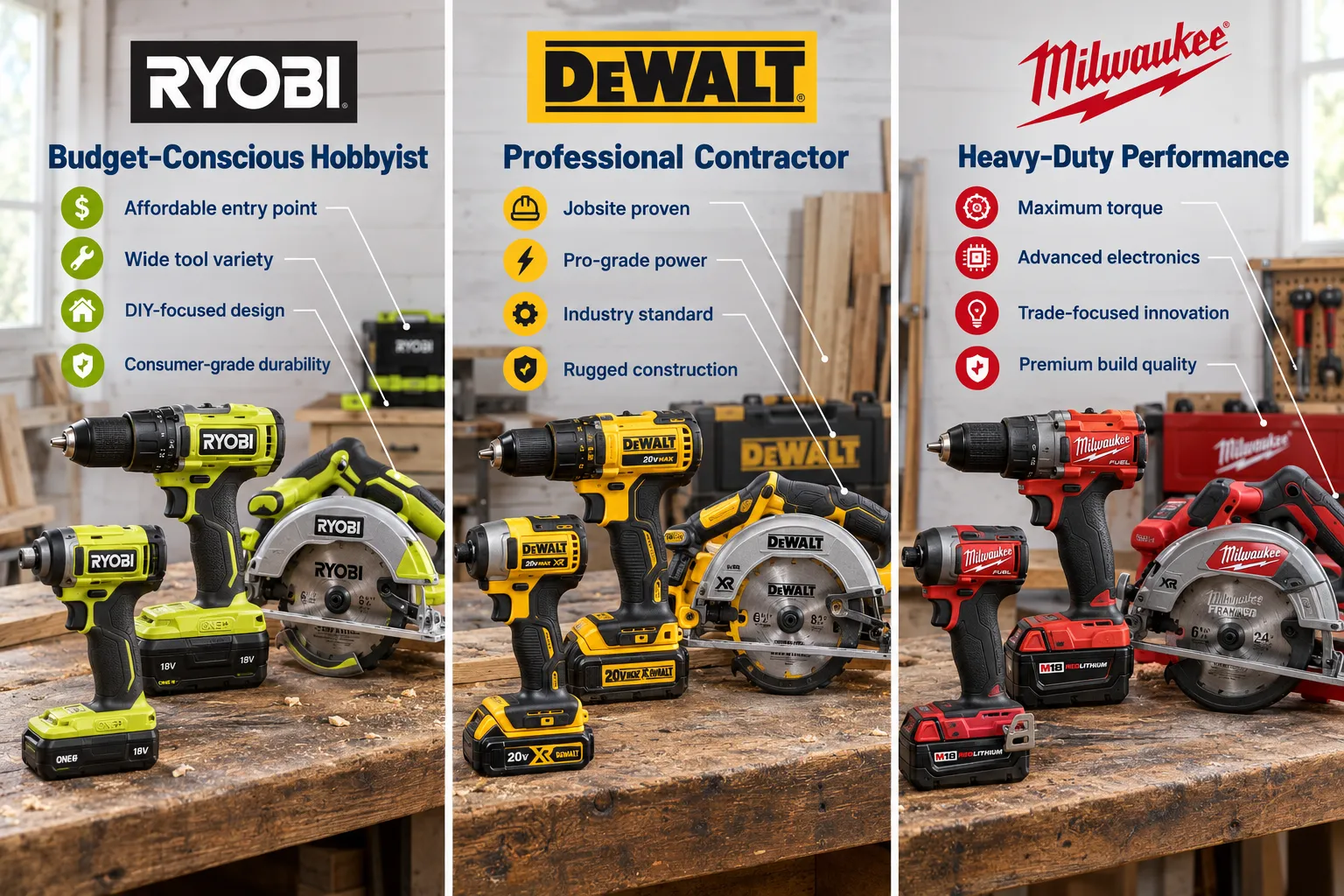
Ryobi, often recognized by its vibrant green tools, stands out as the go-to brand for hobbyist woodworkers, DIY enthusiasts, and homeowners. Its 18V ONE+ system is a sprawling ecosystem boasting over 175 tools, all powered by the same battery. This extensive range means you can find a cordless version for almost any task, from drilling and sanding to specialized items like inflators and vacuums.
Strengths for Woodworking:
- Affordability: Ryobi tools are generally the most budget-friendly, making it easy to build a comprehensive workshop without a massive initial investment. This is particularly appealing for those just starting out or working on occasional projects like crafting your perfect woodworking nightstand.
- Versatile Tool Range: Beyond the core drills and saws, Ryobi offers unique woodworking-centric tools like trim routers, brad nailers, and even glue guns, all on the same 18V platform. This versatility is unmatched at its price point.
- Battery Compatibility: The ONE+ system allows older batteries to power newer tools and vice versa, offering excellent backward and forward compatibility.
Considerations:
- Power Output: While sufficient for most light-to-medium woodworking tasks, Ryobi tools may sometimes lack the raw power or endurance for heavy-duty, prolonged use or dense hardwoods compared to their professional counterparts.
- Durability: Built primarily for home use, Ryobi tools might not withstand the constant abuse and demanding environments of a professional workshop.
Ideal User: The weekend warrior, the burgeoning furniture maker, or anyone who values a wide selection of tools at an affordable price for diverse woodworking hobbies and home improvement tasks.
DeWalt: The Jobsite Standard for Serious DIYers and Professionals
DeWalt, with its iconic yellow and black livery, is synonymous with durability, power, and jobsite reliability. Its primary cordless systems are the 20V MAX and the more powerful FLEXVOLT (which automatically switches voltage between 20V MAX and 60V MAX depending on the tool). DeWalt targets serious DIYers, contractors, and professionals who demand consistent performance under rigorous conditions.
Strengths for Woodworking:
- Robust Power: DeWalt’s brushless motors deliver impressive power and runtime, making quick work of cutting, drilling, and sanding even the toughest woods. Their miter saws, circular saws, and planers are particularly well-regarded for woodworking.
- Durability and Ergonomics: Built to withstand demanding jobsite conditions, DeWalt tools are known for their rugged construction and comfortable ergonomics, reducing fatigue during long woodworking sessions.
- Extensive Pro-Grade Tool Lineup: DeWalt offers a wide array of tools crucial for woodworking, including track saws, routers, and finish nailers, many of which are designed for precision and power.
Considerations:
- Price Point: DeWalt tools and batteries are significantly more expensive than Ryobi, reflecting their professional-grade build and performance.
- Weight: Some of the higher-powered tools and larger batteries can be heavier, which might be a factor for intricate, overhead, or extended use.
Ideal User: The experienced woodworker, the small business owner creating custom furniture, or anyone tackling large-scale projects like building box beams for ceilings who requires reliable, high-performance tools that can handle continuous heavy use.
Milwaukee: The Innovation Leader for Specialized and Heavy-Duty Applications
Milwaukee, recognized by its distinctive red and black tools, has carved out a niche as a premium brand focused on innovation, advanced technology, and heavy-duty performance. Their M12 (compact) and M18 (full-size) FUEL systems incorporate brushless motors and advanced REDLINK PLUS intelligence, providing unparalleled power, runtime, and durability. Milwaukee is often favored by professional tradespeople and serious woodworkers who seek cutting-edge tools for specialized and demanding tasks.
Strengths for Woodworking:
- Unrivaled Power and Efficiency: Milwaukee’s M18 FUEL line often leads in terms of raw power, especially for tools like impact drivers, circular saws, and routers, making them excellent for challenging joinery or sustainable wood sourcing where high torque is needed.
- Innovative Tool Design: Milwaukee frequently introduces specialized tools and accessories that cater to specific, often demanding, applications, pushing the boundaries of what cordless tools can achieve in a woodworking shop.
- Advanced Battery Technology: Their REDLITHIUM batteries offer superior runtime and battery life, which is critical for professionals who rely on their tools throughout the day.
Considerations:
- Highest Price Point: Milwaukee tools and batteries are generally the most expensive among the three, representing a significant investment.
- Specialization: While offering a broad range, some of their tools are highly specialized, meaning not every woodworker might need every offering in their catalog.
Ideal User: The professional cabinetmaker, the experienced artisan tackling live edge wood projects, or the discerning hobbyist who prioritizes cutting-edge technology, maximum power, and specialized solutions for intricate and heavy-duty woodworking.
Evaluating Tool Range and Battery Ecosystem for Woodworking Projects
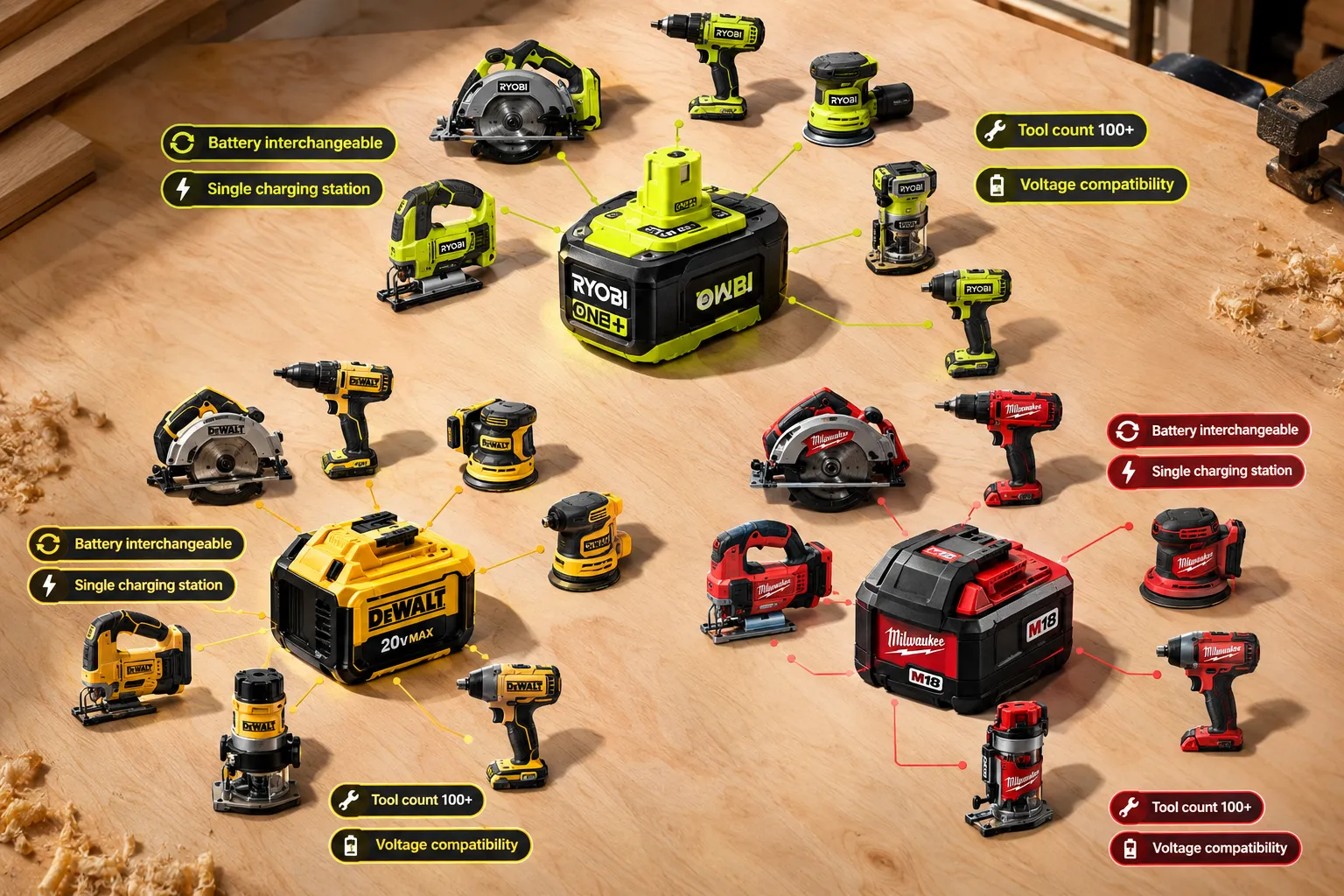
The core of any cordless system lies in its battery platform and the breadth of tools it supports. For woodworkers in 2026, investing in a system means committing to an ecosystem where all your tools share the same battery, simplifying charging, storage, and long-term cost. When comparing Ryobi vs. DeWalt vs. Milwaukee, the sheer variety of woodworking tools available on each platform is a critical deciding factor.
The Importance of a Cohesive Battery Platform
A unified battery platform is arguably the most significant advantage of a cordless system. It eliminates the need for multiple chargers and different battery types, reducing clutter and ensuring you always have a charged battery ready for any tool.
- Ryobi’s 18V ONE+: This system is incredibly diverse, offering everything from basic drills and impact drivers to specialty tools like hot glue guns, inflators, and even small miter saws. For a woodworker, this means you can power your sander, trim router, and nail gun with the same battery, making it incredibly convenient for small to medium-sized workshops and a wide array of children’s woodwork projects.
- DeWalt’s 20V MAX & FLEXVOLT: DeWalt’s strength lies in its comprehensive range of professional-grade tools. The 20V MAX system covers all common woodworking needs, including powerful circular saws, orbital sanders, routers, and finish nailers. The FLEXVOLT system further extends this to high-demand tools like large miter saws and table saws, offering corded performance in a cordless package. This is ideal for those who need to build out a robust workshop for furniture making or extensive home renovations.
- Milwaukee’s M18 & M12 FUEL: Milwaukee offers two distinct battery lines. The M18 system is their powerhouse, featuring innovative tools like track saws, cordless routers, and a strong lineup of cutting and fastening tools. Their M12 line, though smaller, offers incredibly compact and capable tools (e.g., M12 Fuel router, M12 Fuel oscillating multi-tool) perfect for fine detail work, tight spaces, and on-the-go touch-ups. Their focus on the FUEL line means brushless motors and advanced electronics across the board, providing superior performance and runtime.
Key Woodworking Tools: A Comparative Look
When focusing specifically on woodworking, certain tools are indispensable. Here’s how the brands compare on common workshop essentials:
| Tool Category | Ryobi (18V ONE+) | DeWalt (20V MAX / FLEXVOLT) | Milwaukee (M18 / M12 FUEL) |
|---|---|---|---|
| Drills/Drivers | Excellent variety, good for general tasks. | Powerful, durable, professional-grade. | High performance, smart electronics, robust for heavy use. |
| Circular Saws | Entry-level to mid-range options, good for rough cuts. | Strong performance, ideal for framing and breakdown. | Powerful FUEL models, great for efficiency and heavy cutting. |
| Jig Saws/Recip Saws | Versatile, sufficient for most cuts. | Durable, good control, jobsite-ready. | High power and precision, especially FUEL models. |
| Orbital Sanders | Effective for finishing, good value. | Professional finish, comfortable for extended use. | Excellent dust collection, smooth finish. |
| Routers (Trim/Full) | Good for light routing, compact trim routers. | Robust trim and mid-size routers, precise. | Compact M12 and powerful M18 FUEL options, excellent control. |
| Nailers (Brad/Finish) | Affordable, convenient for trim work. | Reliable, consistent fastening for trim and casing. | Fast, powerful, efficient for various fastening tasks. |
When considering tools for precision work and finishing, factors like vibration, balance, and dust collection become important. For instance, a quality orbital sander or the ultimate guide to sharpening woodworking chisels and planes requires fine control, where ergonomics play a significant role.
Performance, Ergonomics, and Cost of Ownership
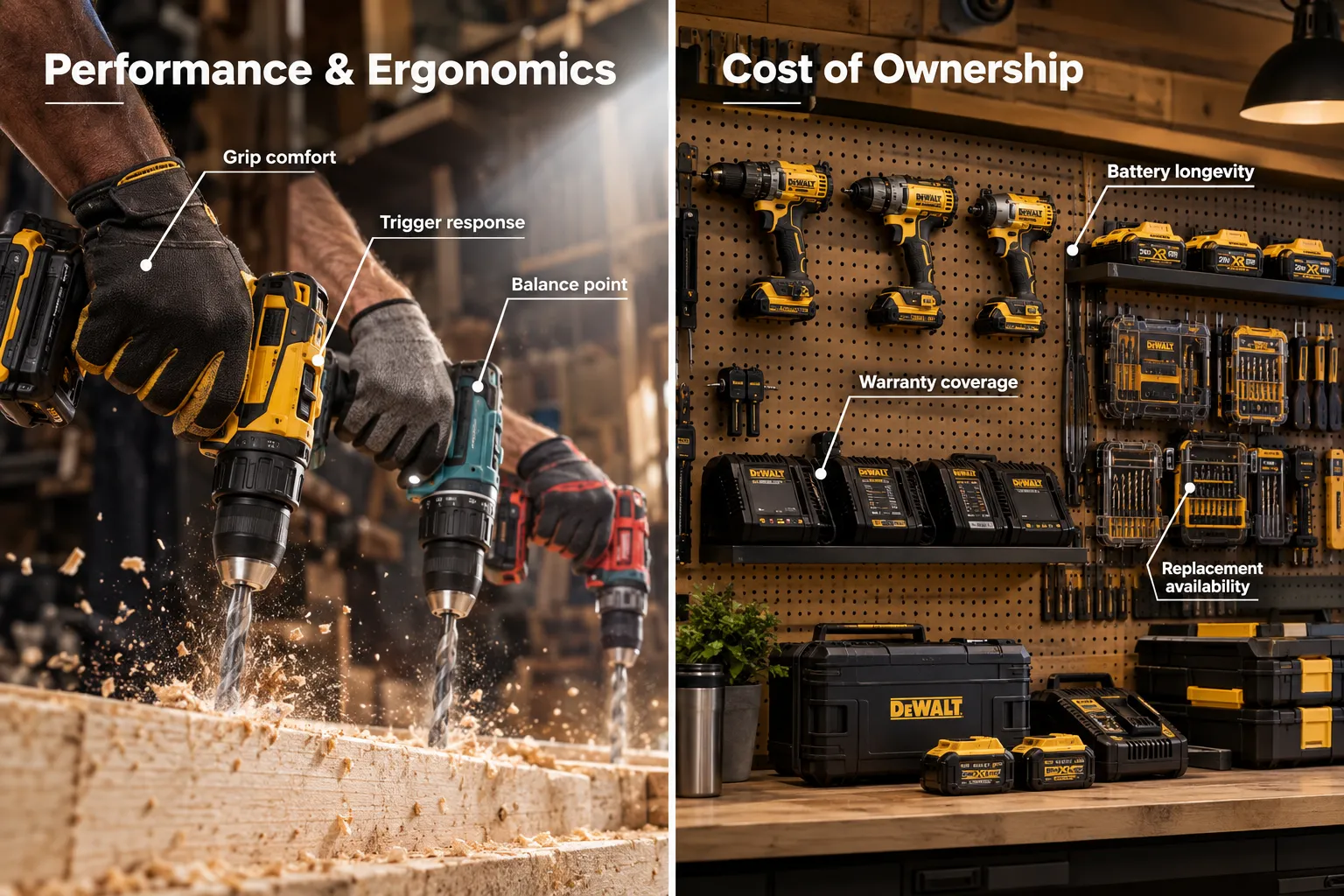
Beyond the sheer number of tools, the actual performance, how a tool feels in your hand, and the long-term cost implications are crucial for any serious woodworker. These factors often reveal the true value of a cordless system.
Performance: Power, Precision, and Reliability
- Ryobi: Generally offers good power for its class. For routine tasks like drilling pilot holes, driving screws, or light sanding, Ryobi performs admirably. However, when tackling dense hardwoods, continuous rip cuts with a circular saw, or demanding routing tasks, you might notice a drop in power or shorter battery life compared to the other two. Precision tools, like their trim router, are competent for casual use but might not offer the fine-tuning capabilities of higher-end models.
- DeWalt: Known for consistent, robust performance. Their 20V MAX and FLEXVOLT tools provide impressive power, often matching or exceeding corded counterparts for demanding woodworking tasks. DeWalt tools excel in applications requiring sustained power, such as breaking down sheet goods with a circular saw or using a heavy-duty planer. Their precision tools, like their track saws and routers, are designed for accurate, repeatable cuts. The brand has a strong reputation for reliability, making them a trusted choice for professionals.
- Milwaukee: Often sets the benchmark for cordless power and efficiency, especially with its FUEL line. M18 FUEL tools leverage advanced brushless motors and smart electronics to deliver incredible torque, speed, and runtime. This makes them exceptional for high-demand applications like drilling large holes, aggressive routing, or driving large fasteners into hardwoods. Milwaukee’s innovation also translates into specialized, high-performance tools that can streamline complex woodworking processes.
Ergonomics and User Experience
How a tool feels and handles directly impacts user fatigue and precision.
- Ryobi: Tools are typically designed with a comfortable, if somewhat basic, grip. They are generally well-balanced for their size, though some larger tools might feel a bit unwieldy. The overall build quality is solid for home use, but not as refined as professional-grade tools.
- DeWalt: Emphasizes user comfort and robust construction. Many DeWalt tools feature rubber overmolds, well-placed handles, and balanced designs to reduce fatigue during prolonged use. Their tools feel substantial and well-built, inspiring confidence during demanding tasks.
- Milwaukee: Prioritizes advanced ergonomics and a premium feel. Many Milwaukee tools are compact for their power output, offering excellent balance and comfortable grips. Their M12 line, in particular, is lauded for its compact size without sacrificing performance, making it ideal for precision work and reaching tight spaces in projects like a woodworking bedroom.
Cost of Ownership
The initial purchase price is just one part of the equation; long-term cost of ownership includes batteries, chargers, and future tool expansion.
- Ryobi: Has the lowest entry barrier. Tool-only options are very affordable, and battery prices are reasonable. This allows woodworkers to acquire a wide range of tools over time without breaking the bank. The long-standing ONE+ platform also means less concern about battery obsolescence.
- DeWalt: Represents a mid-to-high investment. While initial kits can be competitive, individual tool-only purchases and especially higher-capacity batteries add up. However, their durability often means a longer lifespan and less frequent replacement, potentially saving money in the long run.
- Milwaukee: Has the highest initial investment. Tools and batteries are premium-priced, reflecting their advanced technology and professional focus. For professionals, the increased efficiency, reliability, and innovative features often justify the higher cost, as these tools pay for themselves through increased productivity and reduced downtime. For hobbyists, it’s a significant investment that should be weighed against the specific demands of their projects.
When considering the longevity of your tools and the consistency of your results, particularly with projects that require precise measurements and strong joints, understanding the true cost of ownership becomes paramount. Think about how often you replace tools, the cost of replacement batteries, and the overall impact on your project efficiency.
Conclusion
The decision between Ryobi, DeWalt, and Milwaukee for your woodworking projects in 2026 is a nuanced one, heavily dependent on your personal needs, budget, and the scope of your ambitions. There isn’t a single “best” brand; rather, there’s the best brand for you.
For the Hobbyist and Budget-Conscious Woodworker: If you’re just starting, enjoy weekend projects, or need a wide variety of tools without breaking the bank, Ryobi’s 18V ONE+ system offers unparalleled value and versatility. Its extensive tool lineup ensures you’ll find a solution for almost any task, making it an excellent entry point into cordless woodworking.
For the Serious DIYer and Professional-Minded: If your projects demand consistent power, rugged durability, and reliable performance for extended periods, DeWalt’s 20V MAX and FLEXVOLT systems are an outstanding choice. You’ll invest more upfront, but you’ll gain the confidence that your tools can handle the toughest tasks and last for years of heavy use.
For the Innovator and Heavy-Duty Professional: If you prioritize cutting-edge technology, maximum power, and specialized tools for intricate or highly demanding woodworking applications, Milwaukee’s M18 and M12 FUEL systems are unmatched. The higher investment brings superior performance, advanced features, and a premium user experience that can significantly enhance productivity.
Ultimately, consider your current and future woodworking goals. Do you mainly build 3 profitable scrap wood projects under 1 hour, or are you planning a full-scale workshop overhaul? Visit a local store, hold the tools, and get a feel for their ergonomics. The right cordless system will feel like an extension of your own hands, empowering you to create beautiful, lasting pieces for years to come. Choose wisely, and happy woodworking!
SEO Meta Title: Ryobi vs DeWalt vs Milwaukee: Cordless Woodworking Guide 2026 SEO Meta Description: Choosing the best cordless system for woodworking projects in 2026? Compare Ryobi, DeWalt, and Milwaukee’s power, tool range, and cost for your workshop.