
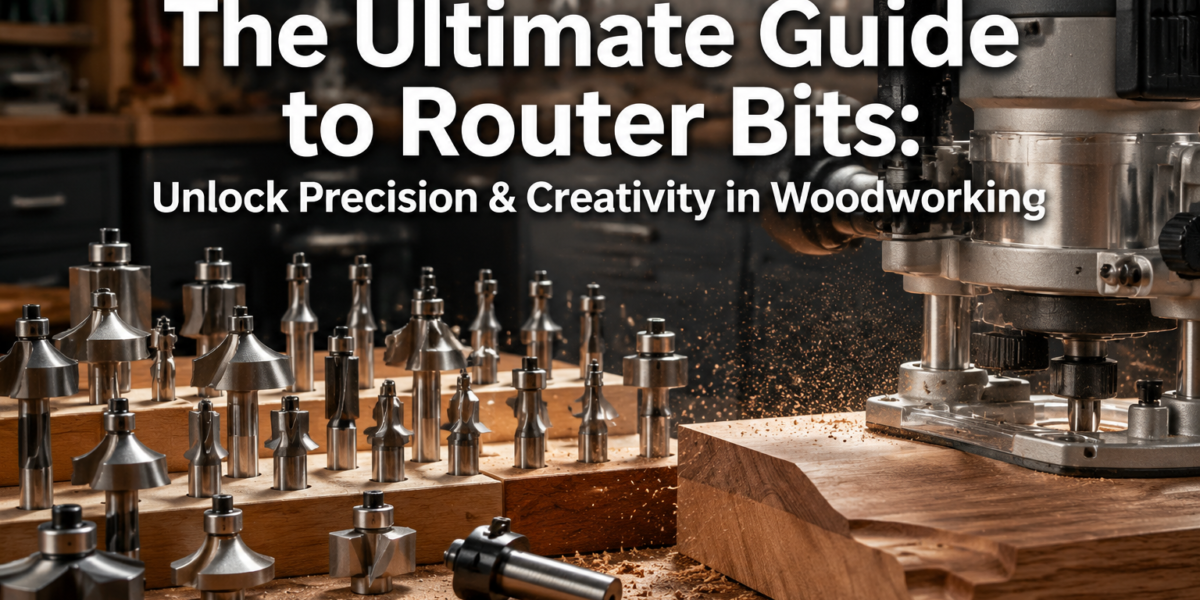
The average woodworking project in 2026 demands a level of precision and finish that hand tools alone often cannot provide. Enter the router, a versatile power tool, and its indispensable companions: router bits. These seemingly small components are the true workhorses, shaping raw lumber into elegant profiles, strong joints, and decorative flourishes. However, navigating the vast selection of router bits can be daunting, even for seasoned woodworkers. This comprehensive article, “The Ultimate Guide to Router Bits: Types, Uses, and How to Choose the Right Bit for Every Woodworking Task,” aims to demystify this essential aspect of woodworking, equipping you with the knowledge to select the perfect bit for every cut.
Key Takeaways
- Router bits are specialized cutting tools that fit into a router, creating specific profiles and joints in wood.
- They come in various types, including straight, dado, rabbeting, flush trim, round-over, chamfer, and decorative bits, each designed for unique tasks.
- Understanding bit construction materials (high-speed steel, carbide-tipped, solid carbide) and shank sizes (1/4″ vs. 1/2″) is crucial for performance and safety.
- Selecting the right bit involves considering the project type, wood species, desired profile, and the specific cut needed.
- Proper care, including cleaning and sharpening, extends bit lifespan and ensures consistent, high-quality results.
Exploring the Diverse Types of Router Bits and Their Core Functions
Router bits are as varied as the woodworking projects they enable. Each bit boasts a unique cutting edge designed to perform a specific function, from creating simple grooves to intricate decorative profiles. Understanding these fundamental types is the first step in mastering your router.
 image displaying an organized array of common router bit types—straight bits, dado bits, rabbeting bits, flush](https://zsxkvszxbhpwnvzxdydv.supabase.co/storage/v1/object/public/generated-images/kie/17ace43a-9543-4618-b6ec-434e128dece1/slot-1-1778645539261.png))
Essential Router Bit Categories
Router bits can generally be categorized by their primary function. Here’s a breakdown of the most common types you’ll encounter:
- Straight Bits: These are fundamental bits, designed for cutting straight, square-bottomed grooves (dados), slots, and mortises. They are available in various diameters and cutting lengths. Think of them as the workhorses for basic joinery and grooving.
- Dado Bits: While straight bits can cut dados, specific dado bits are optimized for this purpose, often featuring shear angles for cleaner cuts in plywood and veneered materials.
- Rabbeting Bits: Characterized by a top-mounted bearing, these bits cut a rabbet (a step-shaped recess) along the edge of a workpiece. They are indispensable for creating joints like half-laps, panel backs, and door recesses.
- Flush Trim Bits: Featuring a bottom-mounted bearing, flush trim bits allow you to trim one piece of material perfectly flush with another, often used for pattern routing or trimming laminate.
- Round-Over Bits (or Beading Bits): These bits create a smooth, rounded edge, transforming sharp corners into soft, safe, and aesthetically pleasing curves. With a different bearing, they can also create a small bead profile.
- Chamfer Bits: Cutting a 45-degree (or other angle) bevel on an edge, chamfer bits are used for decorative edges, easing sharp corners, or preparing edges for joinery.
- Cove Bits: Opposite of a round-over, a cove bit cuts a concave, quarter-round profile into the edge or surface of wood.
- Roman Ogee Bits: A classic decorative bit, the Roman Ogee produces an S-shaped profile, commonly seen on molding, table edges, and furniture details.
- Edge-Forming Bits: This broad category includes bits for creating intricate decorative profiles like classical ogee, bead and cove, and various molding profiles. They are perfect for adding elegance to tabletops, frames, and cabinetry.
- Grooving and Slotting Bits: Beyond straight bits, these include specific bits for tongue and groove joints, biscuit slots, and T-slots. For intricate joinery like box joints, specialized router bits for box joints are available.
- Panel Raising Bits: These large, specialized bits are used to create the raised or recessed panels found in cabinet doors and decorative millwork. They require a powerful router and often a router table for safe and effective use. Choosing and Using Router Tables: Maximizing Precision and Safety for Edge Profiling and Joinery offers valuable insights into safe operation.
Router Bit Construction and Materials
The performance and durability of a router bit largely depend on its construction materials and design.
- High-Speed Steel (HSS): Less common for general routing, HSS bits are inexpensive but dull quickly when cutting hardwoods. Best for softwoods or light work.
- Carbide-Tipped (CT): The most common type, these bits have carbide inserts brazed onto a steel body. Carbide is significantly harder and holds an edge much longer than HSS, making them suitable for hardwoods, softwoods, and composites. Most bits you buy will be carbide-tipped.
- Solid Carbide (SC): Entirely made of carbide, these bits are extremely durable and provide excellent cut quality. They are often used for specialty applications, particularly in CNC routers, where precision and longevity are paramount. Check out our Beginner’s Guide to CNC Routers for Small Woodshops for more on CNC applications.
- Shank Size: Router bits come with either a 1/4-inch or 1/2-inch shank.
- 1/4-inch shanks are common for smaller bits and less powerful routers. They are prone to more vibration and deflection under heavy loads.
- 1/2-inch shanks offer greater stability, reduce vibration, and are preferred for larger bits, deeper cuts, and more powerful routers. Always use a 1/2-inch shank bit if your router accepts it, as it provides a cleaner cut and reduces the risk of bit breakage.
Mastering Router Bit Applications: Practical Uses for Every Woodworking Task
The true power of a router lies in its versatility, enabled by the vast array of available bits. From crafting sturdy joinery to adding elegant decorative touches, router bits are indispensable in almost every woodworking discipline. This section of “The Ultimate Guide to Router Bits: Types, Uses, and How to Choose the Right Bit for Every Woodworking Task” delves into practical applications.
 image illustrating various woodworking applications performed by different router bits. One section shows a](https://zsxkvszxbhpwnvzxdydv.supabase.co/storage/v1/object/public/generated-images/kie/17ace43a-9543-4618-b6ec-434e128dece1/slot-2-1778645547625.png))
Joinery and Structural Applications
Router bits excel at creating strong, precise woodworking joints.
- Dados and Grooves: Straight bits or dado bits are perfect for cutting channels across or along the grain, respectively. These are fundamental for shelves, cabinet backs, and frame-and-panel construction.
- Example: Creating dadoes for shelves in a bookcase using a 3/4-inch straight bit.
- Rabbets: Rabbeting bits simplify the creation of rabbet joints, essential for cabinet backs, drawer bottoms, and half-lap joints.
- Example: Cutting a 1/2-inch rabbet along the back edge of a cabinet side panel to accept a plywood back.
- Tongue and Groove: Specialized tongue and groove bits create interlocking profiles, ideal for flooring, paneling, and strong tabletop glue-ups. This is a common method for creating strong, aligned panels. For other joint types, explore our Beginner’s Guide to Essential Woodworking Joints.
- Mortise and Tenon (with jigs): While traditionally a chisel and hand saw joint, routers with specific jigs and straight bits can efficiently cut mortises, particularly for multiple identical components.
Edge Treatment and Finishing
Router bits are unmatched for transforming plain edges into refined details.
- Rounding Edges: Round-over bits are perhaps the most frequently used edge-forming bits, softening sharp edges on furniture, countertops, and shelving for both aesthetics and safety.
- Example: Applying a 1/4-inch round-over to the top edge of a child’s toy chest.
- Chamfering: Chamfer bits provide a clean, angled bevel, often used for decorative purposes, to break a sharp edge, or to prepare an edge for subsequent finishing processes.
- Decorative Profiles: Cove, Roman Ogee, Classical Ogee, and various molding bits add intricate details to furniture, trim, and architectural elements, elevating a project’s visual appeal.
- Example: Routing a classical ogee profile on the edge of a custom picture frame.
Pattern Routing and Duplication
When you need to reproduce a shape or trim precisely, specific router bits shine.
- Flush Trimming: Flush trim bits, with their guiding bearing, are essential for trimming veneers, laminates, or excess material to match a template or a finished surface.
- Example: Trimming a piece of laminate perfectly flush with the edge of a countertop.
- Pattern Routing (Template Following): Both flush trim (bearing on the bottom) and top-bearing pattern bits are used to follow a template, allowing for the precise duplication of complex shapes for curved tabletops, guitar bodies, or decorative cutouts.
Specialized Tasks
Beyond the basics, router bits handle unique challenges.
- Keyhole Slots: Keyhole bits cut a T-shaped slot for hanging items flush against a wall, commonly used for picture frames or wall-mounted shelves.
- Panel Raising: For traditional cabinet doors, panel-raising bits create the distinctive profile on the edges of the central panel, giving depth and character. This often requires a router table and specific safety considerations.
How to Choose the Right Bit for Every Woodworking Task in 2026
With an understanding of the types and uses, the next critical step in “The Ultimate Guide to Router Bits: Types, Uses, and How to Choose the Right Bit for Every Woodworking Task” is learning how to select the correct bit for your specific project. This involves considering several factors to ensure optimal performance, safety, and a perfect finish.
image featuring a skilled woodworker’s hands, wearing safety gloves, carefully selecting a specific router bit from a](https://zsxkvszxbhpwnvzxdydv.supabase.co/storage/v1/object/public/generated-images/kie/17ace43a-9543-4618-b6ec-434e128dece1/slot-3-1778645521141.png))
Step 1: Define Your Project and Desired Outcome
Start by clearly identifying what you need to achieve.
- What kind of cut is required? (e.g., straight groove, rounded edge, decorative profile, flush trim, joint preparation).
- What is the desired depth and width of the cut? This will dictate the bit’s diameter and cutting length.
- Is it a structural joint or a decorative edge? This helps narrow down bit categories.
Step 2: Consider the Wood Species and Material
The type of material you’re routing significantly impacts bit choice.
- Softwoods (Pine, Fir): HSS bits can suffice for light work, but carbide-tipped bits are always a better, more durable choice.
- Hardwoods (Oak, Maple, Walnut): Carbide-tipped bits are essential for hardwoods to prevent rapid dulling and burning. For dense or exotic hardwoods, high-quality carbide-tipped or solid carbide bits offer the best performance.
- Plywood, MDF, Particleboard: These engineered materials are very abrasive. Use carbide-tipped bits, and for high-volume work, consider compression bits (a type of spiral bit) that are designed to shear both up and down, preventing tear-out on both faces.
- Laminates: Flush trim bits with carbide tips are ideal for trimming laminates cleanly.
Step 3: Match the Bit Profile to Your Design
This is where your design vision translates into tool selection.
- For square grooves/dados: Straight bit, Dado bit.
- For rounded edges: Round-over bit (specify radius: 1/8″, 1/4″, 1/2″, etc.).
- For angled edges: Chamfer bit (specify angle: 45°, 30°, etc.).
- For specific decorative profiles: Roman Ogee, Cove, Bead, or other specialized molding bits.
- For flush trimming or template work: Flush trim bit (bearing on bottom) or Pattern bit (bearing on top).
Step 4: Determine the Shank Size
Always use the largest possible shank size that your router collet accepts.
- 1/4-inch shank: Suitable for smaller bits, lighter cuts, and less powerful routers. Fine for most hand-held edge-forming.
- 1/2-inch shank: Highly recommended for all larger bits, deep cuts, and any work on a router table. Offers superior stability, less vibration, and better cut quality. If your router has both 1/4-inch and 1/2-inch collets, always opt for the 1/2-inch for larger or more demanding tasks.
Step 5: Evaluate Bit Quality and Brand
Investing in quality router bits pays dividends in cut quality, durability, and safety.
- Carbide Grade: High-quality bits use micro-grain carbide, which is harder and holds an edge longer.
- Shear Angle: Bits with a positive shear angle cut more efficiently and reduce tear-out.
- Anti-Kickback Design: Many bits feature a reduced body diameter behind the cutting edge to limit the depth of cut per rotation, improving safety by reducing the risk of kickback.
- Reputable Brands: Stick with trusted brands like Freud, CMT, Bosch, Amana, or Whiteside for consistent quality.
Step 6: Consider Accessories and Safety
- Bearings: Many bits come with bearings to guide the cut. Ensure the bearing is clean and free-spinning.
- Router Table: For large bits, precise joinery, and safer operation, a router table is often essential.
- Featherboards and Push Blocks: Always use appropriate safety accessories, especially when routing on a table.
- Eye and Ear Protection: Non-negotiable for any routing operation.
By systematically addressing these points, you can confidently choose the optimal router bit for any woodworking task in 2026, ensuring clean cuts, precise joinery, and beautiful finishes. Remember, a sharp, high-quality bit is not just about aesthetics; it’s about efficiency and safety in your workshop. For maintaining your other essential cutting tools, refer to The Ultimate Guide to Sharpening Woodworking Chisels and Planes.
Conclusion
The router bit cabinet, once a source of confusion, can now be seen as a treasure chest of possibilities. “The Ultimate Guide to Router Bits: Types, Uses, and How to Choose the Right Bit for Every Woodworking Task” has aimed to illuminate the vast world of these critical woodworking accessories. From understanding the fundamental differences between straight bits and decorative ogees, to appreciating the importance of carbide tips and shank sizes, you now possess the knowledge to approach your next project with confidence.
Armed with this guide, you’re better prepared to select the perfect bit for precision grooves, elegant edges, or robust joinery. Remember that safety, proper technique, and maintenance of your router bits are just as crucial as the selection itself. Always prioritize high-quality bits, keep them clean and sharp, and match the bit to the material and task at hand. By doing so, you’ll unlock the full potential of your router, elevate your craftsmanship, and create woodworking projects that are both functional and beautiful.
Actionable Next Steps:
- Assess Your Current Bit Collection: Inventory your existing router bits and identify any gaps based on common projects you undertake.
- Invest in Core Bits: If you’re starting, acquire a high-quality set of essential bits (straight, round-over, chamfer, rabbeting) with 1/2-inch shanks if your router allows.
- Practice on Scraps: Before committing to a project, always test your chosen bit and router settings on scrap material of the same species.
- Regular Maintenance: Implement a routine for cleaning your router bits after each use to remove pitch and resin buildup, extending their lifespan and maintaining cutting quality.
- Expand Your Knowledge: Explore advanced routing techniques, such as using router tables or specialized jigs, to further enhance your skills.