
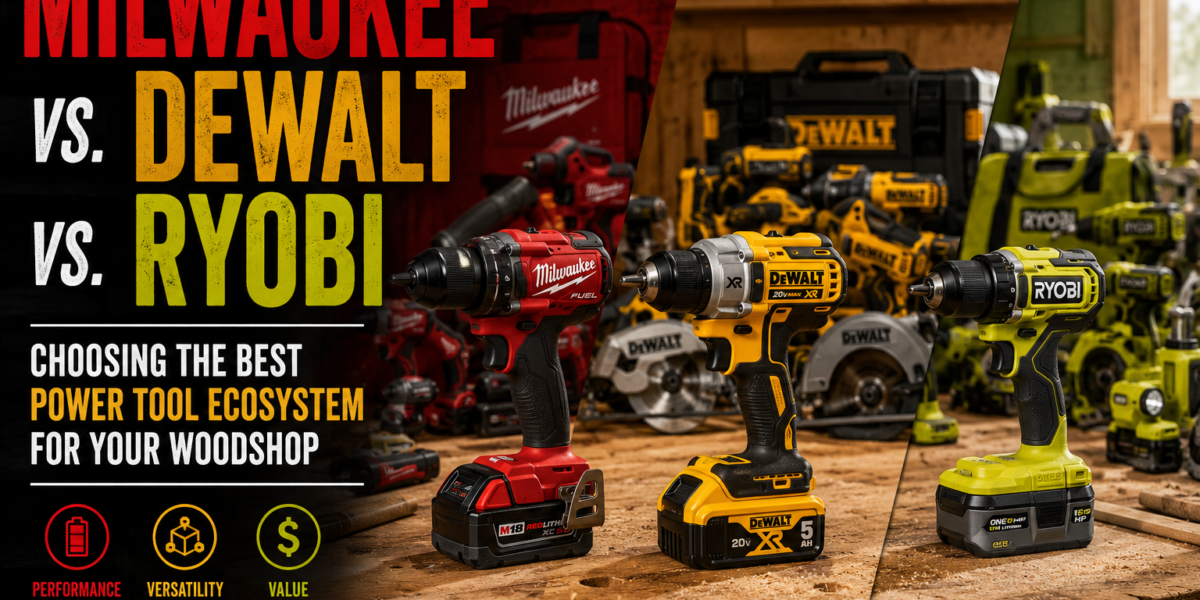
The average woodworker spends over $1,500 on power tools in their first two years, a significant investment that often dictates future purchases. Choosing the right power tool ecosystem early on can save thousands, prevent compatibility headaches, and profoundly impact the efficiency and enjoyment of your craft. For woodworkers navigating the myriad of options in 2026, the debate often boils down to three titans: Milwaukee, DeWalt, and Ryobi. This article will provide a comprehensive comparison, guiding you in choosing the best power tool ecosystem for your woodshop by dissecting their strengths, weaknesses, and ideal use cases.
Key Takeaways
- Milwaukee excels in professional-grade performance and durability, particularly for heavy-duty, demanding woodworking tasks, offering advanced M18 and M12 Fuel lines.
- DeWalt provides a strong balance of professional power, reliability, and widespread availability, making it a robust choice for serious hobbyists and contractors who need dependable tools.
- Ryobi offers exceptional value and versatility with its extensive ONE+ 18V system, making it ideal for beginners, DIYers, and those seeking a broad range of tools without breaking the bank.
- Consider your primary woodworking projects, budget, and future expansion needs before committing to an ecosystem, as battery compatibility is key.
- Evaluate not just individual tools, but the breadth of accessories, specialized woodworking tools, and dust collection solutions each brand offers.
Understanding the Power Tool Ecosystem: Milwaukee vs. DeWalt vs. Ryobi for Your Woodshop
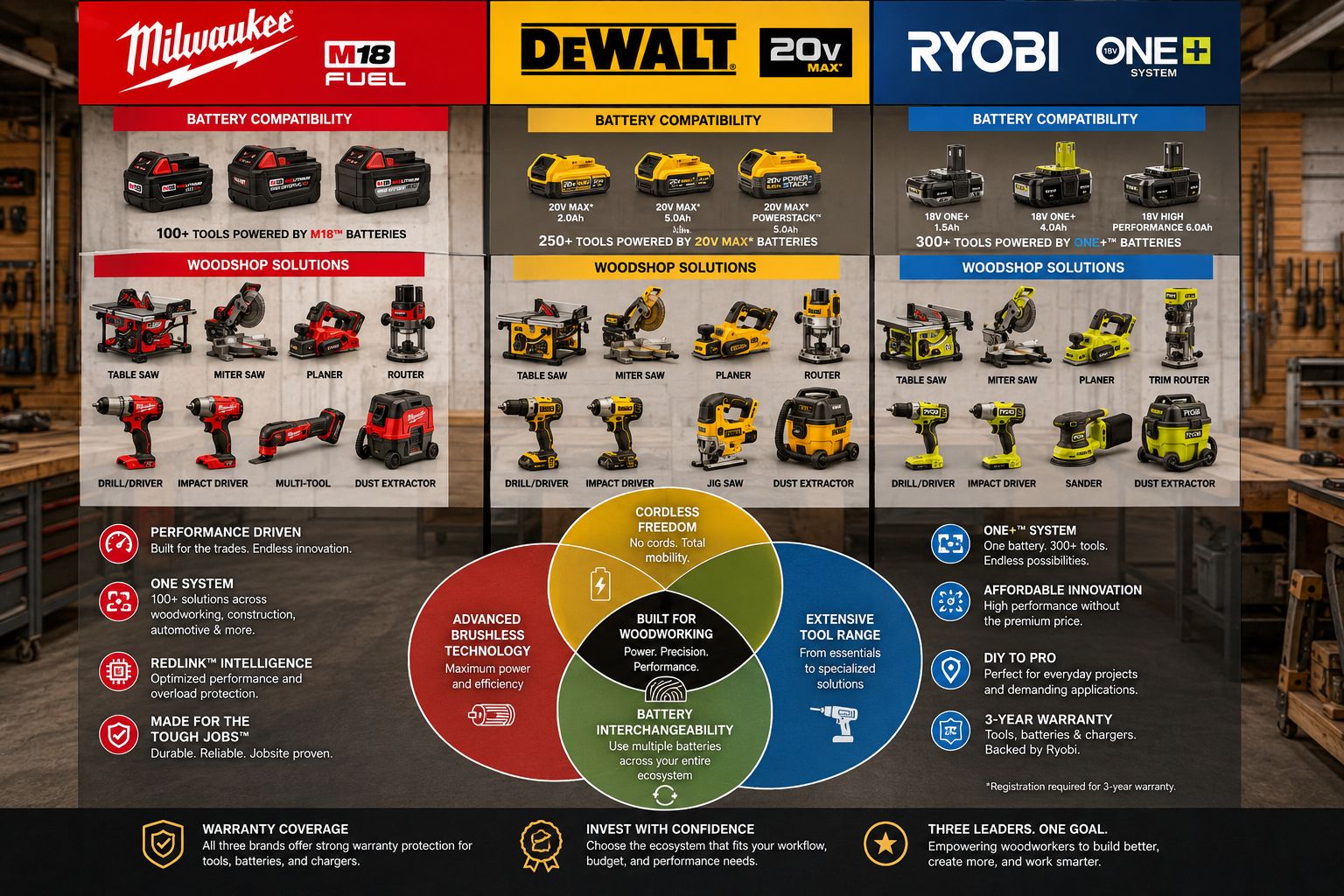
When committing to a power tool brand, you’re not just buying a single tool; you’re investing in an “ecosystem.” This includes a shared battery platform, chargers, and a vast array of compatible tools that can run off the same power source. This compatibility is crucial for efficiency, cost-effectiveness, and minimizing clutter in your woodshop. The primary contenders for woodworkers, Milwaukee, DeWalt, and Ryobi, each offer a distinct philosophy regarding power, innovation, and value.
Milwaukee is often hailed for its cutting-edge technology and robust performance, aimed squarely at professional tradespeople. DeWalt holds a strong reputation for durability and reliability, a workhorse brand favored by contractors and serious DIYers alike. Ryobi, on the other hand, carves out its niche with affordability and an unparalleled breadth of tools under a single battery platform, appealing to hobbyists and budget-conscious users. Understanding these foundational differences is the first step in choosing the best power tool ecosystem for your woodshop.
Milwaukee: Precision, Power, and Professional Performance
Milwaukee has, in recent years, aggressively pursued innovation, particularly with its M18 and M12 Fuel lines. These tools are engineered with brushless motors, advanced electronics, and proprietary battery technology (REDLITHIUM) to deliver superior power, run time, and durability. For the serious woodworker, Milwaukee offers tools that consistently perform under heavy loads, often outperforming competitors in challenging applications.
Strengths for Woodworkers:
- Exceptional Power and Torque: Milwaukee’s drills, impact drivers, and circular saws often lead their class in raw power, essential for dense hardwoods or long cuts.
- Durability and Build Quality: Tools are built to withstand demanding job site conditions, translating to long-term reliability in a busy woodshop.
- Advanced Battery Technology: The REDLITHIUM batteries offer excellent run time and longevity, with rapid charge capabilities.
- Specialized Tools: Milwaukee offers a strong lineup of specialized tools useful in woodworking, from compact routers to detail sanders and even job site radios.
- Innovation: They are often at the forefront of new tool categories and technology.
Considerations:
- Higher Price Point: Milwaukee tools typically come with a premium price tag, which can be a significant barrier for hobbyists or those with tighter budgets.
- Weight: Some of their more powerful tools can be heavier, which might be a factor for extended use.
For woodworkers engaged in demanding projects that require consistent, high-power output and absolute reliability, Milwaukee’s ecosystem is a compelling choice. Think large-scale furniture building, custom cabinetry, or repetitive, heavy-duty tasks where tool failure is not an option. Their commitment to innovation also means access to some of the most advanced tools on the market.
DeWalt: Reliable Workhorses for the Dedicated Woodworker
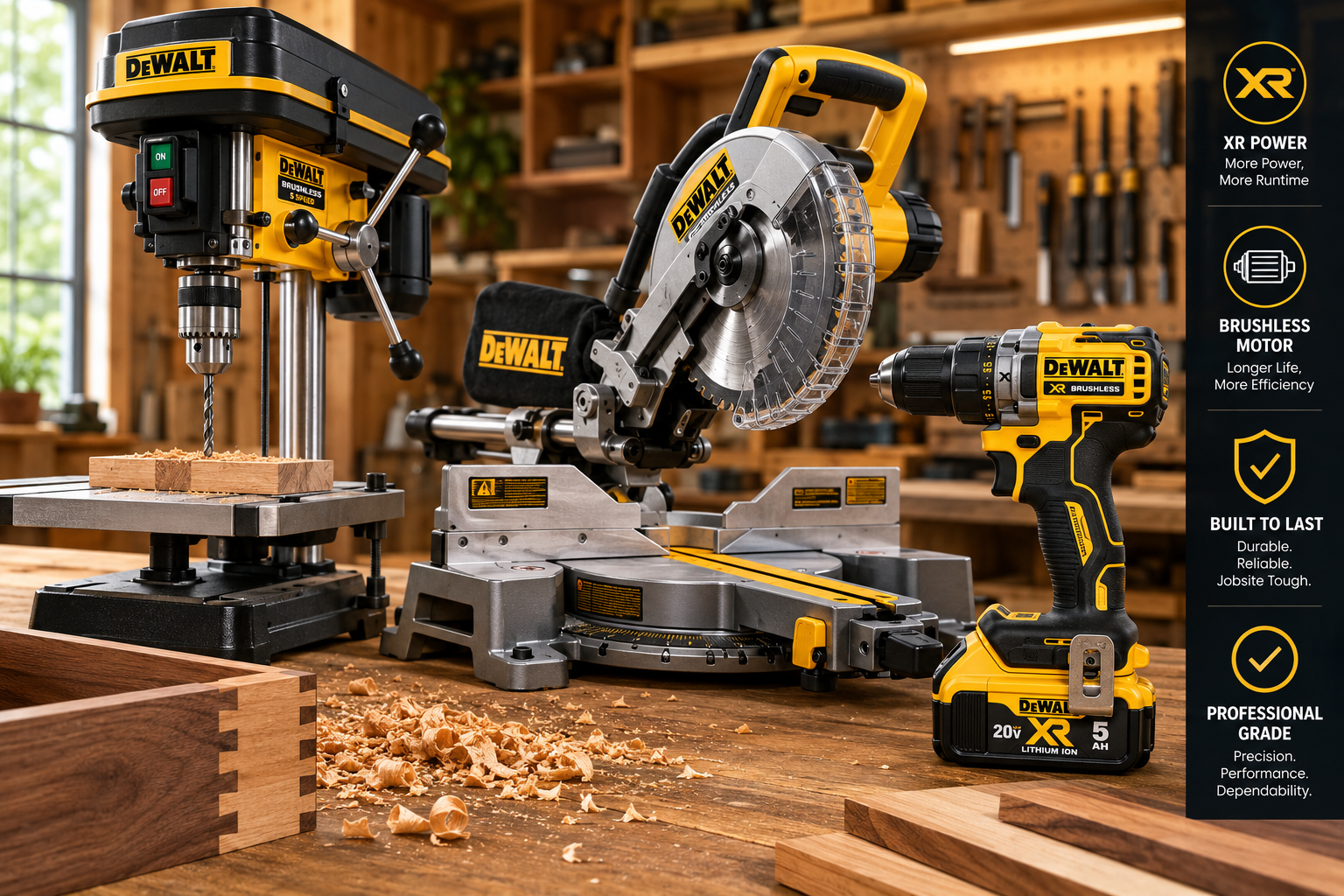
DeWalt has long been a staple in both professional construction and dedicated woodworking shops. Their 20V MAX and FLEXVOLT battery platforms are renowned for their robustness and widespread availability. DeWalt aims for a sweet spot between raw power and dependable durability, offering tools that are consistently capable and built to last. For many, DeWalt represents the gold standard of professional-grade tools that won’t let them down.
Strengths for Woodworkers:
- Proven Reliability: DeWalt tools have a reputation for being tough and consistently performing day in and day out.
- Excellent Ergonomics: Many users find DeWalt tools to be well-balanced and comfortable to use for extended periods, reducing fatigue.
- Extensive Tool Lineup: DeWalt offers a comprehensive range of cordless and corded tools that cover nearly every woodworking need, from drills and saws to planers and specialized finishing tools.
- Widespread Availability and Support: DeWalt tools and accessories are readily available at most major retailers, and their customer service network is robust.
- FLEXVOLT Technology: Their FLEXVOLT batteries can automatically switch between 20V and 60V, providing additional power for larger tools like miter saws or table saws, expanding the cordless workshop possibilities.
Considerations:
- Mid-to-High Price Range: While generally less expensive than Milwaukee, DeWalt still represents a significant investment compared to Ryobi.
- Innovation Pace: While reliable, DeWalt might not always introduce cutting-edge technology as rapidly as Milwaukee.
A woodworker who prioritizes dependable performance, excellent ergonomics, and a widely supported ecosystem will find DeWalt to be an outstanding choice. It’s particularly well-suited for those who run their woodshop as a serious hobby or a small business, where consistent performance and longevity are paramount. Their cordless table saws and miter saws powered by FLEXVOLT batteries offer significant flexibility. For those looking to optimize their workspace, consider integrating a DIY Smart Workshop Dust Collection System which can often be paired with DeWalt’s dust extractors.
Ryobi: Unbeatable Value and Unrivaled Versatility
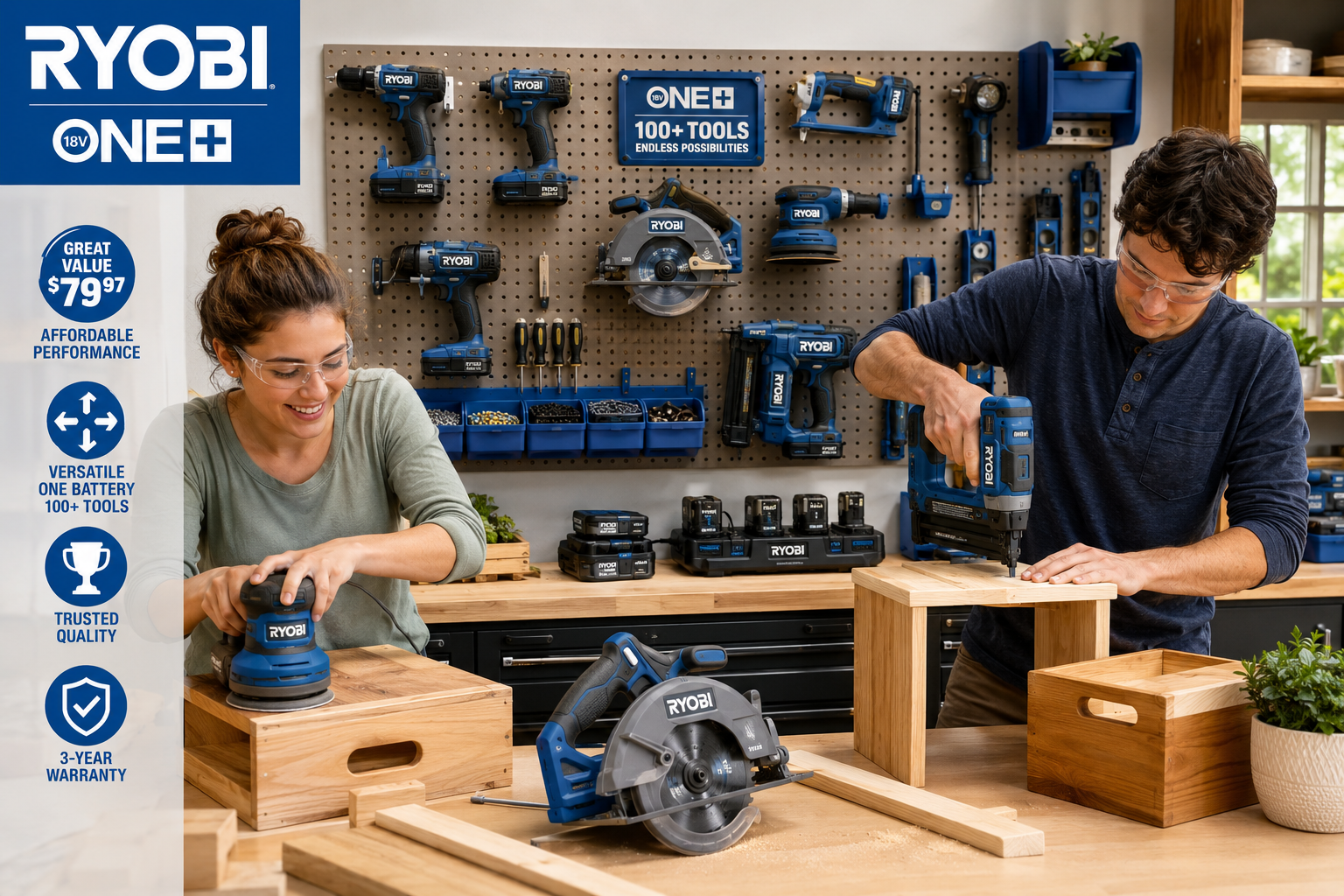
Ryobi stands out for its commitment to affordability and the sheer breadth of its ONE+ 18V system. With over 280 tools running on the same 18V battery platform in 2026, Ryobi offers an ecosystem that is unmatched in its versatility, covering not just woodworking tools but also automotive, cleaning, and gardening equipment. This makes Ryobi an incredibly attractive option for beginners, DIYers, and those who need a wide array of tools for diverse projects without breaking the bank.
Strengths for Woodworkers:
- Exceptional Value: Ryobi tools are consistently more affordable than Milwaukee or DeWalt, allowing users to acquire a wider range of tools for the same budget.
- Vast Ecosystem: The ONE+ system boasts an incredible number of tools, ensuring there’s almost always a Ryobi solution for any task, from a simple drill to specialized wood carving tools.
- Accessibility: Ryobi tools are widely available at Home Depot, making them easy to purchase and expand upon.
- Beginner-Friendly: The lower price point makes it an excellent entry point for new woodworkers building their first workshop.
- Innovation in Niche Tools: While not always leading in raw power, Ryobi often introduces unique and highly functional tools for specific tasks, like specialized trim saws or inflators.
Considerations:
- Performance: While perfectly adequate for most hobbyist and DIY tasks, Ryobi tools generally don’t match the raw power and run time of their Milwaukee or DeWalt counterparts, especially for heavy-duty, continuous use.
- Durability: Tools are generally built for light-to-medium duty, and may not hold up as well as professional-grade tools under constant, rigorous use.
- Brushless Offerings: While Ryobi does offer brushless tools (HP line), they are not as prevalent or as high-performance across the board as with Milwaukee Fuel or DeWalt XR.
For the aspiring woodworker, the casual hobbyist, or anyone who needs a broad collection of tools for various home and workshop projects without a professional budget, Ryobi offers an unparalleled combination of value and versatility. It’s an ideal choice for building out a functional woodshop for projects like custom robust floating shelves with hidden fasteners or tackling basic furniture construction.
Making Your Choice: Comparing Key Factors
Choosing the best power tool ecosystem for your woodshop involves more than just looking at brand names. It requires a thoughtful evaluation of several key factors:
Budget Considerations
Your budget is often the most significant deciding factor.
- Ryobi: Clearly the most budget-friendly option. You can acquire a vast collection of tools for the price of a few Milwaukee or DeWalt items. This makes it excellent for starting a workshop from scratch or for those who need a wide variety of tools for occasional use.
- DeWalt: Occupies the middle ground. It’s an investment, but one that typically pays off in reliability and performance for serious hobbyists or small business owners.
- Milwaukee: The premium choice. If your budget allows, Milwaukee offers top-tier performance and durability, but it’s a considerable upfront cost.
Project Demands and Usage Frequency
Consider the type of woodworking projects you undertake and how often you use your tools.
- Heavy-Duty, Professional Use: If you’re building large cabinets, felling trees, or running your woodshop as a full-time business, Milwaukee’s raw power and durability will be invaluable.
- Serious Hobbyist, Weekend Warrior, or Light Contractor: DeWalt offers the perfect blend of power, reliability, and ergonomics for consistent, demanding hobby projects or occasional professional work.
- Casual DIYer, Beginner, or Occasional Projects: Ryobi provides more than enough capability for general home repairs, basic furniture building, and light woodworking projects. It’s a great choice for those just getting started or those who need a diverse set of tools for various tasks around the house. For beginners, understanding essential woodworking jigs can greatly enhance precision with any tool brand.
Battery Platforms and Future Expansion
The battery platform is the heart of your ecosystem.
- Milwaukee: Offers both M18 and M12 systems. The M18 is their primary woodworking platform, while M12 provides compact, lighter-duty tools that are surprisingly capable.
- DeWalt: Primarily the 20V MAX system, with the innovative FLEXVOLT batteries that adapt for 60V tools, offering impressive power for larger equipment like table saws or miter saws.
- Ryobi: The ONE+ 18V system is vast, offering incredible breadth. While typically not as powerful as Milwaukee or DeWalt, the sheer number of compatible tools is a significant draw.
Think about how you plan to expand your tool collection in the future. If you foresee needing specialized woodworking tools like a cordless planer or a specific router, check which brand offers the best options within their battery ecosystem.
Ergonomics and Comfort
Tool comfort can significantly impact fatigue during long woodworking sessions.
- DeWalt is often praised for its ergonomic designs, which feel balanced and comfortable in hand.
- Milwaukee tools are generally well-designed, but their more powerful tools can be heavier.
- Ryobi tools are typically lighter, which can be beneficial for beginners or those with less hand strength, though some may find them less refined in balance.
Availability and Warranty
- DeWalt and Ryobi have excellent retail availability (DeWalt at various stores, Ryobi primarily Home Depot).
- Milwaukee is also widely available, often at specialty tool stores and larger hardware chains.
- All three brands offer standard warranties (typically 3-5 years on tools, 1-3 years on batteries), but it’s always wise to check specific terms.
Specific Tool Categories for Woodworking
While general ecosystem strengths are important, consider how each brand performs in specific tool categories crucial for woodshops:
Drills and Drivers
- Milwaukee: M18 Fuel drills and impact drivers are top performers, offering immense power and control, ideal for driving large fasteners into dense wood or continuous drilling.
- DeWalt: 20V MAX XR drills and drivers are extremely reliable, powerful, and ergonomically sound, making them a go-to for most woodworking applications.
- Ryobi: ONE+ HP brushless drills and drivers offer good performance for most tasks at a fraction of the cost, perfect for assembling furniture or general drilling.
Saws (Circular, Jigsaw, Miter)
- Milwaukee: Offers high-performance cordless circular saws and jigsaws, with M18 Fuel models easily handling thick materials. Their M18 Fuel Miter Saw is a powerful, though heavy, cordless option.
- DeWalt: Strong contenders in all saw categories, with reliable circular saws, excellent jigsaws, and their FLEXVOLT miter saws that rival corded performance. Building a custom Murphy bed would greatly benefit from DeWalt’s cutting precision.
- Ryobi: Offers a wide array of saws, from compact circular saws to basic miter saws. They are suitable for light to medium cutting tasks, such as cross-cutting dimensional lumber for DIY wooden birdhouses.
Sanders and Routers
- Milwaukee: Offers robust sanders (random orbital, detail) and compact routers that deliver excellent finish and control.
- DeWalt: Their random orbital sanders are highly regarded for ergonomics and effective dust collection. DeWalt also has capable compact routers.
- Ryobi: Provides various sanders and routers that are very budget-friendly and perform well for most finishing and routing tasks, especially for beginners learning to master the router table.
Dust Collection
While specialized dust collection systems are often separate, each brand offers cordless shop vacuums and attachments.
- Milwaukee and DeWalt: Often have more robust cordless shop vacuums and better integration with professional-grade dust extractors.
- Ryobi: Offers good value cordless shop vacuums suitable for lighter cleanup in a hobby shop. For more comprehensive solutions, consider dedicated dust collection systems.
Conclusion
Choosing the best power tool ecosystem for your woodshop in 2026 ultimately depends on your individual needs, budget, and woodworking aspirations.
- If uncompromising power, advanced technology, and professional-grade durability are your top priorities, and your budget allows, Milwaukee is likely the superior choice.
- If you seek a balance of robust performance, proven reliability, excellent ergonomics, and a comprehensive tool lineup suitable for serious hobbyists and contractors, DeWalt offers an incredibly dependable ecosystem.
- If value, versatility, and an extensive array of tools for diverse home and workshop projects are what you need, particularly as a beginner or DIYer, Ryobi delivers an unbeatable proposition with its ONE+ system.
Before making your final decision, visit a local hardware store to physically handle tools from each brand. Feel their ergonomics, weight, and balance. Consider which battery platform best aligns with your current and future project goals. Investing in the right power tool ecosystem from the start will not only enhance your woodworking capabilities but also bring greater satisfaction to every project you undertake.
SEO Meta Title: Milwaukee vs. DeWalt vs. Ryobi: Choosing Your 2026 Woodshop Tools SEO Meta Description: Compare Milwaukee, DeWalt, and Ryobi power tool ecosystems for your woodshop in 2026. Discover the best for performance, value, and versatility.