

A startling 60% of homeowners desire enhanced security for their valuables, yet only a fraction actively incorporate discreet storage solutions into their everyday furniture. This growing demand for both aesthetics and functionality provides a unique opportunity for woodworkers and DIY enthusiasts. Building unique nightstands with hidden compartments, incorporating advanced joinery and robust security features, is not merely a project; it is a blend of artistry, engineering, and practical security. These pieces transform a mundane bedroom essential into a clandestine vault, offering peace of mind while elevating the room’s design. This article delves into the intricate process, from selecting the right materials to mastering complex joinery and implementing sophisticated security measures, ensuring your custom nightstand stands as a testament to craftsmanship and intelligent design in 2026.
Key Takeaways
- Custom nightstands with hidden compartments offer superior discreet storage and security for valuables.
- Advanced joinery techniques are crucial for both structural integrity and concealing secret mechanisms.
- Integrating sophisticated security features, from magnetic to biometric locks, ensures effective concealment and access control.
- Careful planning, material selection, and precision in execution are paramount for a successful and aesthetically pleasing build.
- These projects merge traditional woodworking with modern security, creating truly unique and functional furniture.
Designing Your Stealth Nightstand: Conception and Material Selection
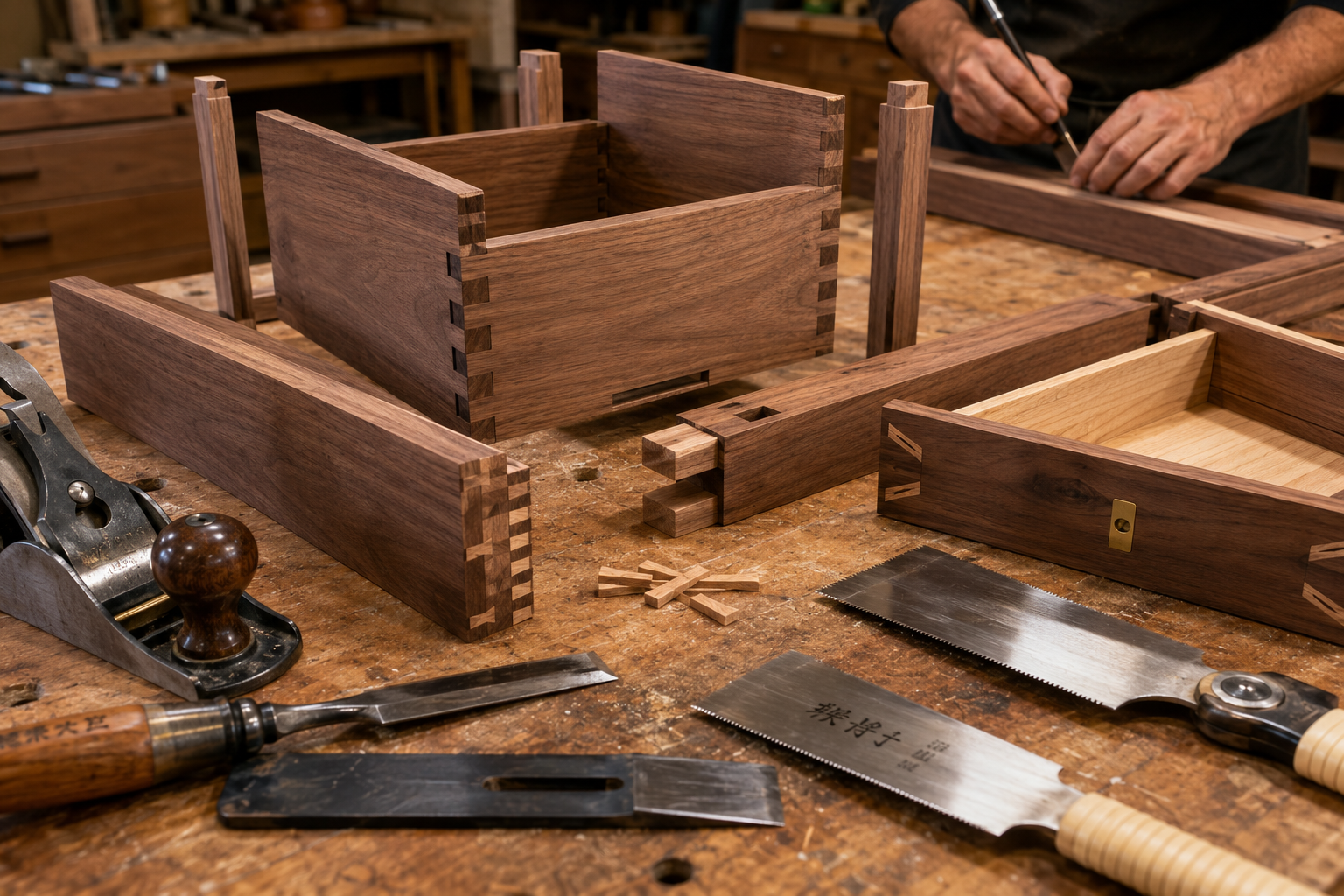
The journey of Building Unique Nightstands with Hidden Compartments: Advanced Joinery and Security Features begins long before the first cut of wood. It starts with a comprehensive design phase, where aesthetics, functionality, and security converge. Consider the overall style of the bedroom. Is it modern, rustic, minimalist, or traditional? The nightstand should complement, not clash with, the existing decor. Sketching out multiple designs, considering various dimensions, drawer configurations, and the intended location of hidden compartments, is a crucial first step.
When planning the hidden compartment, visualize how it will integrate seamlessly. Will it be a false bottom drawer, a sliding side panel, a secret cavity behind a decorative element, or even a push-to-open panel activated by a specific sequence? Each choice influences the joinery required and the complexity of the security mechanism. For instance, a sliding panel might necessitate a precise dado or groove joint, while a false bottom demands careful routing and a robust locking mechanism.
Material selection is equally vital. The type of wood dictates the final look, durability, and workability. Hardwoods like oak, maple, walnut, or cherry are excellent choices due to their strength, stability, and beautiful grain patterns.
- Oak: Known for its durability and prominent grain.
- Maple: Offers a fine, uniform texture and excellent hardness, ideal for intricate joinery.
- Walnut: Prized for its rich, dark color and workability, lending a luxurious feel.
- Cherry: Develops a beautiful patina over time, easy to work with.
Consider the dimensional stability of the wood, especially when designing moving parts for hidden compartments. Understanding wood movement is critical to prevent binding or warping over time. For more insights on this, review our guide on Understanding Wood Movement: How to Design and Build Furniture That. Plywood or MDF can be used for internal structures or drawer boxes to reduce cost and increase stability, but for exposed surfaces and structural elements, solid wood is preferred for its aesthetic appeal and longevity.
Essential Tools and Workshop Setup
A well-equipped workshop is indispensable for a project of this complexity. Precision is paramount, especially when working with advanced joinery and tight tolerances required for hidden compartments.
Table 1: Essential Tools for Building Unique Nightstands with Hidden Compartments
| Tool Type | Specific Tools/Accessories | Purpose |
|---|---|---|
| Measuring & Marking | Precision tape measure, combination square, marking gauge, calipers | Ensuring accurate dimensions and squareness. |
| Cutting | Table saw, miter saw, bandsaw, router, jig saw, Japanese hand saws | For precise cuts, dados, rabbets, and joinery. Japanese hand saws are excellent for fine joinery. (Beginner’s Guide to Japanese Hand Saws: Precision Cuts and Essential) |
| Shaping & Joinery | Chisels, hand planes, router bits, dado stack, drill press, mortiser | Crafting intricate joints like dovetails, mortise and tenons. Router bits are crucial for shaping and grooves. (The Essential Guide to Router Bits: Choosing the Right Profile,) |
| Assembly | Clamps (various sizes), wood glue, mallet | Securing joints during drying; selection of appropriate wood glue is important. (The Ultimate Guide to Wood Glue: Choosing the Right Adhesive for) |
| Finishing | Orbital sander, sanding blocks, scrapers, finishing cloths | Preparing surfaces for a flawless finish. |
A sturdy workbench is also fundamental. For options, consider our guide on Building a Custom Wood Workbench: Design Considerations and. Good lighting and a robust dust collection system are not just for convenience but crucial for safety and accuracy.
Advanced Joinery Techniques for Stealth and Strength
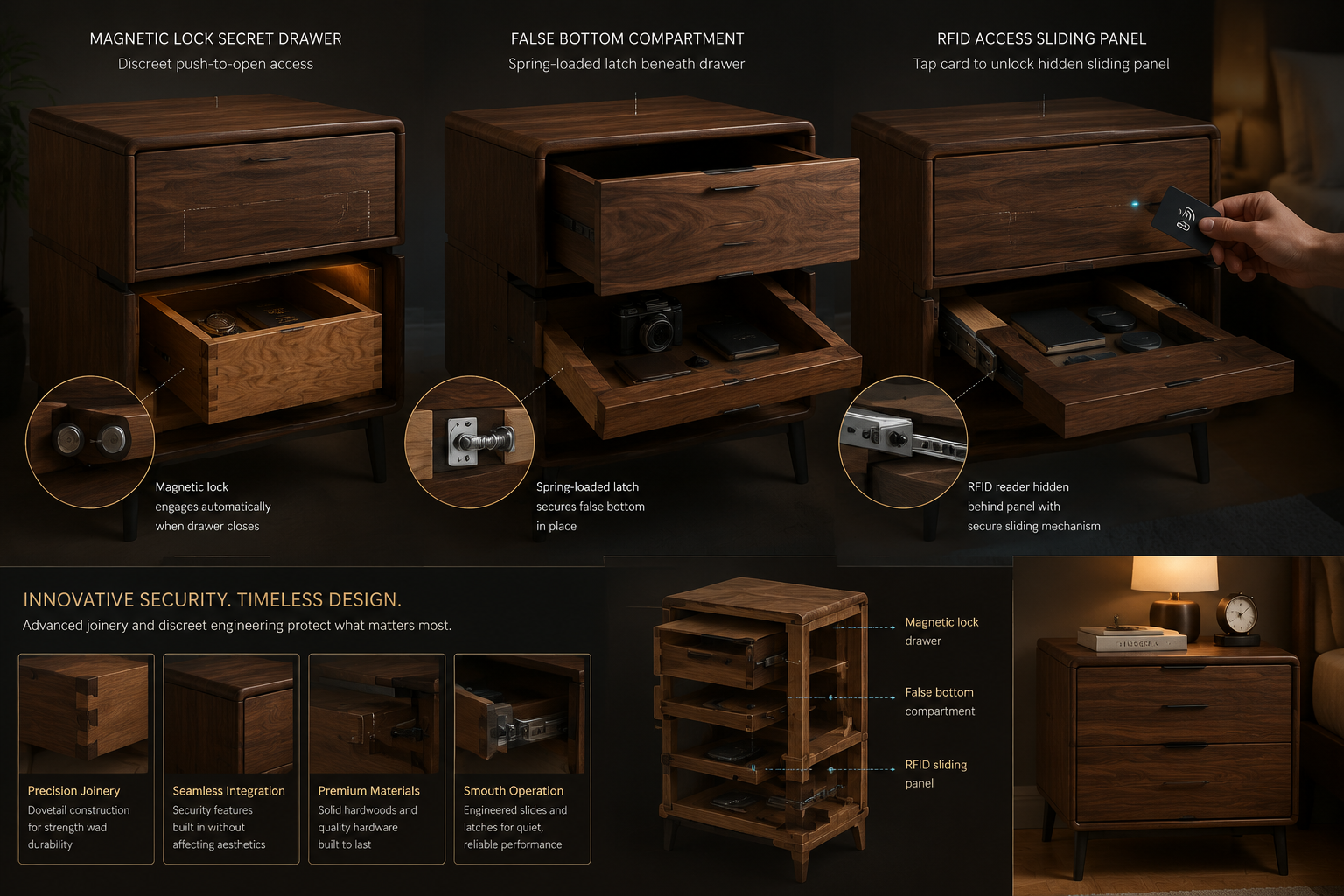
The heart of Building Unique Nightstands with Hidden Compartments: Advanced Joinery and Security Features lies in its joinery. Beyond basic butt joints and pocket holes, advanced techniques ensure both structural integrity and the seamless concealment of secret elements. Precision in these joints is what allows a hidden compartment to vanish into the furniture’s design.
Dovetails: The Gold Standard for Drawer Construction
Dovetail joints are renowned for their strength, resistance to pulling apart, and aesthetic appeal. They are ideal for drawer boxes, including those that house hidden compartments.
- Through Dovetails: Visible on both mating pieces, excellent for strong and decorative drawer corners.
- Half-Blind Dovetails: Visible only from one side, perfect for drawer fronts where you want a clean exterior look but maximum strength for the drawer box. This is particularly useful for a false-front drawer that serves as a hidden compartment.
- Secret Dovetails (Mitered Dovetails): Completely concealed from the outside, offering the strength of a dovetail with the clean appearance of a miter joint. These are challenging but exceptionally effective for disguising structural elements that might otherwise hint at a hidden feature.
Cutting precise dovetails requires skill and patience, whether by hand with chisels and saws or with a router and a dovetail jig. The tighter the fit, the stronger and more invisible the joint.
Mortise and Tenon: Robust Framework Connections
For the main framework of the nightstand (legs, rails, stiles), the mortise and tenon joint is unparalleled in strength and durability. It involves a tenon (a projection) on one piece fitting snugly into a mortise (a cavity) on another.
- Through Mortise and Tenon: The tenon passes completely through the mortise, visible on the opposite side.
- Blind Mortise and Tenon: The tenon does not pass all the way through, remaining concealed. This is often preferred for furniture where exposed joinery might detract from the design.
- Haunched Mortise and Tenon: A variation where a part of the tenon is removed to prevent the mortise from showing at the edge of the rail, enhancing both strength and aesthetics.
The precise fitting of mortise and tenon joints is crucial for the nightstand’s stability. Hand tools like chisels and mortising planes, or power tools like a mortising machine or router with a guide, are used for this.
Mitered Spline Joints: Reinforcing Hidden Panels
When creating hidden panels or false fronts, mitered spline joints offer superior strength and alignment compared to simple miter joints. A mitered joint is cut at an angle (usually 45 degrees), and a spline (a thin strip of wood) is inserted into opposing grooves cut into the mating pieces. This greatly increases the gluing surface and resistance to racking or shearing forces, making it ideal for sections that need to move or withstand repeated opening and closing. For other projects requiring advanced joinery, explore Beyond the Basic Box: Advanced Joinery for Unique Wooden Gift Boxes.
Dados and Rabbets: Precise Channels and Recesses
Dados (a flat-bottomed groove cut across the grain) and rabbets (a cut along the edge or end of a board) are fundamental for creating precise channels for sliding panels, drawer bottoms, and back panels. When planning a hidden compartment that slides out or pivots, these joints ensure smooth operation and exact alignment, crucial for maintaining the illusion of a solid piece of furniture. For instance, a dado might house the runners for a hidden drawer, or a rabbet could form the lip for a false bottom.
Integrating Security Features and Concealment Mechanisms
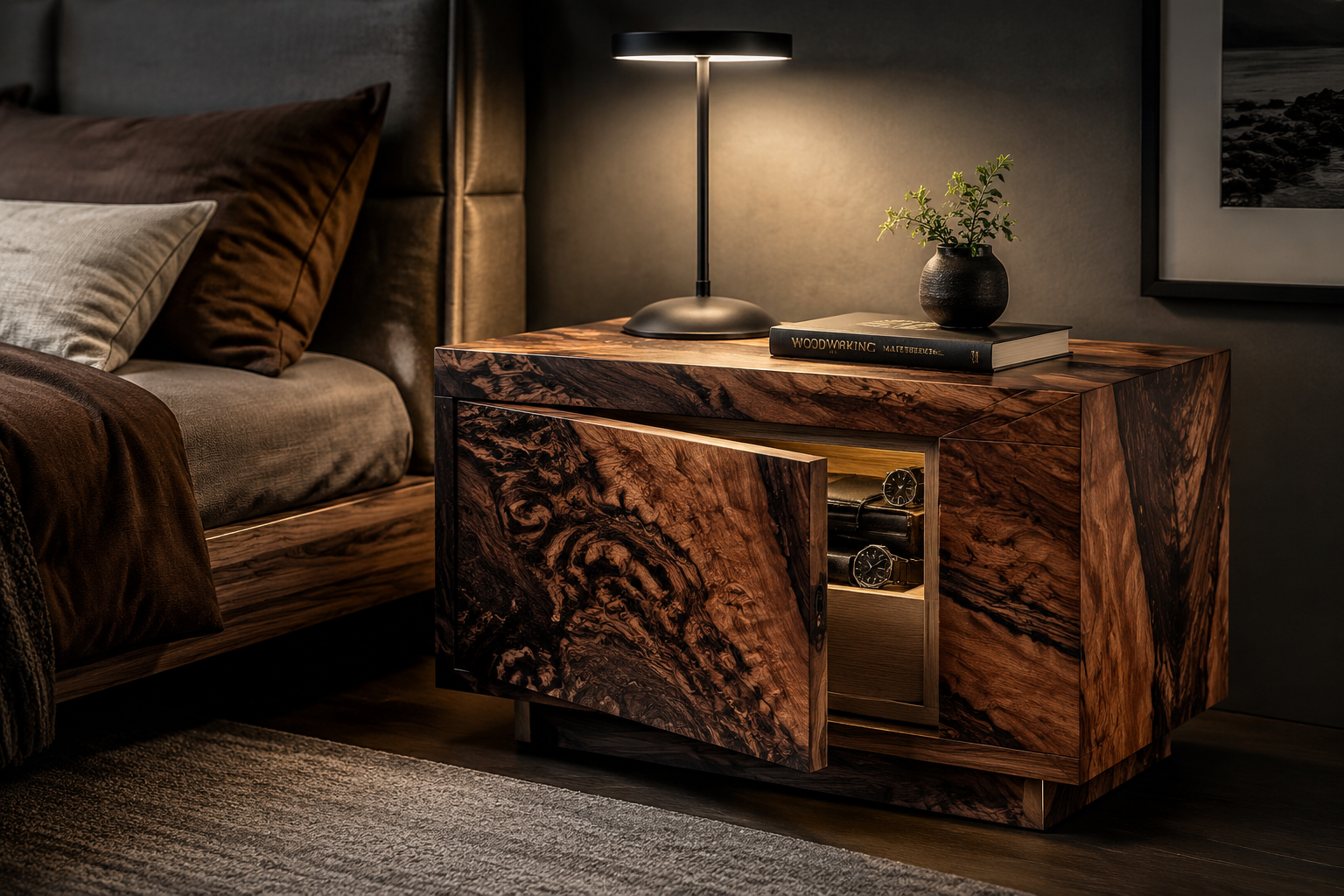
The true magic of Building Unique Nightstands with Hidden Compartments: Advanced Joinery and Security Features lies in how effortlessly security and concealment are integrated. This section explores various mechanisms and how to incorporate them discreetly.
Magnetic Locks and RFID Systems
For simple yet effective hidden access, magnetic locks are a popular choice. These often involve a magnetic latch installed inside the compartment and a key that, when held in a specific external spot, releases the lock. For enhanced security and a more tech-savvy approach, RFID (Radio-Frequency Identification) locking systems can be embedded. A small RFID reader is hidden beneath the surface of the nightstand, and a matching RFID card or tag, when swiped or tapped over the reader, triggers a solenoid or motor to release the lock. This allows for entirely invisible access without any visible keyholes or buttons.
Mechanical Trickery: False Bottoms and Sliding Panels
Traditional mechanical trickery remains highly effective.
- False Bottoms: This involves creating a shallow upper drawer or shelf, with a deeper compartment beneath it. The false bottom can be released via a hidden latch, a magnetic catch, or a strategically placed push-pin. The challenge is making the false bottom appear completely natural and inaccessible.
- Sliding Panels: A section of the nightstand’s side or top can be designed to slide open, revealing a compartment. This often requires precise dado or groove joints, as mentioned, along with smooth-gliding hardware (e.g., drawer slides or specialized linear bearings) and a robust locking mechanism that is released by a specific action, such as pressing a certain spot, or a sequence of pushes/pulls on another drawer.
- Pivot or Hinge Mechanisms: Some designs might incorporate a panel that pivots or swings open. This requires strong, hidden hinges, often European-style concealed hinges, to maintain the seamless exterior.
The key to successful concealment is designing the activation mechanism to be subtle and unique. This could be a specific pattern of presses on a drawer front, a strategically located knothole that acts as a button, or a hidden lever disguised as a decorative element.
Electronic and Biometric Solutions
For the ultimate in security and modern convenience, advanced electronic and biometric solutions can be integrated.
- Keypad Locks: Small, discreet keypads can be embedded into the side or top of the nightstand, allowing access via a PIN code. These can be wired to small solenoids that control the locking mechanism.
- Biometric Fingerprint Scanners: Miniature fingerprint scanners can be seamlessly integrated into the nightstand’s surface. Only authorized fingerprints can unlock the compartment. These require careful installation and wiring to a power source and the locking mechanism. The goal is to make the scanner appear as part of the nightstand’s design, perhaps disguised as a decorative inlay or a part of the handle.
When incorporating electronic components, careful routing of wires and secure housing of batteries or power supplies are necessary to maintain the compartment’s secrecy and the nightstand’s structural integrity. Ensuring easy access for battery replacement or maintenance without revealing the compartment is also crucial. For other projects with integrated storage, consider Building a Custom Murphy Bed with Integrated Desk: Space-Saving.
Finishing and Final Touches
The finishing process is where your unique nightstand truly comes to life, and it’s also critical for maintaining the illusion of a solid, uncompromised piece of furniture. A meticulous finish will highlight the wood’s natural beauty and ensure the hidden compartment remains undetectable.
Surface Preparation
Proper surface preparation is non-negotiable. Start by sanding all surfaces thoroughly, progressing through various grits from coarser (e.g., 80-100 grit) to finer (e.g., 180-220 grit), removing all scratches and imperfections. Pay extra attention to the edges and corners of moving parts or panels that abut the hidden compartment. Any unevenness or gaps could betray the secret. Dust thoroughly between grits. For a truly smooth surface, a final hand-sanding with a very fine grit (320-400) can make a significant difference.
Choosing the Right Finish
The choice of finish impacts both aesthetics and durability.
- Oil Finishes: Penetrating oil finishes (like tung oil or linseed oil) highlight the natural grain and provide a warm, hand-rubbed look. They are durable but may require more frequent reapplication. They also offer excellent protection against moisture. For more on this, read about Oil on Pine: Benefits, Tips, and Alternatives.
- Varnish or Polyurethane: These film-forming finishes offer superior protection against scratches, moisture, and general wear. They come in various sheens (matte, satin, semi-gloss, gloss) and are highly durable. Apply multiple thin coats, sanding lightly between coats for a smooth, even finish.
- Lacquer: Provides a very hard, clear finish that dries quickly. It is often sprayed on for a flawless, factory-like appearance.
Regardless of the finish chosen, ensure even application across all surfaces, including the inside of the visible drawers and the hidden compartment itself. Inconsistencies in finish can sometimes reveal a hidden feature.
Hardware and Final Assembly
Careful selection and installation of hardware are vital. For standard drawers, high-quality drawer slides (e.g., soft-close full-extension slides) enhance functionality. For the hidden compartment, hardware should be as discreet as possible. If using magnetic or RFID locks, ensure the components are installed cleanly and out of sight. Test all mechanisms repeatedly to ensure smooth operation and reliable locking/unlocking.
Final assembly involves joining the finished components, ensuring all joints are tight and square. Double-check the alignment of all moving parts of the hidden compartment. The goal is for the nightstand to look and feel like a completely solid, conventional piece of furniture, with no hint of its secret interior.
Conclusion
Building unique nightstands with hidden compartments, leveraging advanced joinery and robust security features, is a challenging yet profoundly rewarding woodworking endeavor. It marries the timeless artistry of furniture making with the practical needs of modern security, resulting in a piece that is both beautiful and functional in ways that traditional furniture cannot match. From the initial design and careful selection of materials to the meticulous execution of complex joinery and the seamless integration of security mechanisms, every step demands precision, patience, and a keen eye for detail. The end product is not just a nightstand; it is a personalized, secure sanctuary for your most cherished items, disguised as an elegant addition to your bedroom in 2026.
By mastering techniques like dovetails, mortise and tenons, and mitered splines, and by thoughtfully incorporating magnetic, RFID, or even biometric locking systems, woodworkers can create truly unique pieces that offer both peace of mind and a testament to their advanced skills. This project encourages innovation, pushing the boundaries of what furniture can be and demonstrating that security can be as beautiful as it is effective. Embrace the challenge, enjoy the process, and take pride in creating a heirloom-quality piece that will serve its purpose for years to come.
SEO Meta Title: Build Unique Nightstands with Hidden Compartments & Advanced Joinery SEO Meta Description: Master advanced joinery & security features for building unique nightstands with hidden compartments. Secure your valuables discreetly in 2026.