

The subtle warp in a tabletop or a stubborn drawer that sticks with the seasons are not signs of poor craftsmanship, but rather nature’s persistent influence on wood. Every woodworker, from novice to seasoned artisan, eventually encounters the reality of wood movement, the expansion and contraction of timber in response to changes in humidity. Ignoring this fundamental characteristic leads to warped panels, cracked joinery, and ultimately, furniture that fails to stand the test of time. Mastering “Understanding Wood Movement: How to Design and Build Furniture That Lasts” is not merely a technical skill; it is an essential mindset that transforms good woodworking into exceptional, enduring artistry.
Key Takeaways
- Wood is a hygroscopic material, meaning it constantly absorbs and releases moisture, causing it to change dimensions.
- Wood moves most significantly across its grain (tangentially and radially) and very little along its length (longitudinally).
- Proper wood selection, seasoning, and acclimation are crucial first steps in managing movement.
- Design strategies like floating panels, breadboard ends, and appropriate joinery accommodate movement to prevent structural failure.
- Applying balanced finishes and controlling environmental humidity help mitigate extreme changes in wood dimensions.
Understanding Wood Movement: The Science Behind the Shrink and Swell
Wood is a remarkable natural material, but its organic nature means it is not inert. It is hygroscopic, constantly striving to reach equilibrium with the moisture content in the surrounding air. This constant exchange of moisture is what causes wood to expand (swell) when it absorbs water and contract (shrink) when it releases it. This phenomenon, known as wood movement, is the single most critical factor influencing the longevity and stability of wooden furniture.
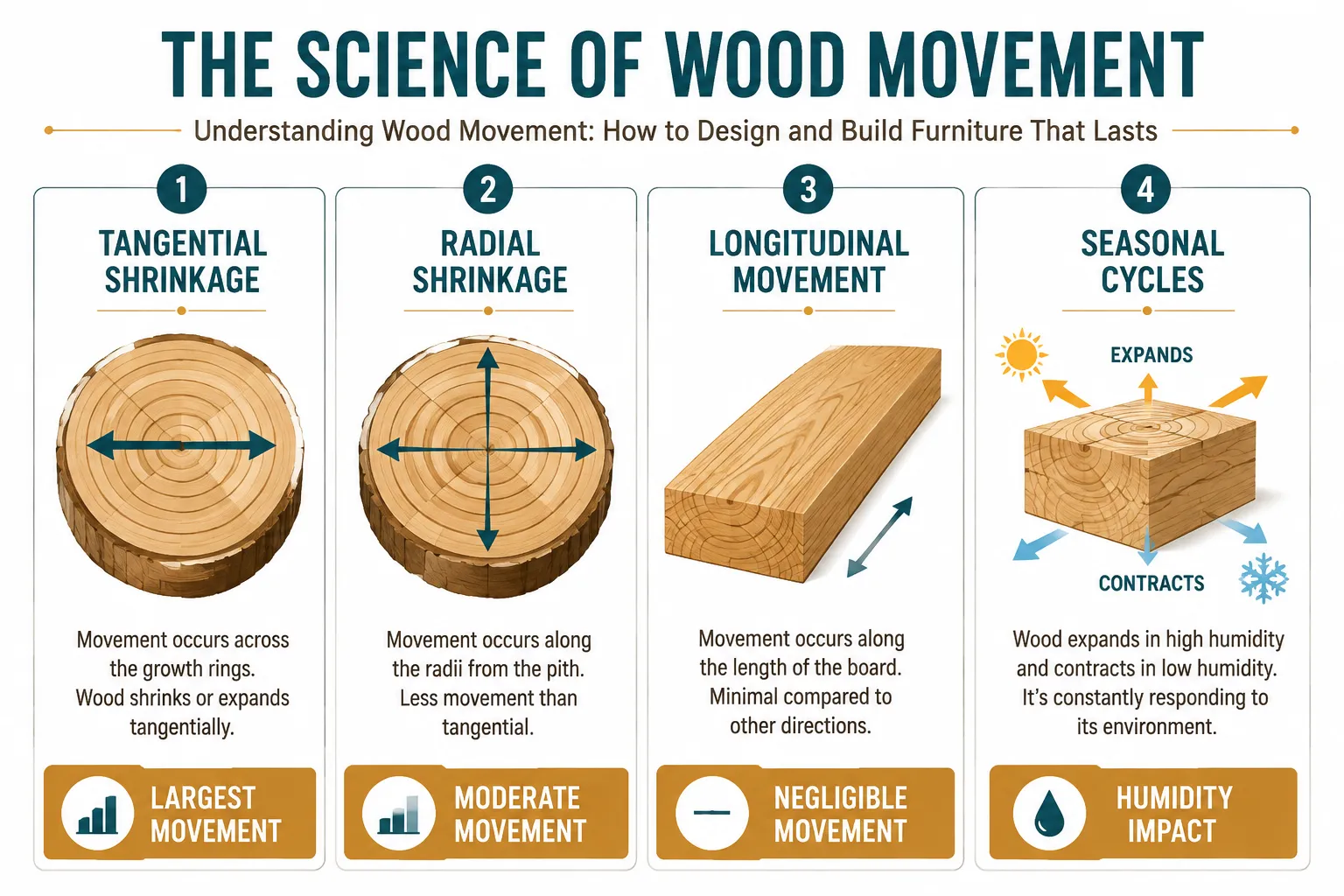
The movement of wood is not uniform in all directions. It behaves differently along its three anatomical axes:
- Longitudinal (along the grain): Wood moves very little along its length, typically less than 0.1% for most species. This negligible movement makes it a reliable dimension for length in most designs.
- Radial (across the growth rings, perpendicular to the grain): Movement in this direction is moderate, usually ranging from 2% to 6% from green to oven-dry.
- Tangential (around the growth rings, perpendicular to the grain): This is where wood moves the most, often between 4% and 10% from green to oven-dry.
These percentages highlight why a flat-sawn board, where most of the face is tangential grain, will cup more significantly than a quarter-sawn board, which presents mostly radial grain on its face. The difference in tangential versus radial movement is also why solid wood panels tend to warp or crack if rigidly constrained.
Factors Influencing Wood Movement
Several factors dictate the extent and speed of wood movement:
- Species: Different wood species have varying densities and cell structures, leading to different levels of movement. For example, oak is known for significant movement, while mahogany is relatively stable.
- Moisture Content (MC): This is the primary driver. As ambient humidity changes, the wood’s MC changes, directly affecting its dimensions. Furniture typically performs best when its MC is stable between 6% and 9%, reflecting indoor environmental conditions in most climates.
- Grain Orientation/Cut: As mentioned, flat-sawn (tangential) boards move more than quarter-sawn (radial) boards. Understanding the cut of your lumber is vital for predicting its behavior.
- Board Dimensions: Wider boards will exhibit more total movement across their width than narrower ones, even if the percentage of movement is the same. Thickness has less impact on linear movement but affects stability and resistance to warping.
- Environmental Conditions: The most critical external factor is relative humidity (RH). A dry winter with low RH will cause wood to shrink, while a humid summer with high RH will cause it to swell. Rapid changes in RH are particularly detrimental.
Understanding these fundamentals is the bedrock of “Understanding Wood Movement: How to Design and Build Furniture That Lasts.” Without this knowledge, furniture design becomes a gamble against nature’s inevitable forces.
Designing for Stability: Strategies for Lasting Furniture
The key to building furniture that lasts is not to fight wood movement, but to anticipate and accommodate it. This means incorporating design elements and joinery techniques that allow wood to expand and contract freely without creating stress points or structural failures.
Essential Design Principles
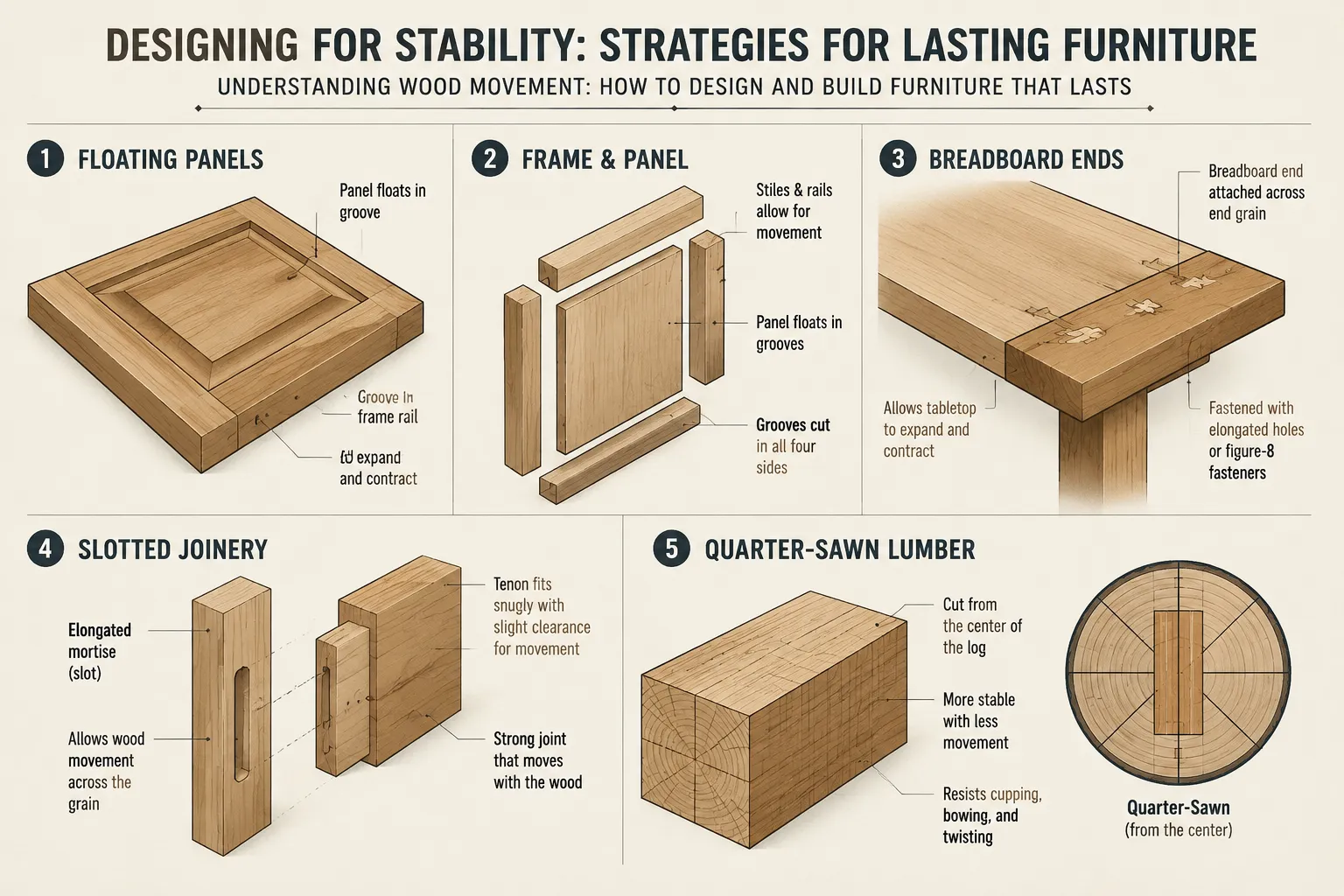
Frame and Panel Construction: This is arguably the most common and effective strategy. Instead of using a single solid board for a wide surface like a cabinet door or tabletop, a frame (stiles and rails) holds a thinner, “floating” panel. The panel is cut slightly smaller than its opening and fits into grooves in the frame, allowing it to expand and contract within the frame without stressing the joinery or cracking. This principle is fundamental to traditional designs like Shaker furniture joinery.
Breadboard Ends: For solid tabletops or wider panels, breadboard ends are an elegant solution. These are pieces of wood attached to the ends of a panel, running perpendicular to the main panel’s grain. They serve to keep the panel flat and prevent cupping while allowing the main panel to expand and contract across its width. The joinery for breadboard ends must be carefully designed to allow this movement, often utilizing elongated mortises for pegs or screws, as discussed in mastering wood joinery techniques.
Slotted Fasteners and Z-clips for Tabletops: When attaching a solid wood tabletop to an apron or base, never fasten it rigidly with screws directly through the apron. Instead, use specialized tabletop fasteners like Z-clips, figure-eight fasteners, or slotted blocks. These allow the tabletop to move horizontally while keeping it securely attached vertically.
Allowing for Gaps: In some designs, especially those with inset panels or drawer bottoms, a small gap (e.g., 1/16″ or 1/8″) should be left around the edges to allow for seasonal expansion. This gap will be less noticeable when the wood is at its largest extent.
Grain Orientation Matching: When joining multiple boards, try to alternate the end grain patterns (e.g., heartwood up, then heartwood down) to help balance the forces of cupping and keep the overall panel flatter.
Plywood and Engineered Woods: Plywood, MDF, and other engineered wood products are dimensionally stable because their layers are oriented with alternating grain directions or composed of wood fibers, effectively canceling out most movement. They are excellent choices for cabinet carcasses, drawer bottoms, and panel inserts where stability is paramount.
Selecting the Right Cut: Whenever possible, use quarter-sawn lumber for critical components like tabletops or drawer fronts, as it is inherently more stable and less prone to cupping than flat-sawn material.
Design Strategy Application How it Accommodates Movement Frame & Panel Cabinet doors, case sides Panel floats in grooves, allowing width changes. Breadboard Ends Tabletops, desk surfaces End pieces stabilize width while allowing main panel to move. Tabletop Fasteners Attaching tops to bases Slots or clips allow horizontal movement. Gaps & Reveals Inset panels, drawer bottoms Provides space for expansion without binding. Alternating Grain Glue-ups for wide panels Balances cupping forces to maintain flatness. Quarter-sawn Lumber Critical flat surfaces More dimensionally stable, less prone to cupping.
Understanding “Understanding Wood Movement: How to Design and Build Furniture That Lasts” truly shines in the design phase, where thoughtful consideration of wood’s behavior prevents problems before they start.
Best Practices for Mitigating Wood Movement in 2026
Beyond clever design, effective management of wood movement involves careful material preparation and proper finishing techniques. These practices ensure that your furniture remains beautiful and functional for decades.
Material Selection and Preparation
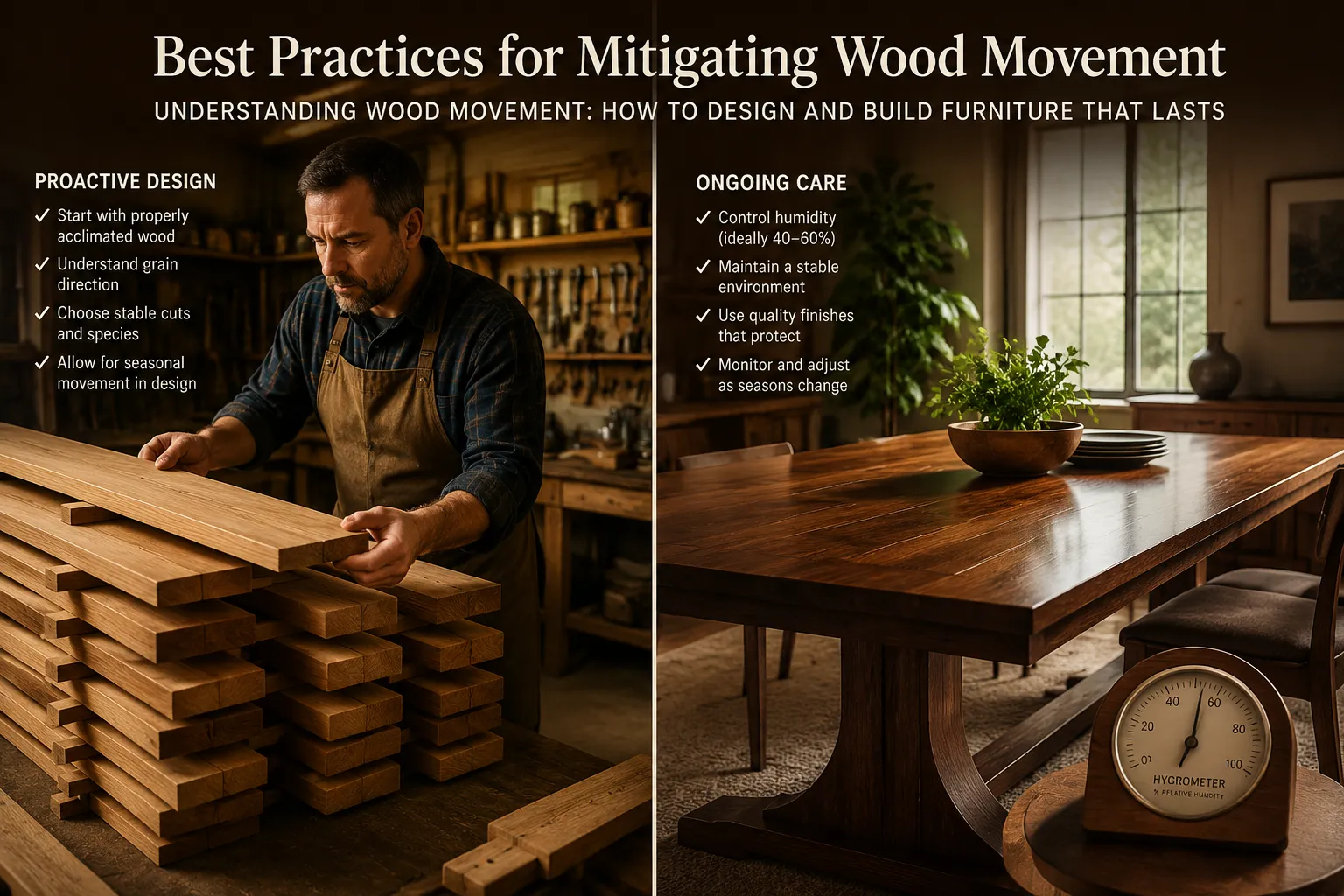
Source Properly Dried Lumber: Always start with kiln-dried lumber from a reputable supplier. Kiln drying brings the wood’s moisture content down to an acceptable level for interior use (typically 6-8%). Green or air-dried lumber will continue to move significantly as it dries indoors.
Acclimation is Crucial: Once purchased, bring the lumber into your workshop or the environment where the furniture will ultimately reside. Stack it neatly with stickers (small spacer strips) between layers to allow air circulation. Let it acclimate for several weeks, or even months, especially for larger pieces or varying climates. This allows the wood to stabilize to the ambient humidity, reducing later movement.
Check Moisture Content: Invest in a good quality moisture meter. Before milling, check the MC of your lumber. It should be consistent throughout the boards and close to the expected equilibrium moisture content (EMC) of the finished piece’s environment. For most indoor furniture in 2026, an MC between 6% and 9% is ideal.
Rough Mill and Rest: When milling rough lumber, dimension it in stages. First, joint one face and one edge, then plane to rough thickness. Allow the wood to rest for 24-48 hours between milling stages. This resting period lets any internal stresses release, and you can re-joint or re-plane as needed before final dimensioning.
Finishing and Environmental Control
Balanced Finishing: Apply an even coat of finish to all surfaces of a piece of wood, top, bottom, and all edges. This creates a balanced barrier against moisture exchange. If only one side is finished, that side will absorb/release moisture at a different rate than the unfinished side, leading to cupping. Even the underside of a tabletop needs finish. For enhancing wood’s natural beauty and protecting against moisture, explore options like finishing reclaimed wood for 2026.
Choose Appropriate Finishes: While no finish completely stops wood movement, some offer better moisture resistance than others. Film-building finishes like polyurethane, lacquer, and shellac provide a stronger barrier than oil finishes, which penetrate the wood. However, even the most robust finish only slows down, rather than prevents, moisture exchange.
Control the Environment: The most direct way to control wood movement after a piece is built is to manage the relative humidity of its environment.
- Humidifiers/Dehumidifiers: In climates with extreme seasonal changes, using a humidifier in dry winters and a dehumidifier in humid summers can help maintain a stable RH in your home, ideally between 35% and 55%.
- Avoid Extreme Locations: Do not place solid wood furniture directly next to heat sources (radiators, vents) or in direct sunlight, as these can cause rapid and localized drying. Similarly, avoid excessively damp basements or areas with high moisture fluctuations.
Consider Wood Type for Climate: If building furniture for a particularly unstable environment (e.g., a cabin with large temperature swings), select wood species known for their stability, such as mahogany, teak, or cedar, or consider engineered wood products.
By meticulously following these best practices, woodworkers can confidently achieve “Understanding Wood Movement: How to Design and Build Furniture That Lasts” in their projects, ensuring satisfaction and enduring quality.
Conclusion
Understanding wood movement is not merely a theoretical exercise; it is the cornerstone of responsible and enduring furniture making. The natural expansion and contraction of wood are inherent characteristics that, when ignored, lead to predictable failures. By recognizing the science behind this movement, adopting smart design principles like frame and panel construction and breadboard ends, and implementing best practices in material preparation and finishing, woodworkers can craft pieces that not only look beautiful but also remain stable and functional through years of seasonal changes.
Embracing the principles of “Understanding Wood Movement: How to Design and Build Furniture That Lasts” means building with foresight, respect for the material, and a commitment to longevity. The furniture you create today, mindful of wood’s dynamic nature, will become cherished heirlooms for generations to come. Take the time to understand your materials, design intelligently, and apply meticulous care, and your woodworking projects will indeed stand the test of time.
Next Steps for Woodworkers:
- Invest in a Moisture Meter: This is your most valuable tool for understanding your wood’s current state.
- Practice Frame and Panel Joinery: Start with a simple cabinet door project to master this fundamental technique.
- Experiment with Finishes: Understand how different finishes interact with moisture and wood.
- Monitor Your Environment: Pay attention to the humidity levels in your workshop and home.
References
- Forest Products Laboratory, U.S. Department of Agriculture. (2010). Wood Handbook: Wood as an Engineering Material. General Technical Report FPL-GTR-190.
- Hoadley, R. B. (2000). Understanding Wood: A Craftsman’s Guide to Wood Technology. Taunton Press.