

The average aspiring woodworker often faces a significant hurdle: accessing affordable, quality raw timber. While commercial sawmills offer convenience, the cost and limited selection can restrict creative projects. For those with a Stihl chainsaw, however, a world of possibilities opens up, transforming fallen trees or purchased logs into custom lumber. Mastering Stihl Chainsaw Techniques for Woodworkers: Milling Slabs, Cutting Joinery Blanks, and Safe Log Handling empowers crafters to unlock unique wood grain, dimension stock for intricate joinery, and ensure safety throughout the demanding process, all without the need for a dedicated sawmill. This article delves into practical methods for leveraging your chainsaw beyond firewood, enabling you to bring larger, more ambitious woodworking visions to life in 2026.
Key Takeaways
- Milling Slabs: Learn how to set up an Alaskan sawmill attachment with your Stihl chainsaw to efficiently cut live-edge slabs and custom dimensional lumber from raw logs, maximizing material yield.
- Cutting Joinery Blanks: Discover techniques for quickly rough-cutting joinery stock from larger timbers, saving time and allowing for more precise hand tool or machine work later.
- Safe Log Handling: Understand essential safety protocols, leverage techniques, and appropriate tools for safely moving, securing, and processing heavy logs to prevent injury.
- Chainsaw Maintenance: Regular sharpening and maintenance are crucial for precision cuts and safe operation when using your Stihl chainsaw for woodworking tasks.
- PPE is Non-Negotiable: Always wear appropriate personal protective equipment, including chaps, helmet with face shield, hearing protection, and gloves, for all chainsaw operations.
Mastering Stihl Chainsaw Techniques for Woodworkers: Milling Slabs
Milling your own slabs is arguably one of the most rewarding aspects of bringing a Stihl chainsaw into your woodworking repertoire. It allows you to create unique live-edge pieces and custom dimensions unattainable from standard lumberyards. The key to successful slab milling lies in a sturdy setup and consistent technique.
The primary tool for converting a chainsaw into a portable sawmill is an Alaskan mill attachment. This jig clamps to your chainsaw bar and allows for precise, parallel cuts along the length of a log. While different brands exist, they all operate on the same principle, guiding the saw to cut consistent thicknesses.
Setting Up Your Log and Mill
Before any cuts are made, ensure your log is securely positioned. Heavy-duty saw horses or cribbing can elevate the log to a comfortable working height and prevent it from rolling. Stability is paramount for safety and cut accuracy. Once the log is stable, you’ll need a flat, straight reference surface for your initial cut. This can be a sturdy 2×4 or an aluminum ladder clamped firmly to the top of the log. This guide provides the first, crucial flat surface that all subsequent cuts will reference.
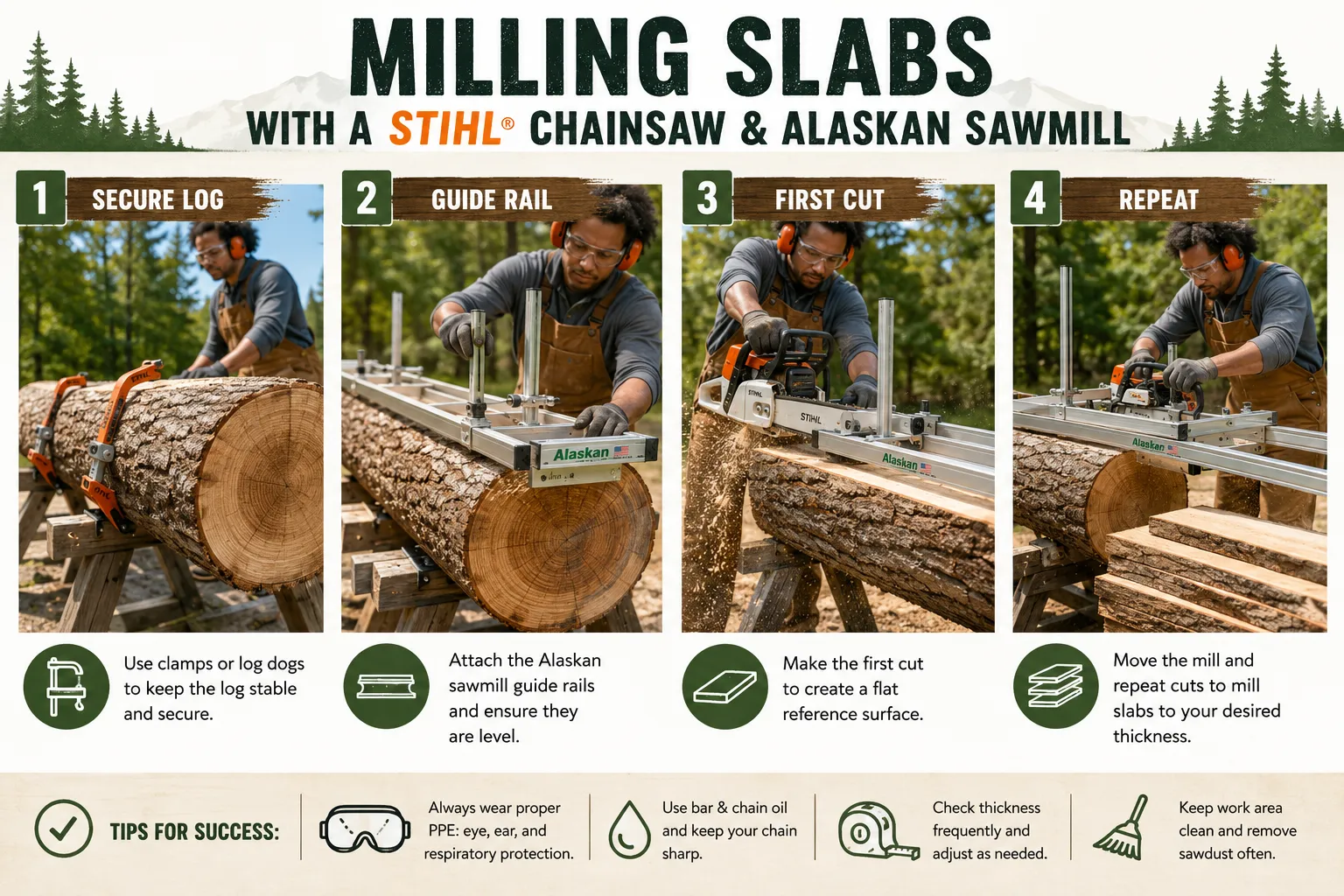
Steps for Milling Slabs:
- Secure the Log: Place the log on stable supports, ensuring it cannot move during cutting.
- Establish First Cut Guide: Clamp a straight edge (e.g., a 2×4 or ladder) along the top of the log. This guide must be perfectly straight and level.
- Attach Alaskan Mill: Mount your Stihl chainsaw to the Alaskan mill attachment according to the manufacturer’s instructions. Ensure the chain is sharp and tensioned correctly.
- Make the First Cut: Engage the chainsaw and slowly push it along the guide rail, allowing the saw to do the work. Maintain a consistent speed and pressure. This cut removes the first “face” of the log, creating a flat surface.
- Remove Guide, Flip Log: Once the first cut is complete, remove the guide rail. You can then carefully flip the log 90 degrees, resting the newly cut flat surface on your supports. This is often the easiest way to establish a second reference face.
- Make Subsequent Cuts: Adjust the Alaskan mill to your desired slab thickness. Use the previously cut flat surface as your new reference point, either by running the mill directly on it or by clamping another guide. Repeat the cutting process, collecting your custom slabs.
Choosing the right Stihl chainsaw for milling is important. For larger logs and faster milling, a powerful saw (e.g., Stihl MS 391 or larger) with a longer bar (25-36 inches) is highly recommended. Always use ripping chain, which is specifically designed for cutting along the grain and provides a smoother, more efficient cut than standard cross-cut chain. Remember that regular hand tool sharpening and maintenance extends to your chainsaw chain; a dull chain is dangerous and ineffective.
Stihl Chainsaw Techniques for Woodworkers: Cutting Joinery Blanks
While slab milling focuses on creating broad surfaces, cutting joinery blanks with a Stihl chainsaw is about efficiently dimensioning smaller, workable pieces from larger stock. This technique is invaluable for initial breakdown of logs or heavy timbers into sizes manageable for table saws, bandsaws, or hand tools, especially when working with unique wood species selection for visible joinery that might not be available as pre-milled lumber.
The goal here isn’t fine precision but rather rough dimensioning, getting close to your final size with minimal waste and effort. For this, a mid-range Stihl chainsaw (e.g., MS 271 Farm Boss) is often sufficient, providing a good balance of power and maneuverability.
Breaking Down Timber for Joinery Stock
Imagine you have a large beam or a section of a log that you want to transform into blanks for traditional Japanese wood joinery or other furniture components. Using a chainsaw for the initial breakdown saves wear and tear on smaller, less powerful machines and allows you to work with dimensions too large for many traditional workshop tools.
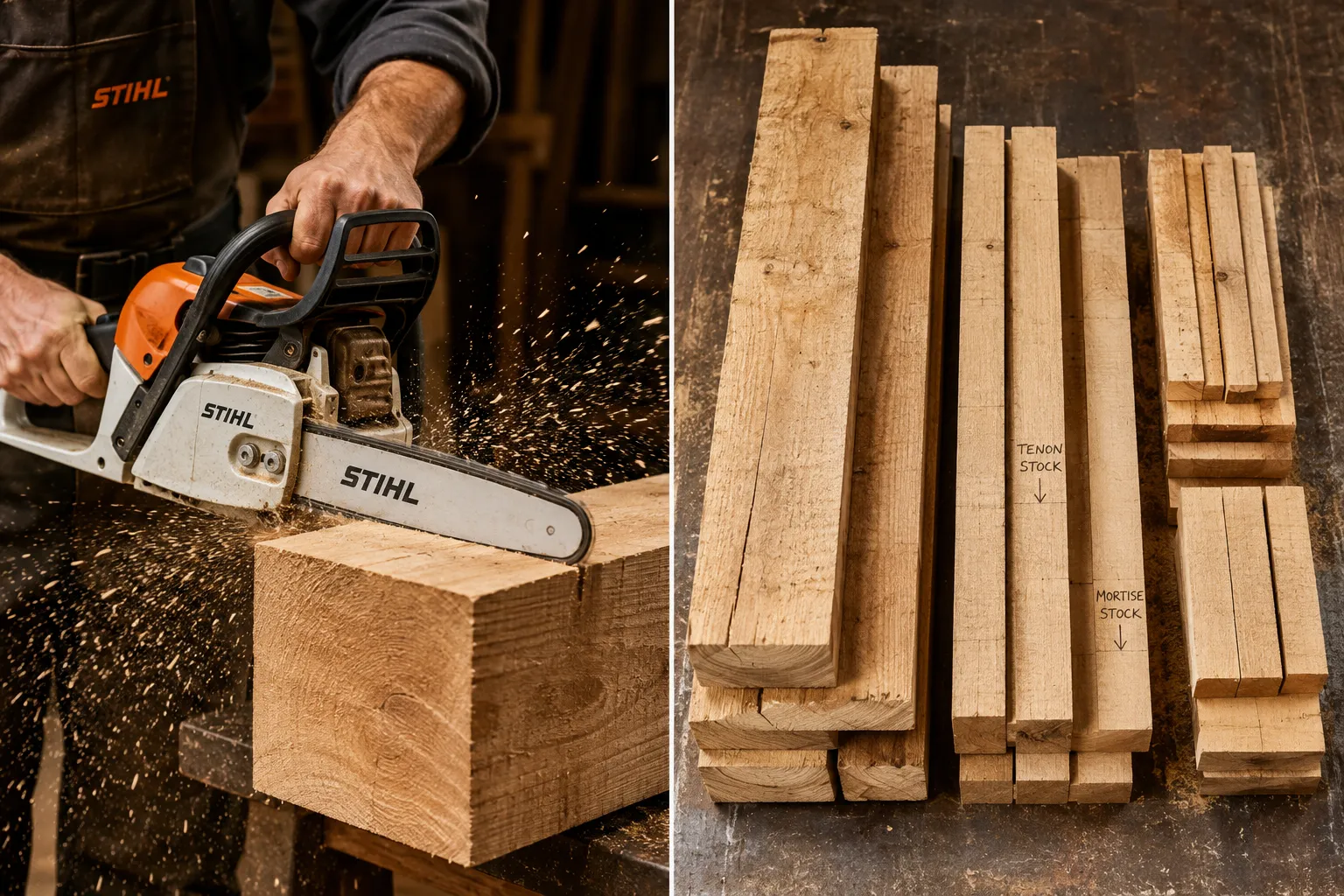
Techniques for Rough Dimensioning:
- Cross-cutting to Length: For shorter blanks, use your chainsaw to cross-cut the log or timber to the approximate required length. Always score your cut lines with a lumber crayon or chalk line first.
- Rip Cutting with a Guide: For longer, narrower blanks (e.g., legs for a table or rails for a cabinet), you can perform a rip cut. If you don’t need a full Alaskan mill, a simpler guide can be used. Clamp a straight edge (like an aluminum channel or a sturdy board) parallel to your desired cut line on the log. Run the side of your chainsaw’s bar along this guide to achieve a relatively straight rip cut. This method is quicker for a few cuts than setting up a full milling jig.
- Squaring Off Edges: To get closer to square stock, you can make several parallel cuts. For example, to create a 4×4 blank from a round log section, you’d make two opposing rip cuts to create two flat faces. Then, rotate the log 90 degrees and make two more cuts, referencing the newly created faces. This creates a roughly square timber that can then be further refined on a bandsaw or jointer.
- Preparing Live-Edge Blanks: When preparing for projects like a Japandi Slatted Bench with Live-Edge Seat, the chainsaw is perfect for removing rough bark and quickly flattening one face, or removing the pith, to get a piece ready for more precise milling or hand work. This prepares the piece for detailed work, such as selecting and preparing a live-edge slab.
When performing these cuts, consistency in applying pressure and guiding the saw is more important than speed. Let the sharp chain do the work. Mark your cut lines clearly and aim for oversizing your blanks slightly, knowing you will refine them further with more precise woodworking tools.
Safe Log Handling for Woodworkers
Working with large logs and heavy timbers poses significant safety challenges. Neglecting proper log handling techniques can lead to serious injury. When dealing with the power of a Stihl chainsaw and the weight of raw timber, safety must be your absolute top priority. This is especially true when attempting advanced Stihl Chainsaw Techniques for Woodworkers: Milling Slabs, Cutting Joinery Blanks, and Safe Log Handling.
Essential Safety Equipment and Practices
No chainsaw operation should begin without full personal protective equipment (PPE). This includes:
- Chainsaw Chaps/Pants: Made from ballistic nylon fibers, these are designed to snag and stop the chain instantly in case of contact. They are non-negotiable.
- Helmet with Face Shield and Hearing Protection: Protect your head from falling branches, your eyes from sawdust and chips, and your ears from the extreme noise of the chainsaw.
- Gloves: Provide grip and protection from splinters and minor cuts.
- Steel-Toed Boots: Protect your feet from falling logs or the chainsaw.
Beyond PPE, understand the physics of logs. Logs are heavy, can roll unexpectedly, and stored energy in stressed wood can release violently (kickback).
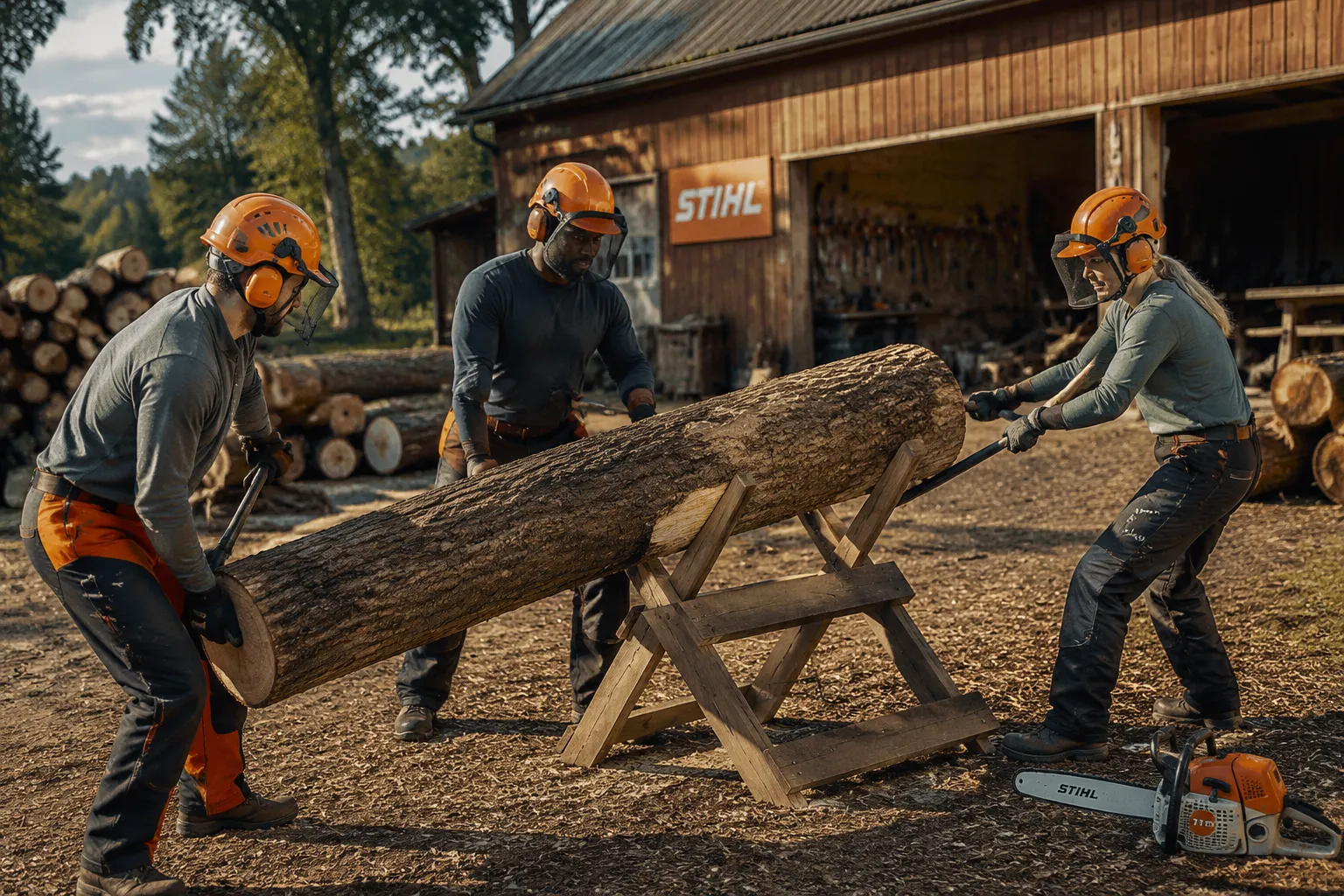
Safe Log Handling Practices:
- Stable Work Area: Always work on level ground, clear of obstructions, tripping hazards, and bystanders. Ensure you have ample room to maneuver the log and your chainsaw.
- Secure the Log: Before making any cut, ensure the log is stabilized. Use robust saw horses, cribbing, or wedges to prevent rolling. Never cut a log that isn’t fully supported.
- Identify Stress and Pinch Points: Before cutting, inspect the log for branches, crotches, or compression points. A log resting on the ground might be under tension or compression, and improper cuts can lead to kickback, chain pinching, or the log shifting dangerously. Plan your cuts to relieve stress safely, often by making small relief cuts or starting on the compression side.
- Use Mechanical Advantage: Don’t rely on brute strength alone to move heavy logs. Invest in tools like a peavey or cant hook for rolling and positioning logs. A log arch or log dolly can significantly reduce strain when moving logs across uneven ground. Even a simple set of log tongs can aid in lifting and positioning.
- Team Lift for Heavy Logs: For very large logs, never work alone. Plan the lift with a partner, communicate clearly, and lift with your legs, not your back.
- Clear Escape Routes: Always have a clear escape path planned before starting a cut, in case the log shifts or rolls unexpectedly.
- Fuel and Maintenance: Refuel your chainsaw when the engine is cool to avoid fire hazards. Regularly check chain tension, sharpen the chain, and ensure the chain brake is functional. A well-maintained chainsaw is a safer chainsaw. For tips on sharpening, refer to our essential guide to hand tool sharpening and maintenance.
By adhering to these rigorous safety measures, you not only protect yourself but also develop the confidence to effectively employ Stihl Chainsaw Techniques for Woodworkers: Milling Slabs, Cutting Joinery Blanks, and Safe Log Handling in your pursuit of unique timber for your woodworking projects.
Conclusion
Embracing Stihl chainsaw techniques for woodworking, from milling custom slabs to roughing out joinery blanks and meticulously handling logs, significantly expands a woodworker’s capabilities. It allows for creative freedom, access to unique wood grain, and cost savings that traditional lumber sources often can’t provide. In 2026, the modern woodworker equipped with the right knowledge and tools can transform raw timber into stunning, functional art.
While the power of a chainsaw is immense, so is the responsibility of wielding it safely. Always prioritize personal protective equipment, understand log mechanics, and practice meticulous maintenance. By mastering these techniques and adhering to the highest safety standards, you unlock the potential of fallen trees and raw logs, turning them into the foundation for your next heirloom piece. Start with smaller projects to build confidence, consistently apply safe practices, and watch your woodworking horizons expand.
Meta Title: Stihl Chainsaw Woodworking: Mill Slabs & Cut Joinery Safely Meta Description: Master Stihl chainsaw techniques for woodworkers in 2026. Learn safe log handling, milling custom slabs, and cutting joinery blanks for unique projects.