
The journey into woodworking often begins with a single question: which tools should I invest in first? This pivotal decision, particularly when choosing between established brands like Ryobi and DeWalt, can set the trajectory for a beginner woodworker’s entire shop and project capabilities. In 2026, with an ever-expanding market of cordless power tools, understanding the nuances of each brand’s ecosystem is crucial. This article delves into the core aspects of “Ryobi vs. DeWalt for Beginner Woodworkers: Which Tool Line Should You Build Your Shop Around?” exploring their strengths, weaknesses, and suitability for those just starting their journey in crafting with wood.
Key Takeaways
- Cost-Effectiveness vs. Performance: Ryobi offers exceptional value and a vast battery-compatible system, ideal for budget-conscious beginners. DeWalt provides higher performance, durability, and a more professional feel, suitable for those planning rapid skill progression.
- Battery Ecosystems: Both brands boast extensive cordless platforms (Ryobi 18V ONE+, DeWalt 20V MAX), but DeWalt’s FLEXVOLT offers a unique 20V/60V dual-voltage advantage for larger tools.
- Tool Variety and Specialization: Ryobi excels in sheer breadth of tools, including lifestyle and garden products. DeWalt focuses more intensely on professional-grade construction and woodworking tools.
- Durability and Longevity: DeWalt generally offers superior build quality and durability, designed for demanding job site conditions. Ryobi tools are well-suited for DIY and hobbyist use but may not withstand heavy, daily abuse as well.
- Upgrade Path: Choosing a brand establishes an upgrade path. Ryobi allows for gradual expansion into many tools at a lower cost. DeWalt offers a clear path to more powerful and specialized professional tools within the same battery system.
Understanding the Tool Ecosystems: Ryobi vs. DeWalt for Beginner Woodworkers
When a beginner woodworker considers which tool line to build their shop around, they are not just buying individual tools; they are investing in an entire ecosystem. This includes battery compatibility, charger types, the range of available tools, and the overall support from the manufacturer. Ryobi and DeWalt represent two distinct philosophies in this market, each with a compelling offering for new enthusiasts.
Ryobi, often found at home improvement giants like Home Depot, positions itself as the go-to brand for DIYers and hobbyists. Their 18V ONE+ system is renowned for its expansive range of tools, encompassing everything from drills and saws to leaf blowers and portable vacuums, all powered by the same battery. This “one battery fits all” approach is incredibly appealing to beginners, as it minimizes the cost and complexity of managing multiple battery types. For someone setting up their first dedicated woodworking space, the ability to buy an affordable combo kit and then gradually add specific tools like an orbital sander, a jig saw, or a router at a lower price point is a significant advantage. This can be especially useful for projects like crafting custom wooden planters or building simple wall-mounted coat racks.
DeWalt, on the other hand, commands a strong presence in the professional and serious enthusiast market. Their 20V MAX system is known for its robust performance, durability, and ergonomic design, making it a favorite on construction sites and in professional workshops. While DeWalt tools typically come at a higher price, their build quality often justifies the investment, promising longer lifespan and better performance under demanding conditions. For a beginner woodworker who plans to quickly progress to more intricate projects or potentially use their skills for profitable small-batch woodworking, the DeWalt line offers tools engineered for consistent, heavy use. Their batteries, while generally more expensive, often offer more power and advanced features, including the FLEXVOLT line which can automatically switch between 20V and 60V for higher-demand tools.
| Feature | Ryobi 18V ONE+ (Beginner Focus) | DeWalt 20V MAX / FLEXVOLT (Beginner Focus) |
|---|---|---|
| Target User | DIYer, Hobbyist, Budget-conscious Beginner | Serious Hobbyist, Aspiring Professional, Performance-focused Beginner |
| Initial Cost | Lower (excellent value combo kits) | Higher (premium price point) |
| Tool Variety | Extremely vast (300+ tools), including garden/lifestyle | Extensive (250+ tools), focused on construction/woodworking |
| Battery System | 18V ONE+ (single voltage) | 20V MAX (single voltage) & FLEXVOLT (20V/60V auto-switching) |
| Performance | Good for most beginner and DIY tasks, sufficient power | Excellent for demanding tasks, higher torque and run-time |
| Durability | Good for occasional to regular home use | Excellent, built for job site resilience and heavy use |
| Ergonomics | Generally good, comfortable for average hands | Often superior, designed for prolonged professional use |
| Availability | Widely available (Home Depot primary), online | Widely available (various retailers, online) |
| Warranty | Typically 3-year limited | Typically 3-year limited, sometimes longer on specific tools |
| Upgrade Path | Easy expansion into many tools at similar performance levels | Clear path to higher-performance, specialized tools within ecosystem |
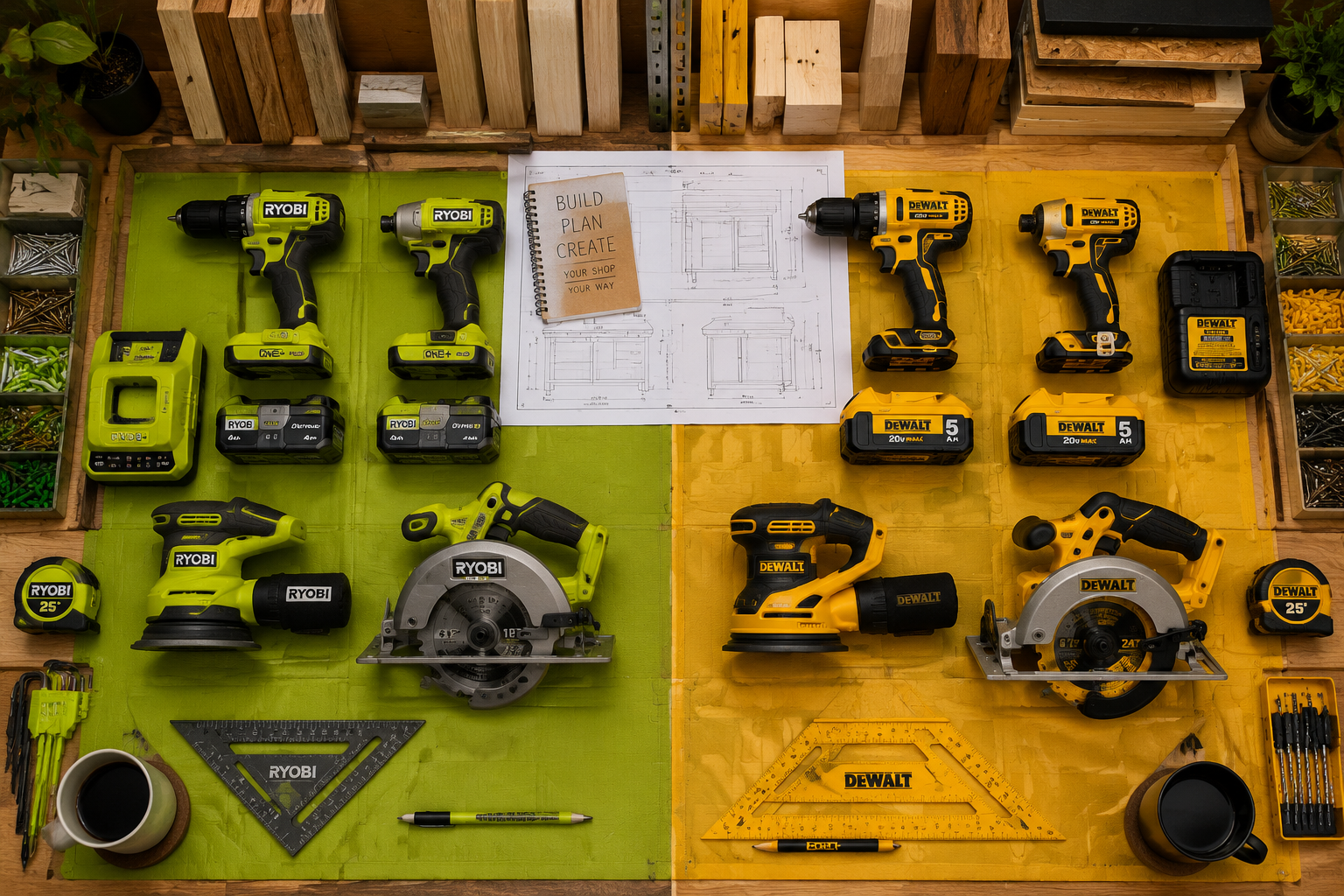
For beginner woodworkers, the choice often boils down to balancing budget with anticipated future needs. Ryobi provides an accessible entry point with enough power and versatility for common projects, allowing users to gradually expand their collection without breaking the bank. DeWalt offers a more robust foundation, for those who foresee themselves delving deeper into complex joinery, large-scale builds, or even professional endeavors.
Core Tools Comparison: Saws, Drills, and Sanders for the Beginner Woodworker
Focusing on the essential tools—drills, saws, and sanders—provides a clearer picture of how Ryobi and DeWalt cater to the beginner woodworker. These are the workhorses of any shop, foundational for almost every project from simple cutting boards to more ambitious furniture pieces. The initial investment in these core tools often dictates the early success and enjoyment of a new woodworker.
Drills and Impact Drivers: Both Ryobi and DeWalt offer a wide array of drills (hammer drills, standard drills) and impact drivers. Ryobi’s 18V ONE+ drills are perfectly adequate for most woodworking tasks, such as drilling pilot holes, driving screws, or using spade bits for larger holes. Their impact drivers provide sufficient torque for most fasteners. For example, a beginner making simple wooden knife blocks or assembling a workbench will find Ryobi’s offerings reliable and comfortable.
DeWalt’s 20V MAX drills and impact drivers, while more expensive, typically offer higher power, faster RPMs, and often superior ergonomics. Their brushless motor technology, more common in DeWalt’s mid-to-high-tier offerings, provides increased efficiency, longer run-time, and extended tool life. For a beginner who might tackle tougher woods or more repetitive tasks, the added power and durability of a DeWalt drill can be a noticeable benefit.
Saws: Saws are arguably the most critical tools in a woodworker’s arsenal.
- Circular Saws: Ryobi 18V circular saws are excellent for general-purpose cutting of sheet goods like plywood or breaking down lumber. They are lightweight and easy to handle, making them ideal for initial cuts. DeWalt’s 20V MAX circular saws often boast more power, deeper cut capacities, and more durable shoe plates, which can be advantageous for precise, long rip cuts or crosscuts in thicker stock.
- Jig Saws: Both brands offer capable cordless jig saws. Ryobi’s jig saws are great for intricate cuts, curves, and cutouts in thinner materials. DeWalt’s versions often feature more advanced orbital action settings, faster blade changes, and better vibration control, leading to cleaner cuts and less fatigue during extended use.
- Miter Saws: While both brands offer larger corded and cordless miter saws, for beginners building a shop, the compact 18V/20V cordless miter saws are often considered. Ryobi offers several options, including sliding miter saws, at competitive prices. DeWalt’s cordless miter saws are highly regarded for their precision, power, and often better dust collection, a crucial factor when thinking about a DIY smart workshop dust collection system.
Sanders: Sanding is a woodworking rite of passage. Random orbital sanders are typically the first sander a beginner acquires. Ryobi’s 18V random orbital sanders are perfectly serviceable for smoothing surfaces, preparing for finishes, and general sanding tasks. They are lightweight and get the job done for most projects. DeWalt’s 20V MAX random orbital sanders often feature better dust collection systems, lower vibration, and slightly more aggressive material removal, which can speed up the sanding process and improve finish quality. For projects requiring a professional finish, like power tool mastery for decorative wood projects, the subtle improvements in a DeWalt sander might make a difference.
For the beginner woodworker focusing on core tools, here’s a quick summary:
- Ryobi: Offers excellent value, making it easier to acquire a full set of basic tools quickly. Performance is sufficient for most beginner projects and general DIY tasks.
- DeWalt: Provides higher-performance tools with better durability and ergonomics, suitable for those who demand more power, precision, and longevity from their equipment, and who anticipate heavier usage.
The decision for core tools often comes down to budget versus long-term performance expectations. If you are uncertain about your long-term commitment to woodworking, Ryobi offers a safe and affordable entry point. If you know you’ll be serious and want tools that can grow with your skills, DeWalt provides a more robust initial investment.
Battery Systems, Upgrade Paths, and Long-Term Value for Beginner Woodworkers
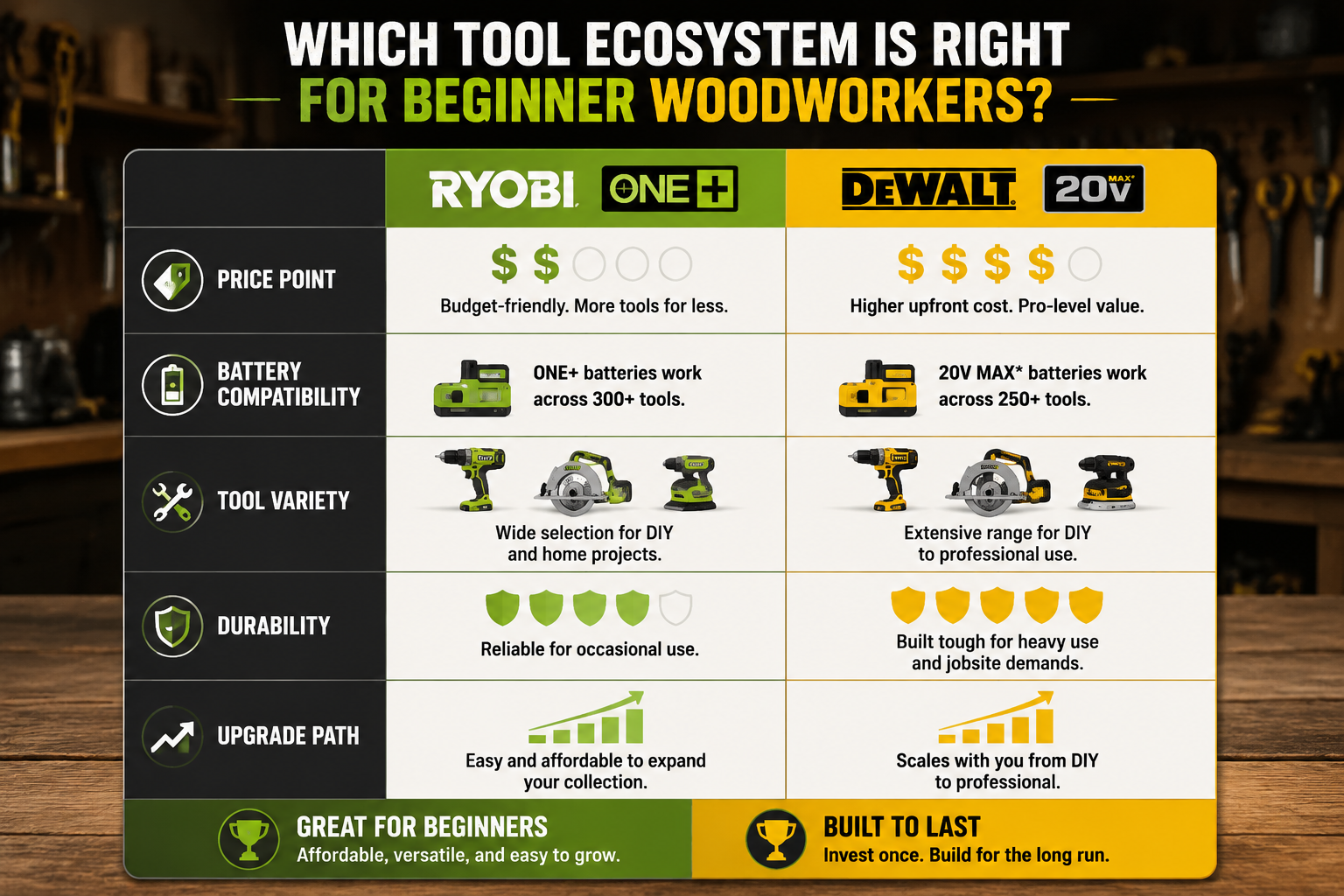
The battery system is the heart of any cordless tool line. For beginner woodworkers, choosing between Ryobi’s 18V ONE+ and DeWalt’s 20V MAX (and its FLEXVOLT extension) is a critical factor influencing long-term costs, tool expandability, and performance capabilities. This decision impacts not just your initial purchases but your future ability to expand your shop with specialized tools for tasks like mastering dovetail joinery or crafting intricate items.
Ryobi’s 18V ONE+ Ecosystem: Ryobi’s strength lies in its expansive and backward-compatible 18V ONE+ battery system. Almost every Ryobi 18V tool ever made works with any Ryobi 18V battery. This means that a battery purchased in 2026 will power tools released years ago, and vice-versa. This consistency is a massive benefit for beginners, as it removes the fear of obsolete batteries and allows for gradual, affordable expansion. The sheer number of tools (over 300) that operate on this single platform is unmatched, extending beyond traditional woodworking into automotive, cleaning, and gardening. This versatility means your woodworking batteries can also power a shop vac or a fan in your workshop, providing exceptional value. The accessible price point for batteries and tools makes it easy to add specialized items like a trim router, a pin nailer, or a compact planer as your skills develop, without a significant financial hit.
DeWalt’s 20V MAX / FLEXVOLT Ecosystem: DeWalt’s 20V MAX system is designed for professional performance and durability. While the initial investment in batteries and tools is higher, they typically offer better power delivery and longer run times. DeWalt batteries are known for their rugged construction, suitable for demanding job site conditions. The significant advantage for woodworkers, particularly those who might eventually tackle larger projects like building live edge dining tables, is the FLEXVOLT line. FLEXVOLT batteries are unique because they can automatically switch between 20V and 60V, powering both the standard 20V MAX tools and higher-voltage, more powerful tools like their 60V circular saws, miter saws, and table saws. This provides a seamless upgrade path to professional-grade equipment within the same battery platform, offering unparalleled versatility for heavier-duty applications that might strain a less powerful 18V system.
Upgrade Paths and Long-Term Value: For beginner woodworkers, considering the upgrade path is crucial.
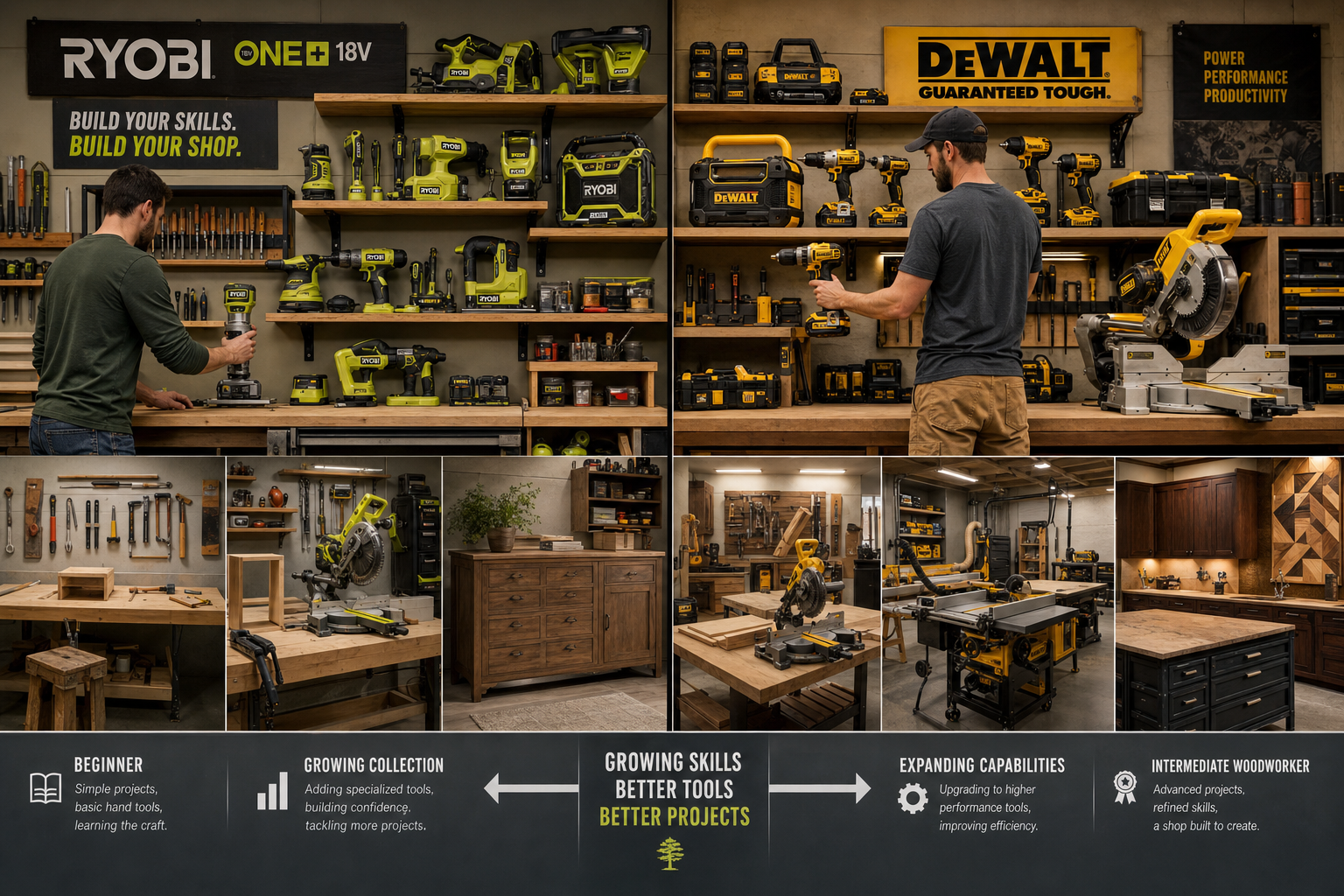
- Ryobi: The upgrade path with Ryobi is typically horizontal. You’ll likely add more tools within the 18V ONE+ system, expanding your capabilities by increasing the number of tools, rather than significantly increasing the power of each individual tool type. This is perfect for hobbyists who enjoy variety and dabbling in different aspects of woodworking and DIY.
- DeWalt: The DeWalt ecosystem offers a more vertical upgrade path. You can start with basic 20V MAX drills and impact drivers, and as your skills and projects grow, seamlessly transition to more powerful 20V tools (e.g., a larger circular saw) or step up to the 60V FLEXVOLT tools for heavy-duty applications, all while using interchangeable batteries. This system is designed for growth and sustained performance, which offers considerable long-term value for serious enthusiasts and those contemplating woodworking as a side business. For maximizing space and organization, regardless of your chosen brand, consider exploring DIY smart workshop storage solutions to keep your growing tool collection tidy.
Ultimately, the long-term value for a beginner woodworker from either Ryobi or DeWalt depends on individual aspirations. If affordability, breadth of tools for general home use, and a relaxed hobbyist approach are priorities, Ryobi offers incredible value. If higher performance, professional durability, and a clear path to heavy-duty tools for more demanding projects are key, DeWalt is the more strategic long-term investment. Both brands offer solid warranties and widespread availability, ensuring support for your woodworking journey.
Conclusion
The decision of which tool line to build your shop around – Ryobi vs. DeWalt for beginner woodworkers – is deeply personal and depends heavily on individual priorities, budget, and long-term aspirations. In 2026, both brands offer robust ecosystems, but they cater to slightly different needs.
For the budget-conscious beginner, the hobbyist, or the DIYer who anticipates occasional to moderate use across a wide range of tasks, Ryobi’s 18V ONE+ system presents an unbeatable value. Its vast array of tools, all running on a single, affordable battery platform, makes entry into woodworking accessible and encourages experimentation. You can easily acquire a comprehensive starter kit and gradually add specialized tools as needed, making it an excellent choice for learning the ropes without a significant financial outlay.
Conversely, if you envision yourself rapidly progressing in woodworking, tackling more demanding projects, or even potentially turning your hobby into a side venture, DeWalt’s 20V MAX and FLEXVOLT systems offer a superior foundation. While the initial investment is higher, you gain access to tools known for their professional-grade power, durability, and advanced features. The seamless upgrade path to 60V FLEXVOLT tools provides the power needed for heavier-duty tasks, ensuring your tools can grow with your skills and project ambitions.
Before making your final choice, consider these actionable steps:
- Assess Your Budget: Determine how much you are comfortable spending upfront on essential tools and batteries.
- Define Your Goals: Are you aiming for casual DIY projects, or do you aspire to build fine furniture and potentially sell your creations?
- Handle the Tools: Whenever possible, visit a store and physically hold both Ryobi and DeWalt tools. Evaluate their ergonomics, weight, and feel to see which brand resonates more with your comfort and control preferences.
- Look for Deals: Both brands frequently offer combo kits or special promotions that can significantly reduce the cost of entry.
- Consider the Ecosystem: Think about not just your first tools, but what tools you might want to add in the future. Does the brand offer the specialized items you might need down the line?
Ultimately, there is no single “best” choice, only the best choice for you. By carefully weighing the cost, performance, and ecosystem advantages of Ryobi and DeWalt, you can confidently build a woodworking shop that supports your passion and growth for years to come.