
The perimeter of a woodworking shop, much like the precision joinery within it, demands attention to detail. Neglecting the outdoor areas not only detracts from the professional appearance of your craft space but can also create fire hazards and pest habitats. When faced with the task of taming unruly growth, many woodworkers ponder the perennial question: Weed Wacker vs. String Trimmer: Choosing the Right Tool for Your Woodshop’s Outdoor Maintenance. While often used interchangeably, these tools possess distinct characteristics and optimal applications, and understanding these differences is crucial for efficient and effective landscape management around your valuable workshop.
Key Takeaways
- Terminology Matters: While “weed wacker” and “string trimmer” are often synonymous in casual use, “string trimmer” is the more accurate, overarching term for the tool that uses a rotating line to cut vegetation. “Weed wacker” often implies a more robust, heavy-duty version.
- Power and Application: Weed wackers (brush cutters) excel at clearing thick brush, dense weeds, and small saplings, typically with more powerful engines and thicker lines. String trimmers are ideal for edging lawns, trimming around obstacles, and lighter weed control.
- Power Source Options: Both tools come in gas, corded electric, and cordless electric variants, each with trade-offs in power, portability, and maintenance.
- Maintenance is Key: Proper care, including line replacement, cleaning, and engine maintenance for gas models, extends the life and performance of your tool.
- Safety First: Always wear appropriate personal protective equipment (PPE), including eye protection, hearing protection, long pants, and sturdy shoes, regardless of the tool chosen.
Understanding the Difference: Weed Wacker vs. String Trimmer: Choosing the Right Tool for Your Woodshop’s Outdoor Maintenance
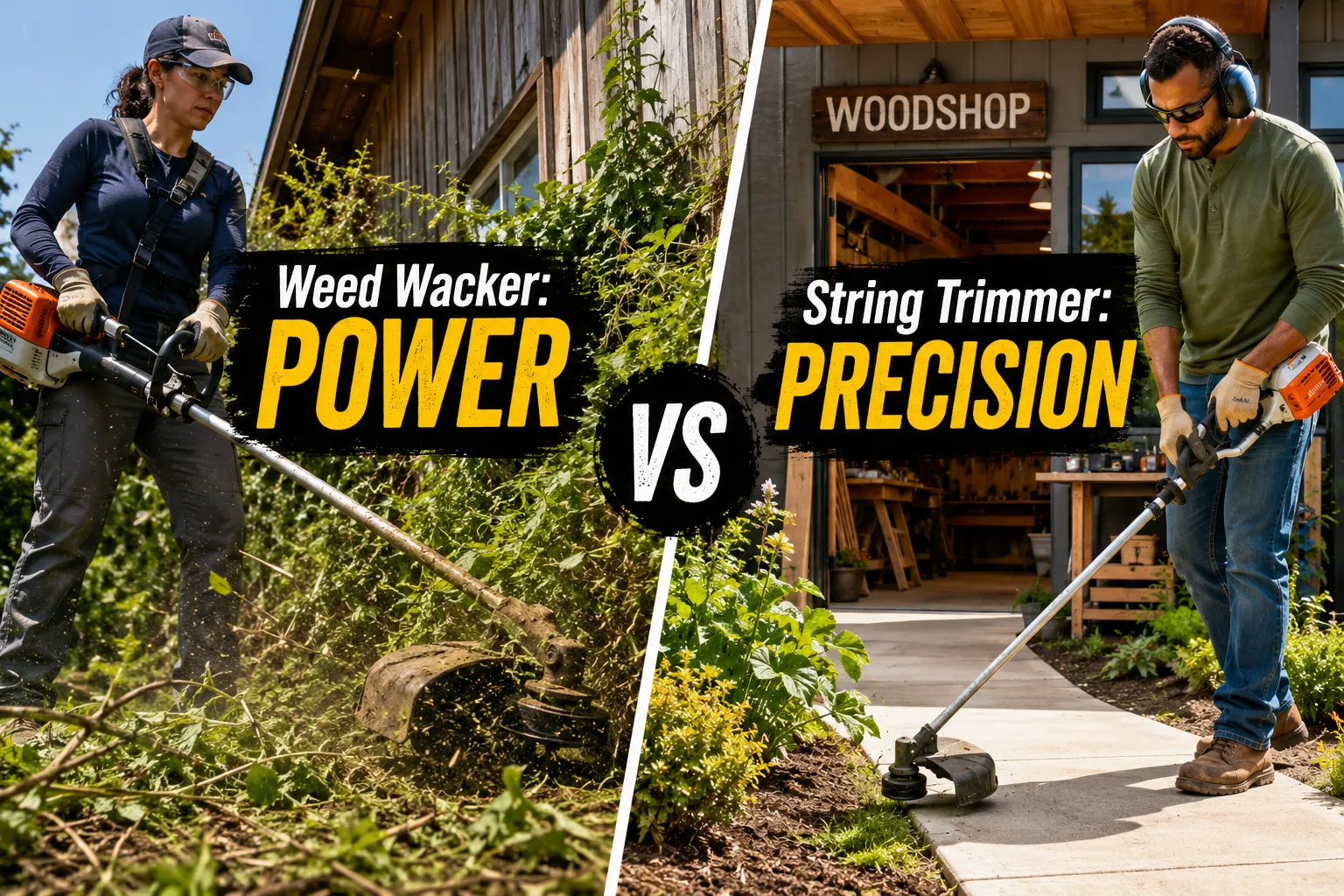
Though their names are frequently interchanged, particularly in American English, a clearer distinction exists for those seeking optimal outdoor maintenance tools. A string trimmer is the generic term for the handheld device that uses a spinning monofilament line to cut grass and weeds. Its primary function is to trim areas that lawnmowers cannot reach, such as around fences, trees, and garden beds, and to create crisp edges along driveways and sidewalks.
A weed wacker, on the other hand, often refers to a more heavy-duty version of a string trimmer, sometimes also called a brush cutter. These models typically feature more powerful engines, thicker cutting lines (or even metal blades), and are designed to tackle much denser, tougher vegetation, including woody weeds, thick brambles, and small saplings that would bog down a standard string trimmer. For a woodworking shop, especially one with a larger property or areas prone to aggressive growth, this distinction becomes highly relevant.
Consider the specific challenges presented by a woodworking shop’s exterior. You might have:
- Fine Edging: Neatly trimmed grass edges along pathways, the workshop foundation, or a patio where you might store lumber temporarily.
- Light Weeds: Grass and soft weeds growing around outdoor storage, lumber stacks, or along fence lines.
- Dense Overgrowth: Patches of thick weeds, thorny bushes, or even small volunteer saplings near undeveloped areas of the property or along a perimeter fence.
For fine edging and light weeds, a standard string trimmer is perfectly adequate. For dense overgrowth, the added power and robust cutting capabilities of a weed wacker (brush cutter) will be invaluable, preventing frustration and potential damage to a less powerful tool.
Key Performance Indicators to Consider
When evaluating models, look at these characteristics:
- Engine Size/Power Output: Measured in cubic centimeters (cc) for gas models or voltage/amps for electric. Higher numbers generally mean more power.
- Cutting Swath: The diameter of the area the line can cut in one pass. Larger swaths mean fewer passes, but can be less precise.
- Line Diameter: Thicker lines (e.g., 0.095 inches or more) are more durable and cut tougher material, while thinner lines (e.g., 0.065-0.080 inches) are better for delicate trimming and edging.
- Head Type:
- Bump Feed: You tap the head on the ground to advance more line. Common and generally reliable.
- Automatic Feed: Line feeds out automatically as it wears down, often via centrifugal force. Can be convenient but sometimes feeds too much or too little.
- Fixed Line: Requires manual replacement of pre-cut line segments. Durable but slower to reload.
- Shaft Type:
- Curved Shaft: Lighter, often less expensive, and good for shorter users doing light trimming.
- Straight Shaft: Longer reach, better for taller users, and often designed for heavier-duty tasks with more robust drive systems. Many brush cutters feature straight shafts.
- Attachments: Some models are multi-tool capable, allowing you to swap out the trimmer head for other attachments like edgers, pole saws, or even cultivators. This versatility can be a significant advantage for a woodworker who appreciates multi-purpose tools.
Powering Your Outdoor Maintenance: Gas, Corded Electric, or Cordless Electric
The choice of power source profoundly impacts a tool’s performance, portability, and maintenance requirements. Each option presents distinct advantages and disadvantages crucial for a woodworker to weigh when selecting the right tool for their specific needs.
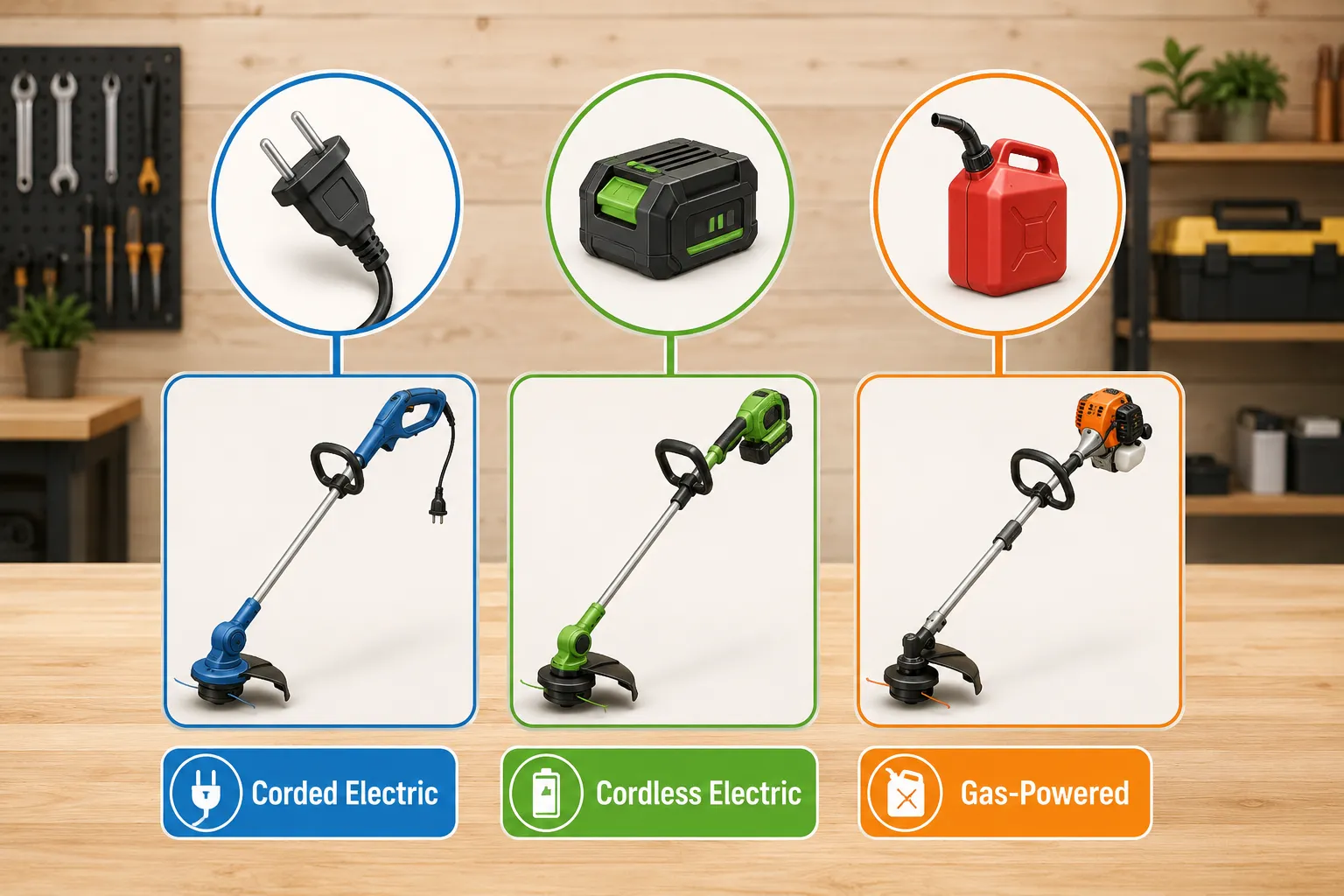
Gas-Powered String Trimmers/Weed Wackers
Pros:
- Maximum Power: Generally the most powerful option, ideal for heavy-duty tasks, dense brush, and large properties.
- Unlimited Mobility: Not restricted by cords or battery life, offering complete freedom of movement.
- Professional Choice: Preferred by many professional landscapers for their robust performance and durability.
Cons:
- Higher Maintenance: Require fuel mixing (for 2-stroke engines), spark plug changes, air filter cleaning, and carburetor adjustments.
- Noise and Emissions: Louder and produce exhaust fumes, which can be an issue in residential areas or for those sensitive to fumes.
- Heavier: Typically heavier than electric models, leading to more fatigue during prolonged use.
- Starting Difficulty: Can sometimes be temperamental to start, especially after storage.
Best for: Woodshops with large properties, significant areas of dense brush, or remote locations where electricity is not readily available.
Corded Electric String Trimmers
Pros:
- Lightweight and Easy to Use: Generally lighter and simpler to operate than gas models.
- No Fuel or Battery Concerns: Plug it in, and it’s ready to go. No refueling, recharging, or engine maintenance.
- Quieter and Emission-Free: A good choice for residential areas where noise and fumes are a concern.
- Lower Maintenance: Very few moving parts to maintain compared to gas.
Cons:
- Limited Mobility: Restricted by the length of the extension cord, which can be a nuisance to manage and a tripping hazard.
- Power Limitations: Typically less powerful than gas models, making them less suitable for very thick weeds or brush.
- Safety Hazard: Risk of cutting the cord, which can be dangerous.
Best for: Small to medium-sized woodshop properties with easy access to outdoor power outlets and lighter trimming tasks.
Cordless Electric (Battery-Powered) String Trimmers/Weed Wackers
Pros:
- Excellent Portability: Offers the freedom of gas models without the fuel, noise, or emissions.
- Lower Maintenance: Similar to corded electric, with minimal upkeep beyond battery charging.
- Quieter and Emission-Free: Environmentally friendly and pleasant to use.
- Instant Start: Press a button, and it’s ready.
- System Versatility: Many brands offer battery systems where the same battery can power multiple tools, including drills, saws, and other outdoor equipment. This is a significant advantage for a woodworker already invested in a brand like Ryobi or DeWalt, allowing them to expand their toolkit efficiently. You can learn more about specific tool selections for a small workshop by checking out “Selecting the Best Ryobi Power Tools for Small Workshop Setup.” or considering the broader comparison in “Ryobi vs. DeWalt for Beginner Woodworkers: Which Tool Line Should You Build Your Shop Around?”
Cons:
- Limited Run Time: Battery life can be a constraint, especially for larger jobs or dense growth. Spare batteries are often necessary.
- Charging Time: Batteries require time to recharge.
- Power Varies: While modern cordless tools are powerful, they might not match the raw output of high-end gas models, particularly for the most demanding brush-cutting tasks.
- Battery Cost: The initial investment in batteries and a charger can add significantly to the overall cost.
Best for: Most woodshops, balancing power, portability, and ease of use. Ideal for medium-sized properties and a mix of light to moderate trimming tasks, especially if you already own other battery-powered tools from the same manufacturer.
Choosing the Right Tool for Your Woodshop’s Outdoor Maintenance
Selecting the ideal tool boils down to a clear assessment of your specific needs, the nature of your property, and your preferences for power, maintenance, and noise.
Assess Your Property and Needs
Vegetation Type:
- Light Grass & Weeds, Edging: A standard string trimmer (corded electric or a lower-voltage cordless electric) will suffice. Look for models with a smaller line diameter.
- Thicker Weeds, Overgrown Areas, Small Brush: A more powerful cordless electric string trimmer (e.g., 40V or 80V systems) or a gas-powered string trimmer is appropriate. Consider models with a larger line diameter or a multi-tool head that can accept blades.
- Dense Woody Brush, Saplings: A dedicated weed wacker or brush cutter (typically gas-powered or high-voltage cordless) with the ability to use metal blades is essential.
Property Size:
- Small (under 1/4 acre): Corded electric or a single-battery cordless trimmer could be sufficient.
- Medium (1/4 to 1/2 acre): Cordless electric (with spare batteries) or a light-duty gas trimmer.
- Large (over 1/2 acre) or Rural: Gas-powered weed wacker/brush cutter or a high-capacity cordless system (multiple batteries, rapid charger).
Proximity to Power Outlets: If you have many outdoor outlets, corded electric is an option for smaller areas. For expansive areas, cordless or gas offers necessary freedom.
Noise and Emissions Tolerance: If your woodshop is in a quiet residential area or you prefer not to deal with fumes, electric models are a clear winner.

Practical Considerations for Woodshops
- Dust Control: Just as you prioritize dust collection inside your workshop, consider how outdoor maintenance kicks up dust and debris. A clean perimeter helps minimize what gets tracked inside.
- Fire Safety: Keeping grass and weeds trimmed around the workshop, especially if you deal with sawdust and wood shavings, is a crucial fire prevention measure. A robust weed wacker can clear dry, flammable vegetation quickly.
- Pest Management: Overgrown areas provide habitat for rodents and insects. Maintaining a clear perimeter helps deter pests from making their way into your shop.
- Tool Storage and Organization: Consider where you will store your trimmer. If space is tight, a multi-tool system where one powerhead accepts various attachments can save space compared to multiple dedicated tools. Efficient storage for all your tools, including outdoor maintenance equipment, can be optimized with solutions like a DIY Clamp Rack and Tool Holder Wall or a DIY Modular Storage System for Power Tool Accessories.
Table: Quick Selection Guide for Your Woodshop
| Feature | Standard String Trimmer | Heavy-Duty Weed Wacker / Brush Cutter |
|---|---|---|
| Primary Use | Edging, light trimming, around obstacles | Dense weeds, thick brush, small saplings |
| Power Source | Corded Electric, Cordless Electric, Gas (light) | Gas (medium to heavy), High-Voltage Cordless |
| Line Diameter | 0.065″ – 0.080″ | 0.095″ – 0.155″ (or metal blades) |
| Engine/Motor | Smaller cc, lower voltage/amps | Larger cc, higher voltage/amps |
| Weight | Lighter | Heavier |
| Cost | Lower | Higher |
| Maintenance | Low (Electric), Medium (Gas) | Medium to High (Gas) |
| Woodshop Scenario | Around foundation, walkways, garden beds | Clearing overgrown property lines, fence rows, undeveloped areas |
Ultimately, for most woodworkers maintaining a typical shop property in 2026, a high-quality cordless electric string trimmer is often the most versatile and practical choice. Look for one from a brand whose battery ecosystem you already own, offering sufficient power (e.g., 40V or higher) and the ability to handle both light trimming and moderately dense weeds. If you face truly aggressive, woody overgrowth, consider a dedicated gas-powered brush cutter or a high-end, commercial-grade cordless weed wacker.
Conclusion
The distinction between a standard string trimmer and a heavy-duty weed wacker (brush cutter) is more than semantic; it’s a practical guide to efficient and effective outdoor maintenance around your woodworking shop. By understanding your specific landscaping challenges, from delicate edging around a newly built entryway bench to reclaiming overgrown perimeters, you can choose the tool that best fits the job. For many, a powerful cordless electric string trimmer offers the ideal balance of convenience, mobility, and capability for maintaining a neat, safe, and professional-looking workshop environment. Invest in the right tool, prioritize safety, and keep your outdoor space as meticulously maintained as your indoor projects.