
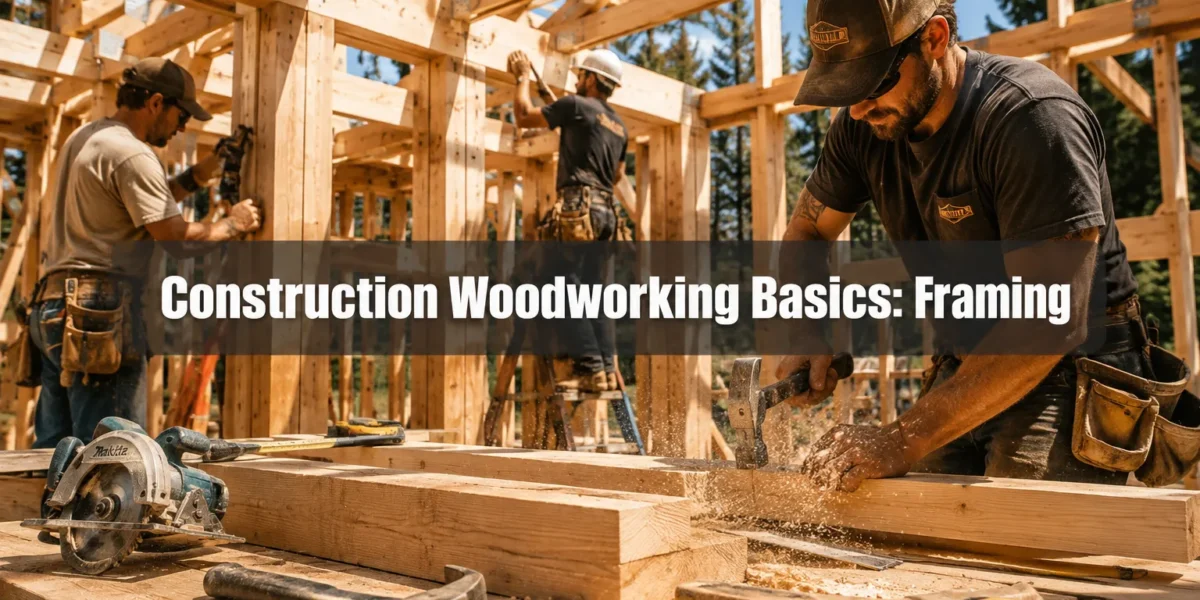
Over 80% of residential structures in North America rely on wood framing (NAHB, 2024), a testament to its enduring strength and versatility. Yet, for many aspiring woodworkers, understanding the fundamental principles behind robust construction, from basic framing to intricate structural joinery and the design of load-bearing furniture, remains a significant hurdle. Mastering these Construction Woodworking Basics: Framing, Structural Joinery, and Load-Bearing Furniture Design is not merely about assembling wood; it is about comprehending the forces at play, selecting the right materials, and executing techniques that guarantee safety, durability, and longevity. This article delves into these essential concepts, providing a foundation for anyone looking to build confidently and competently.
Key Takeaways
- Framing is the Skeleton: Wood framing creates the structural backbone of buildings and large furniture, distributing loads efficiently.
- Joinery is the Art of Connection: Structural joinery techniques like mortise and tenon are vital for creating strong, durable wood connections without relying solely on fasteners.
- Load-Bearing Design is Critical: Furniture and structures must be designed to safely support anticipated weights, considering material properties and joint strength.
- Material Selection Matters: Choosing the correct wood species, dimensions, and fasteners is paramount for structural integrity.
- Accuracy and Practice: Precision in measurements, cuts, and assembly is fundamental to achieving strong, reliable woodworking outcomes.
Understanding Basic Framing in Construction Woodworking
Framing is the process of constructing the skeletal framework of a building or a substantial wooden structure. This framework, typically made from dimensional lumber, provides the necessary support for walls, floors, roofs, and other components, transferring loads down to the foundation. Without a properly executed frame, a structure is susceptible to collapse, instability, or premature wear.
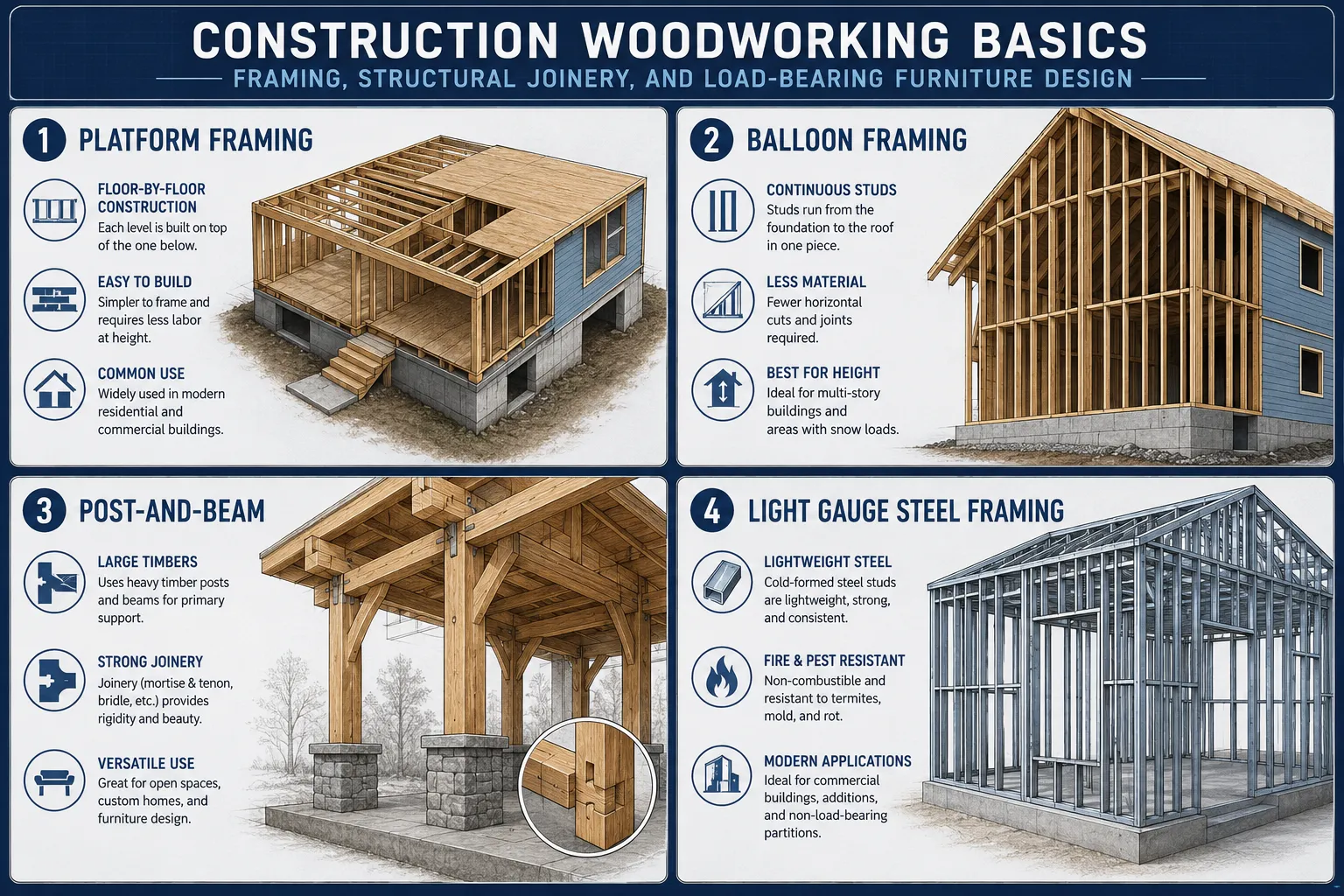
The primary goal of framing is to create a rigid, stable, and strong structure capable of resisting various forces: vertical loads (gravity), lateral loads (wind, seismic activity), and torsional loads. The design must account for the specific application, whether it’s a house, a shed, or a heavy-duty workbench.
Common Framing Methods
While building codes and regional practices vary, several fundamental framing methods are widely used in construction woodworking:
Platform Framing: This is the most prevalent method for residential construction in North America. Each story is framed independently.
- Process: A floor platform is built on top of the foundation or the previous story’s walls. Walls for that story are then constructed on this platform. This process repeats for subsequent stories.
- Advantages: Relatively easy to construct, allows for shorter stud lengths, and fire breaks naturally occur at each floor level.
- Disadvantages: Requires precise leveling at each floor and can lead to more wood shrinkage if not properly managed.
Balloon Framing: Once common, this method is less frequently used today due to fire safety concerns and material efficiency.
- Process: Exterior wall studs extend continuously from the sill plate (foundation) to the roof plate, often spanning multiple stories. Floor joists are then nailed to the sides of these long studs.
- Advantages: Creates very rigid walls with minimal shrinkage.
- Disadvantages: Requires very long, straight studs which are harder to source; continuous voids within walls can act as chimneys in a fire.
Post-and-Beam Framing: A traditional method gaining renewed interest, especially for its aesthetic appeal and structural robustness.
- Process: Utilizes large, heavy timbers (posts) that run vertically and are connected by horizontal beams. The structural integrity comes from the robust connections (joinery) between these large members, rather than many smaller, closely spaced studs.
- Advantages: Creates open interior spaces, offers exceptional strength, and showcases natural wood aesthetics.
- Disadvantages: Requires heavier lifting equipment, specialized joinery skills, and more expensive, larger timbers.
Essential Components of Wood Framing
Regardless of the method, certain components are universal to wood framing:
- Studs: Vertical members that form walls and support loads from above.
- Joists: Horizontal members that support floors and ceilings.
- Rafters/Trusses: Members that form the roof structure.
- Plates: Horizontal members at the top and bottom of walls (sole plate/bottom plate, top plate) that connect studs and distribute loads.
- Headers/Lintels: Horizontal members above openings (windows, doors) that transfer loads around the opening to adjacent studs.
- Sills: Horizontal members at the bottom of window openings.
Proper layout, accurate cuts, and secure fastening are paramount for structural integrity. Using appropriate fasteners, such as construction screws or nails, is critical. For more on fasteners, you can explore resources like this article on Woodworking Fasteners.
Structural Joinery: The Backbone of Woodworking
Structural joinery refers to the methods used to connect two or more pieces of wood in a way that creates a strong, stable, and load-bearing assembly. Unlike simple butt joints reinforced with screws or plates, traditional structural joinery relies on interlocking wood fibers and carefully engineered geometric shapes to resist forces. This approach results in connections that are often stronger than the wood itself, distribute stress efficiently, and can even be disassembled if needed.
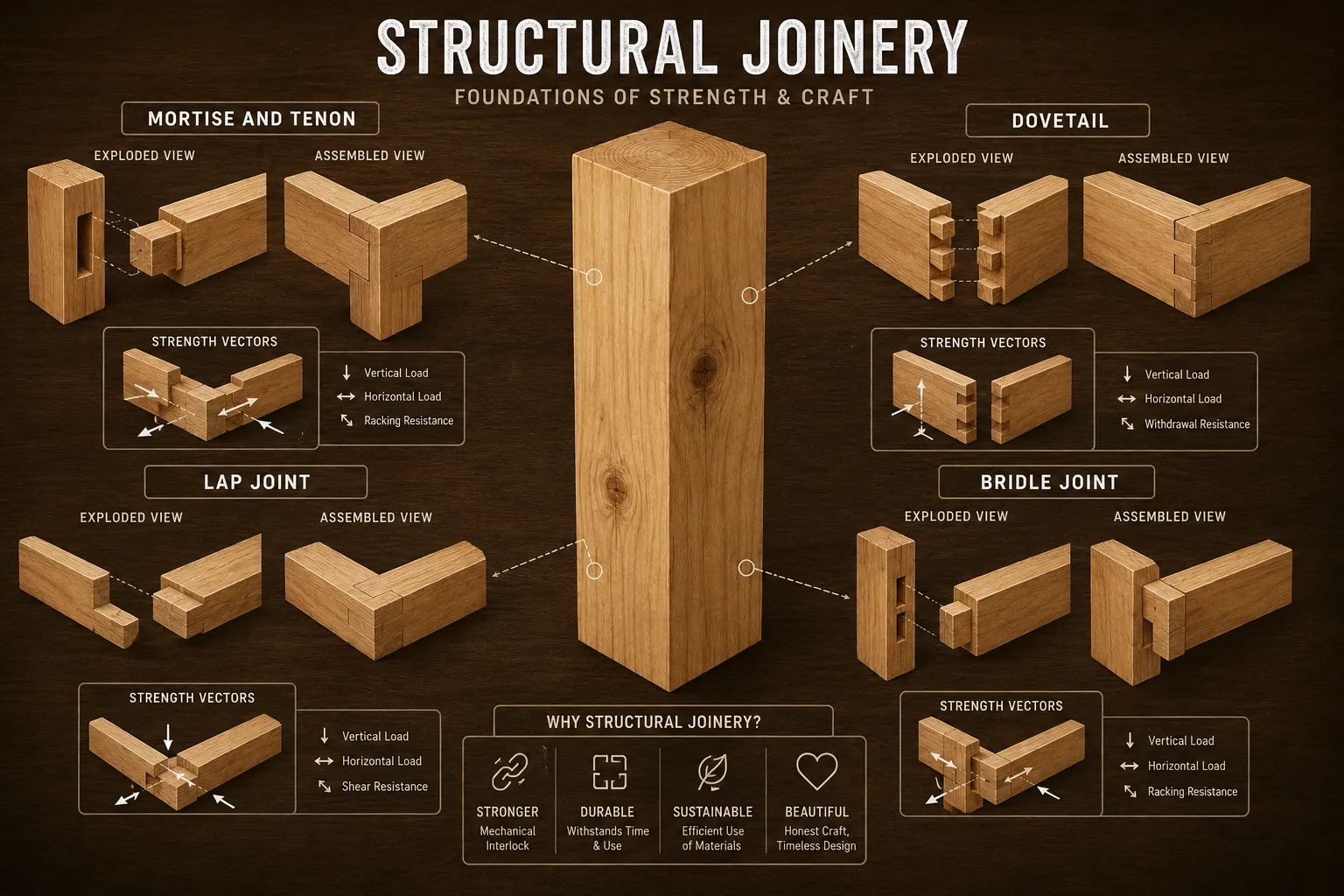
The effectiveness of a joint depends on its ability to resist tension, compression, shear, and torsion. The choice of joint is crucial, especially in load-bearing furniture design or heavy structural components where failure is not an option.
Key Structural Joinery Techniques
For robust construction, several joinery types stand out:
Mortise and Tenon Joint:
- Description: A classic, incredibly strong joint where a rectangular projection (tenon) on one piece fits precisely into a corresponding rectangular hole (mortise) in another.
- Applications: Ideal for connecting rails to legs in tables, chairs, and beds; also vital in timber framing.
- Strength: Excellent resistance to racking (sideways movement), tension, and compression, especially when shoulders are tight.
- Learn More: For a deeper dive, see our Beginners Guide to Hand Cut Mortise and Tenon Joints.
Dovetail Joint:
- Description: Characterized by interlocking “pins” and “tails” that resemble a dove’s tail.
- Applications: Primarily used in drawer boxes, case construction, and any application requiring strong resistance to pulling forces (tensile strength).
- Strength: Unmatched in tensile strength, making it very difficult to pull apart. Less critical for pure compression.
Lap Joint:
- Description: Formed by cutting away half the thickness from each of two pieces of wood so they overlap and create a flush surface when joined.
- Variations: Full lap, half lap, cross lap.
- Applications: Frames, simple assemblies, and situations where two pieces need to meet flush.
- Strength: Good in shear and compression, but weaker in tension unless reinforced.
Bridle Joint:
- Description: Similar to a mortise and tenon, but the tenon extends across the full width of the piece, and the mortise is essentially an open slot.
- Applications: Frame and panel construction, table legs where maximum shoulder bearing is desired, or whenever you need strong corner joints.
- Strength: Offers excellent gluing surface and strong resistance to racking, often used where the joint will be visible.
Modern Approaches to Joinery
While traditional joinery remains foundational, modern woodworking often blends classic techniques with contemporary tools and materials. Hybrid joinery, for instance, can combine the elegance of a hand-cut joint with the precision of CNC machining or the strength of metal connectors. Exploring hybrid joinery tutorials can open up new possibilities for strong and efficient construction. Regardless of the method, the precision of your cuts, the quality of your glue, and the proper clamping pressure are all critical to the strength and longevity of any joint.
Load-Bearing Furniture Design: Applying Structural Principles
Designing load-bearing furniture moves beyond aesthetics; it’s an engineering challenge that requires a deep understanding of how materials behave under stress and how joints distribute those forces. A coffee table, a dining table, a chair, or a bookshelf all must support significant weight safely over time. This section focuses on translating the principles of Construction Woodworking Basics: Framing and Structural Joinery into functional, durable furniture.
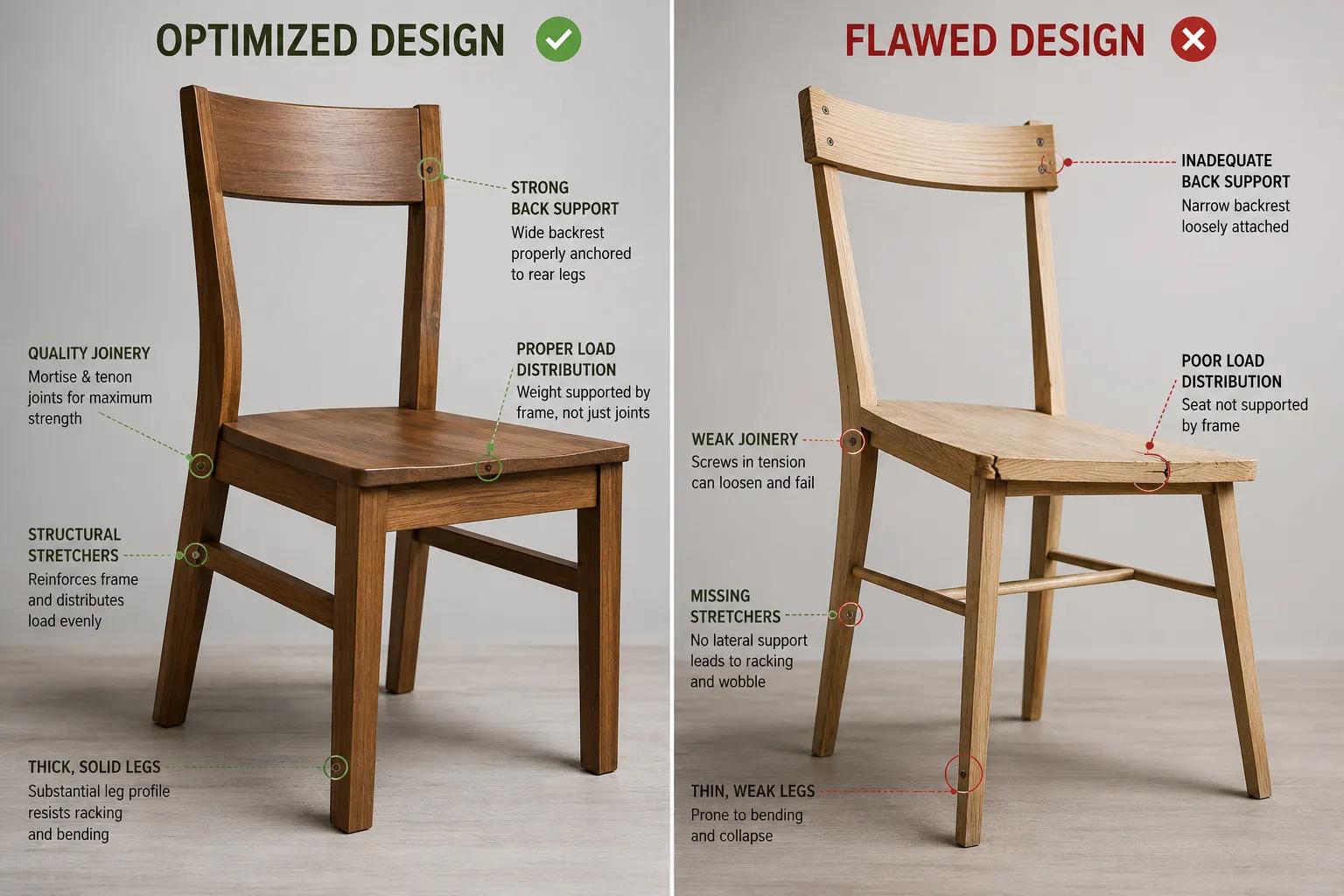
The goal is to create pieces that not only look good but also provide reliable support for their intended use. This involves careful consideration of wood species, dimensioning, joint selection, and overall structural geometry.
Key Considerations in Load-Bearing Furniture Design
Anticipating Loads:
- Static Loads: The constant weight of the furniture itself plus any items placed on it (e.g., books on a shelf, a person sitting on a chair).
- Dynamic Loads: Temporary or moving forces, such as someone sitting down heavily on a chair, items being slid across a table, or even shifting weight. These can exert greater stress than static loads.
- Impact Loads: Sudden, sharp forces, like an object being dropped onto a surface.
Wood Species Selection:
- Different woods have varying strengths, densities, and stiffness. Hardwoods like oak, maple, and walnut offer superior strength and durability for load-bearing applications compared to softer woods like pine, though pine can be sufficient for lighter loads if appropriately dimensioned. For premium projects, considering premium wood selection for 2026 projects is beneficial.
Dimensioning and Proportions:
- Thickness: Thicker components are generally stronger. For tabletops, adequate thickness prevents sagging. For legs, thickness provides stability and resists buckling.
- Width/Depth: Wider or deeper components offer more resistance to bending and racking. For example, a wider rail connecting two legs provides more stability.
- Span: The unsupported distance between two supports. Longer spans require thicker, deeper, or reinforced members to prevent deflection.
Joint Selection for Specific Stresses:
- Compression: Butt joints reinforced with screws or dowels can suffice for purely compressive loads (e.g., column-like elements), but a mortise and tenon offers superior strength.
- Tension: Dovetails are excellent for resisting pulling apart, while through tenons can also provide good tensile strength.
- Shear: Lap joints and mortise and tenons are effective against forces that try to slide one piece past another.
- Racking/Torsion: Mortise and tenon joints, along with diagonal bracing (e.g., corner blocks or stretchers), are critical for preventing furniture from twisting or collapsing sideways.
Structural Geometry and Bracing:
- Triangulation: Introducing triangular elements or bracing significantly increases rigidity and prevents racking. Think of cross-braces on a bookshelf or trestle table.
- Stretchers: Horizontal members connecting legs of tables or chairs enhance stability and transfer loads, particularly in dining tables. For examples, see our guide to dining tables.
- Leg Splay: Legs that angle outwards at the base offer a wider footprint, improving stability and resistance to tipping.
Fastener Reinforcement (When Necessary):
- While joinery should bear the primary load, screws, bolts, and dowels can reinforce joints, especially where traditional joinery is impractical or for knockdown furniture. However, never rely solely on fasteners for critical structural connections without proper joinery or gussets. Proper use of woodworking fasteners can greatly enhance a design.
By meticulously planning and executing each of these elements, woodworkers can create not just beautiful furniture, but also incredibly strong and safe pieces that will last for generations. From building sturdy custom bar stools to round dining tables for small spaces, these principles are universally applicable.
Conclusion
Mastering Construction Woodworking Basics: Framing, Structural Joinery, and Load-Bearing Furniture Design is an ongoing journey that merges age-old wisdom with modern understanding. The principles of framing provide the blueprint for large-scale stability, while structural joinery offers the elegant, interlocking connections that ensure durability without sole reliance on mechanical fasteners. Applying these concepts to load-bearing furniture design transforms a simple idea into a robust, functional, and enduring piece.
As you embark on or continue your woodworking projects in 2026, remember that precision, thoughtful material selection, and an understanding of physics are your most valuable tools. From the initial concept sketch to the final assembly, every decision impacts the structural integrity and longevity of your work. Embrace the challenge, hone your skills, and build with the confidence that comes from a solid foundational knowledge.
Actionable Next Steps:
- Study Joint Strength: Research different joint types and their specific strengths against various forces (tension, compression, shear, torsion).
- Practice Layout and Cutting: Precision is paramount. Practice marking out and cutting various joints on scrap wood until accuracy becomes second nature.
- Analyze Existing Structures: Examine the framing of buildings or the joinery in well-made furniture to understand how these principles are applied in real-world scenarios.
- Start Small, Build Up: Begin with smaller, less critical load-bearing projects (like a simple stool or shelf) before tackling larger structures or more complex furniture pieces.
- Consult Resources: Continuously refer to woodworking guides, building codes, and expert advice to deepen your understanding and ensure safety.
SEO Meta Title: Construction Woodworking: Framing, Joinery & Furniture Design Basics SEO Meta Description: Master construction woodworking basics in 2026, from essential framing methods and robust structural joinery to designing durable, load-bearing furniture.