
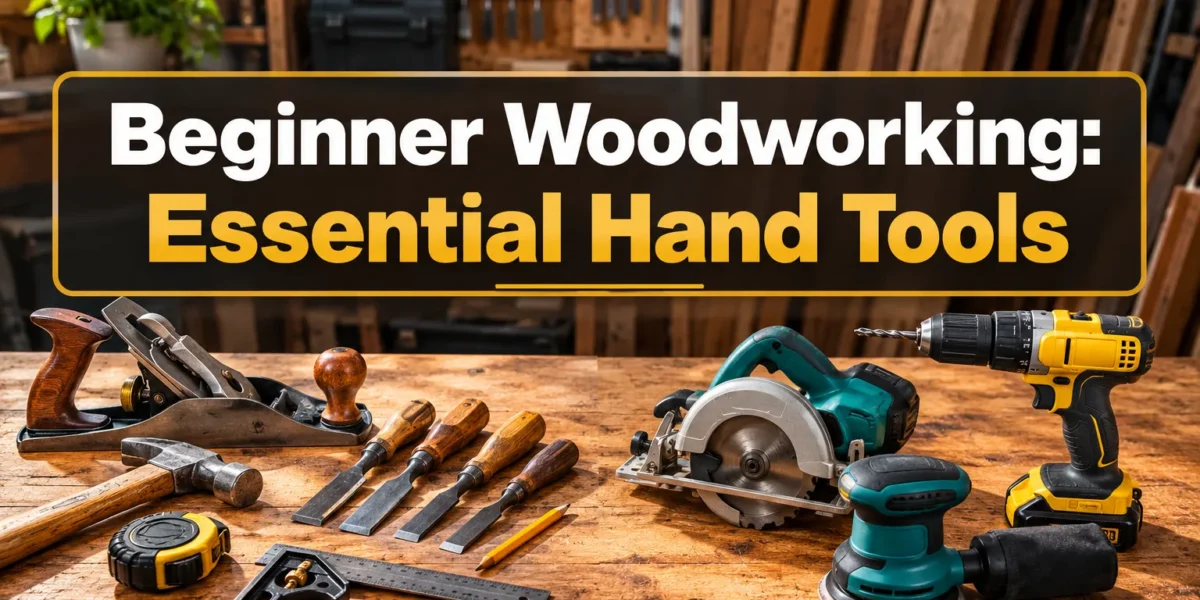
The scent of sawdust, the satisfying thud of a well-seated joint, the smooth finish on a piece of newly crafted wood, these are the hallmarks of woodworking. For many, the dream of creating functional and beautiful items from timber begins with a single, pivotal question: for Beginner Woodworking: Essential Hand Tools vs. Power Tools, Which Should You Buy First? This decision can shape your entire journey, influencing everything from the types of projects you tackle to the skills you develop and the budget you allocate. This guide will navigate the nuanced landscape of both approaches, helping you make an informed choice that aligns with your woodworking aspirations in 2026.
Key Takeaways
- Hand Tools Offer Foundational Skill Development: Hand tools build precision, patience, and a deep understanding of wood grain, often with a lower initial cost for basic setups.
- Power Tools Provide Speed and Efficiency: Power tools accelerate production, making cuts and shaping easier, ideal for larger projects or higher volume, but require a greater initial investment and emphasis on safety.
- Space and Noise are Key Considerations: Hand tools require minimal space and generate less noise, suitable for shared living areas; power tools often demand more dedicated space and produce significant noise and dust.
- Safety is Paramount with Both: While power tools present obvious immediate hazards, hand tools also demand respect and proper technique to prevent injury.
- A Hybrid Approach is Often Best: Many woodworkers find a balance, using essential hand tools for finesse and detail, and power tools for rough cuts and dimensioning.
Beginner Woodworking: Essential Hand Tools vs. Power Tools, Making Your First Purchases
Embarking on a woodworking journey is exciting, but the sheer volume of tools available can be overwhelming. Should you lean into the quiet, methodical world of traditional hand tools, or embrace the speed and power of modern machinery? For Beginner Woodworking: Essential Hand Tools vs. Power Tools, Which Should You Buy First? is not a simple either/or proposition; it’s about understanding your goals, budget, available space, and tolerance for a learning curve. Both avenues offer unique benefits and challenges.
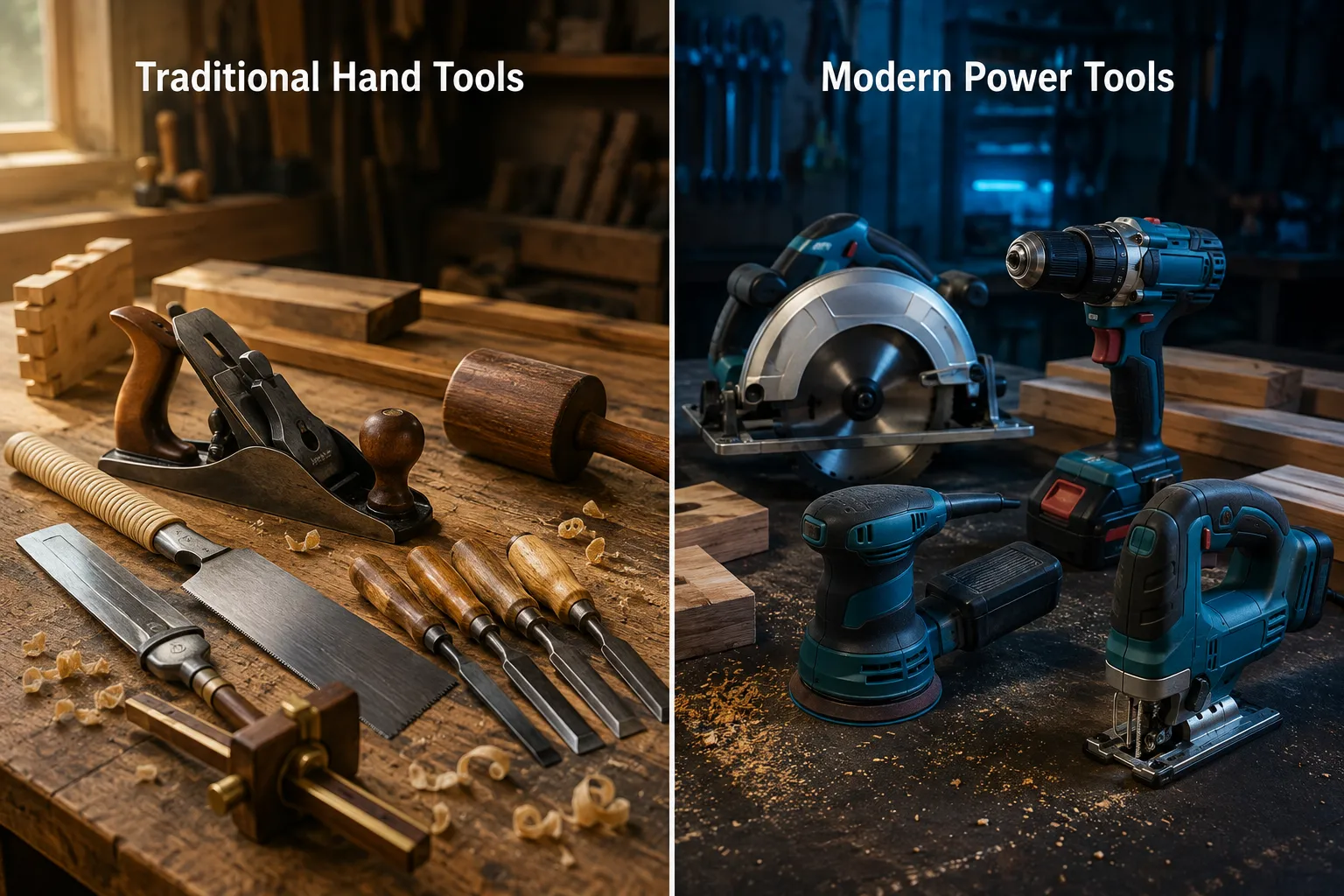
Hand tools provide a direct connection to the material. They demand a slower, more deliberate pace, fostering patience and precision. Working with hand planes, chisels, and saws teaches you to “read” the wood, understanding its grain and how it responds to different forces. This intimate interaction builds fundamental skills that translate well, even if you eventually incorporate power tools. The initial investment for a basic set of quality hand tools can often be lower than for comparable power tools, though high-end hand tools can be expensive. Think about a simple set of chisels, a Japanese pull saw, and a marking gauge, these can tackle numerous projects. To learn more about getting started without power, explore our Introduction To Traditional Hand Tool Woodworking Essential Tools And First Projects Without Power.
Power tools, on the other hand, prioritize efficiency and speed. They can rip through boards, make precise dados, and sand large surfaces in a fraction of the time it would take with hand tools. This means you can complete projects faster and often with less physical effort. For those looking to build larger furniture pieces or tackle multiple projects, power tools can be invaluable. However, they come with a higher entry cost, require dedicated space (often a workshop with proper dust collection), and introduce significant safety considerations due to their speed and cutting power. Understanding how to select and use these tools safely is crucial.
Ultimately, the best path for a beginner depends on personal preference and practical circumstances. Many experienced woodworkers advocate starting with a solid foundation in hand tools to develop crucial skills before introducing power tools. This approach builds a deeper understanding of the craft. Others, particularly those with limited time or ambitious projects, might find power tools more immediately gratifying.
Advantages and Disadvantages of Hand Tools
| Aspect | Advantages | Disadvantages |
|---|---|---|
| Cost | Lower initial investment for a functional basic set. | High-quality hand tools can still be expensive; sharpening supplies needed. |
| Noise | Extremely quiet, ideal for shared spaces or late-night work. | None. |
| Dust | Minimal dust production, mostly chips and shavings. | None. |
| Space | Requires minimal workshop space. | None. |
| Skill Dev. | Builds fundamental understanding of wood, precision, and patience. | Steeper learning curve for mastering techniques. |
| Portability | Highly portable, can work almost anywhere. | None. |
| Safety | Fewer immediate catastrophic risks; injuries tend to be less severe (cuts). | Can still cause serious cuts if not used correctly. |
| Speed | Slower, more meditative process. | Time-consuming for large or repetitive tasks. |
A core benefit of hand tools lies in their ability to foster a deeper connection to the material. When you cut a dovetail joint by hand, for instance, you learn about the wood’s resistance, its grain direction, and the feel of a sharp chisel biting into the fibers. This tactile feedback is invaluable. Hand tools also offer superior control for fine details and delicate work. The Complete Guide To Hand Tool Joinery Crafting Strong And Beautiful Joints Without Power Tools offers excellent guidance on this. Moreover, for those living in apartments or shared living spaces, the minimal noise and dust generated by hand tools are significant advantages.
Advantages and Disadvantages of Power Tools
| Aspect | Advantages | Disadvantages |
|---|---|---|
| Cost | Efficient for high-volume production; can offer precision with jigs. | Higher initial investment for tools, accessories, and safety gear. |
| Noise | Rapid material removal, efficient for large projects and repetitive tasks. | Very loud, requires hearing protection. |
| Dust | Can be equipped with dust collection systems. | Generates significant fine dust, requiring robust dust collection and masks. |
| Space | Machines often require dedicated space; some are bulky. | None. |
| Skill Dev. | Faster results, but may bypass fundamental wood knowledge if relied upon solely. | Can create a dependency, potentially hindering foundational skill development. |
| Portability | Some smaller tools are portable, but larger ones are not. | None. |
| Safety | Faster work, but demands strict adherence to safety protocols and PPE. | High potential for severe injury if not handled correctly. |
| Speed | Excellent for dimensioning lumber, cutting dados, and shaping. | Can quickly remove too much material, less forgiving for errors. |
Power tools shine when it comes to efficiency and processing larger volumes of material. A circular saw can break down sheet goods in minutes, and a router can create consistent joinery with ease. For projects like building a bookcase or a dining table, the speed advantage of power tools is undeniable. Modern power tools also often come with features that enhance precision, such as laser guides and adjustable fences. However, the investment is substantial, not just for the tools themselves, but also for essential safety gear (eyewear, hearing protection, respirators) and a robust dust collection system. For examples of good entry-level power tools, check out Selecting the Best Ryobi Power Tools for Small Workshop Setup.
Choosing Your First Tools: A Practical Approach for Beginner Woodworking: Essential Hand Tools vs. Power Tools, Which Should You Buy First?
When deciding on Beginner Woodworking: Essential Hand Tools vs. Power Tools, Which Should You Buy First?, it’s essential to evaluate your individual circumstances and future woodworking goals. Rather than viewing it as an exclusive choice, consider a practical approach that might involve a gradual integration or a strategic focus.
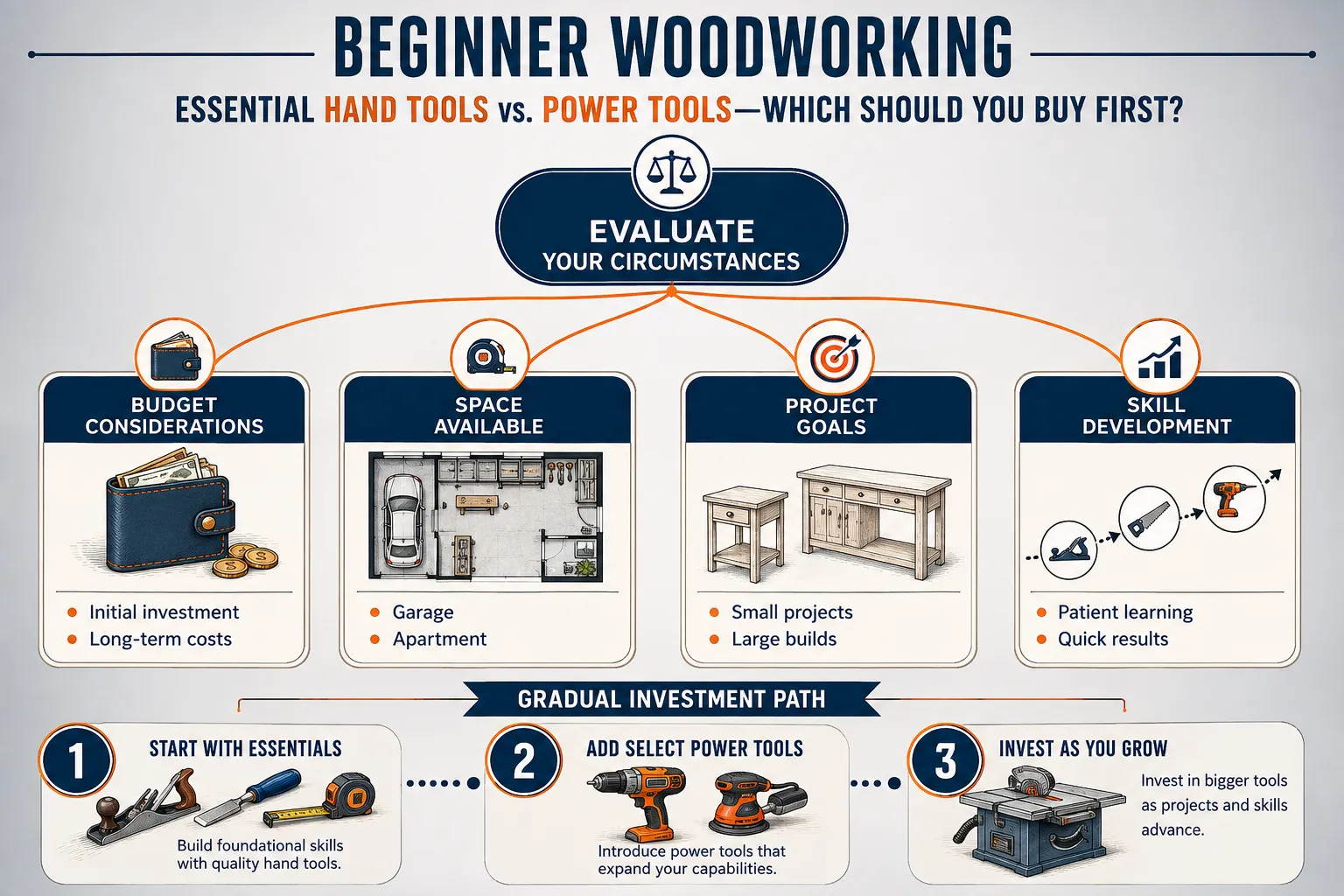
Assessing Your Needs and Resources
- Budget:
- Hand Tools: A basic, functional starter set (saw, chisels, marking tools, sharpening stone) can be assembled for $150-$300.
- Power Tools: Even entry-level power tools (circular saw, drill, sander) will likely cost $400-$800, plus accessories and safety gear.
- Space:
- Hand Tools: Require minimal storage and working space. A workbench and a few feet of clear area are often sufficient.
- Power Tools: Larger machines like table saws, miter saws, or planers need dedicated floor space. Dust collection systems also require room. Consider if you have a garage, basement, or a corner of a spare room.
- Noise Tolerance:
- Hand Tools: Virtually silent, making them suitable for any environment, any time of day.
- Power Tools: Very loud, requiring hearing protection and potentially disturbing neighbors or family members.
- Learning Style/Patience:
- Hand Tools: Demands patience, focus, and a willingness to master precise techniques. The learning curve can be steep but rewarding.
- Power Tools: Often provides quicker results, but still requires learning proper and safe operating procedures. Errors can be more catastrophic.
For those with limited space or a desire for a quieter, more tactile experience, starting with hand tools is an excellent option. You can achieve remarkable results with a modest set of tools and a good workbench. Consider investing in quality tools that can be sharpened and maintained, such as a good set of chisels and a reliable hand plane. Our guide on Essential Hand Tools For Every Woodworker A Comprehensive Guide To Selection Sharpening And Maintenance can help you choose.
If your ambition involves larger projects, faster production, or you have a dedicated workshop space, a few essential power tools can be incredibly beneficial. A cordless drill/driver is almost universally recommended for its versatility. A circular saw can handle initial dimensioning of lumber, and a random orbit sander will drastically speed up finishing.
Recommended Starter Sets for Both Approaches
Essential Hand Tools Starter Kit (Approx. $150-$300)
- Measuring and Marking Tools:
- Tape Measure (25 ft)
- Combination Square (12 inch)
- Marking Knife or Pencil
- Layout Square or Speed Square
- Saws:
- Japanese Pull Saw (Ryoba or Dozuki for fine cuts and crosscuts)
- Coping Saw (for curves)
- Chisels:
- Set of 3-5 Bevel-Edged Chisels (1/4″, 1/2″, 3/4″, 1″)
- Mallet
- Planes:
- Block Plane (for chamfers, small trimming)
- No. 4 Bench Plane (for surfacing, jointing)
- Sharpening Supplies:
- Combination Sharpening Stone (coarse/fine) or Diamond Stones
- Strop and Honing Compound
- Honing Guide
- Clamps:
- At least 4 F-style clamps (12-inch)
- 2 Bar clamps (24-inch)
Essential Power Tools Starter Kit (Approx. $400-$800, plus safety gear)
- Measuring and Marking Tools: (Same as hand tools)
- Tape Measure (25 ft)
- Combination Square (12 inch)
- Marking Pencil
- Cutting Tools:
- Cordless Circular Saw (18V or 20V)
- Jigsaw (for curves and interior cuts)
- Drilling:
- Cordless Drill/Driver (18V or 20V)
- Basic Drill Bit Set
- Sanding:
- Random Orbit Sander (5-inch)
- Assorted Sandpaper (80, 120, 180, 220 grit)
- Clamps:
- At least 4 F-style clamps (12-inch)
- 2 Bar clamps (24-inch)
- Safety Gear (Crucial!):
- Safety Glasses
- Hearing Protection (earmuffs or plugs)
- Dust Mask or Respirator
Remember, these are starting points. As you gain experience, you’ll naturally gravitate towards specific tools that enhance your workflow. The key is to start small, build your skills, and then expand your toolset strategically.
The Hybrid Approach: Combining the Best of Both Worlds in Beginner Woodworking: Essential Hand Tools vs. Power Tools, Which Should You Buy First?
For many woodworkers, especially as they progress beyond initial projects, the answer to Beginner Woodworking: Essential Hand Tools vs. Power Tools, Which Should You Buy First? isn’t an either/or, but rather a strategic blend. The hybrid approach leverages the strengths of both categories, allowing for efficiency where needed and precision where desired. This often proves to be the most practical and rewarding long-term strategy.
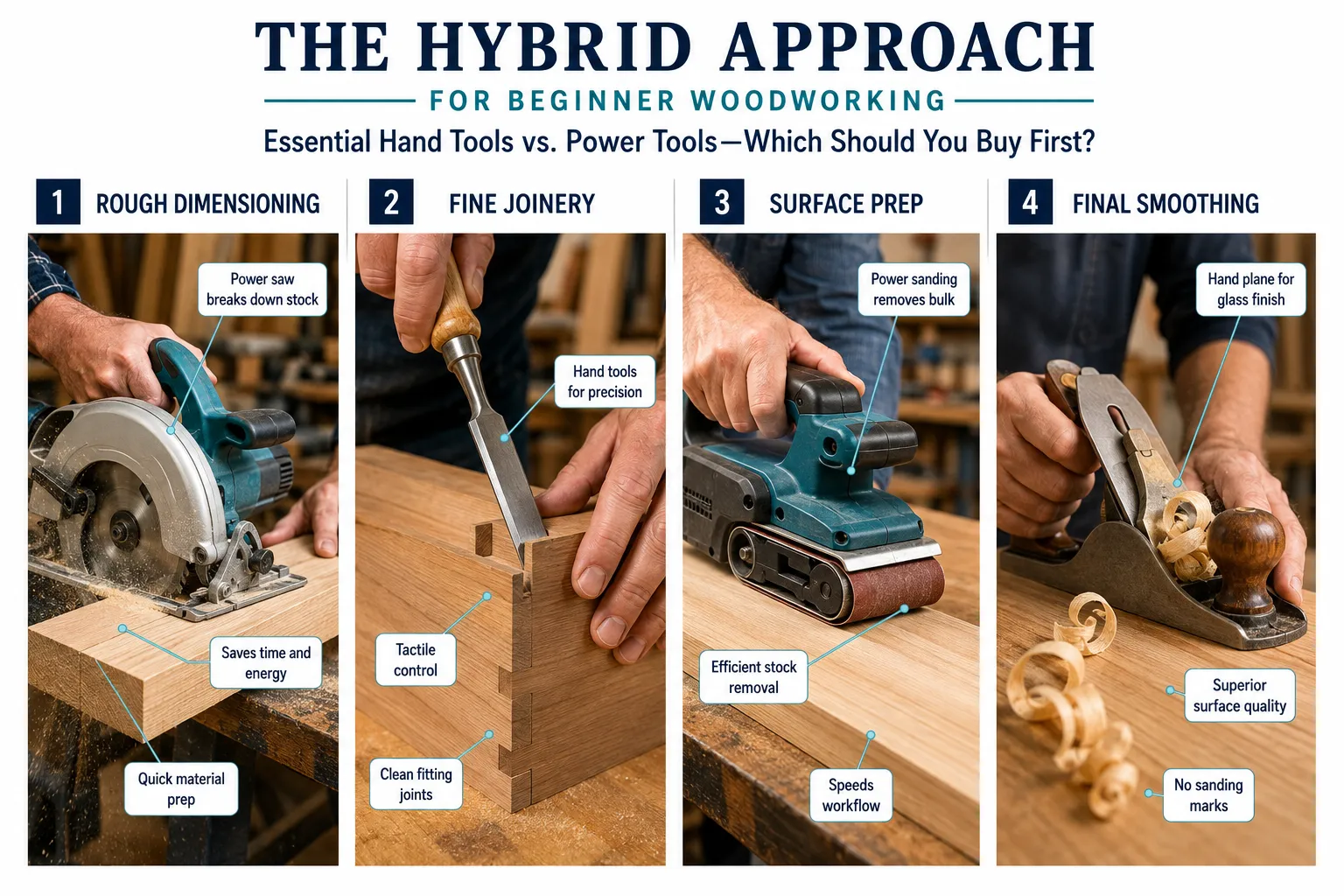
Think of it this way: power tools excel at the rough, repetitive, and dimensioning tasks. A table saw quickly cuts boards to width and length. A planer rapidly flattens rough lumber. A router creates consistent joinery or decorative edges. These tasks, when done by hand, are extremely time-consuming and physically demanding, especially for larger pieces.
However, hand tools often provide superior control for critical, fine-tuning operations. A sharp hand plane can shave off micro-thin curls of wood, bringing a joint to a perfect fit or achieving an unparalleled surface finish. Chisels allow for precise mortise and tenon joinery or dovetails that exude craftsmanship. Even when using power tools for most of a project, a hand plane or a set of chisels can be indispensable for making small adjustments or adding delicate details. For example, after cutting a dado with a router, a chisel might be used to square up the corners.
Examples of a Hybrid Workflow
- Dimensioning Lumber: Use a circular saw or miter saw to rough-cut lumber to length and width.
- Joint Preparation: Use a router to cut mortises or tenons, then refine and fit them with hand chisels for a perfect, tight joint. Explore Introduction To Traditional Hand Tool Joinery Exploring Mortise And Tenon With Chisels And Saws for more on this.
- Surface Preparation: Use a power planer or jointer for initial flattening and straightening of boards, then finish with a hand plane for a truly smooth, burnished surface free of sanding marks.
- Sanding: Power sanders do the bulk of the work, but hand sanding can be crucial for intricate areas or to achieve a final, glass-like finish.
This integrated approach allows beginners to tackle a wider range of projects, learn both mechanical and traditional skills, and ultimately produce higher-quality work. It often means starting with a few crucial tools from each category, rather than trying to build out a complete set of one type. For instance, a cordless drill/driver and a random orbit sander might be your first power tools, paired with a good set of chisels and a Japanese hand saw. This gives you a versatile foundation for many common woodworking tasks.
Ultimately, the journey of Beginner Woodworking: Essential Hand Tools vs. Power Tools, Which Should You Buy First? is an ongoing one. As you develop your skills and identify your preferred style of working, your tool collection will naturally evolve. Don’t be afraid to experiment, learn from others, and adapt your approach to suit each project. The most important thing is to enjoy the process of creating with wood.
Conclusion
The decision of whether to invest in essential hand tools or power tools first for beginner woodworking is a foundational one that shapes your initial experience and skill development. While hand tools foster patience, precision, and a deep connection to the material with a lower initial cost and less noise/dust, power tools offer speed, efficiency, and the ability to tackle larger projects more quickly, albeit with a higher investment and greater safety considerations.
There’s no single “right” answer that applies to everyone in 2026. Your ideal starting point depends on your budget, available workshop space, noise tolerance, and personal learning style. Many experienced woodworkers advocate for starting with a basic set of quality hand tools to develop fundamental skills before incorporating power tools. This hybrid approach often provides the most balanced and rewarding woodworking experience, combining the efficiency of machines with the finesse of handcraft.
For your next steps, consider:
- Assess Your Resources: Look at your budget and available space. Are you working in a small apartment or a dedicated garage?
- Define Your First Project: What do you want to build? Simple projects like a small box or a cutting board can be achieved with a minimal hand tool set. Larger projects might benefit from entry-level power tools.
- Prioritize Quality Over Quantity: Whether hand or power, invest in good quality tools. They will perform better, last longer, and be safer to use.
- Embrace Learning: Watch videos, read articles, and take a local class if possible. Learn proper techniques and, crucially, safety protocols for whichever tools you choose.
- Start Small, Expand Gradually: You don’t need every tool right away. Begin with the essentials and add more as your skills and projects demand.
Remember, woodworking is a journey of continuous learning and creation. The tools you choose are merely extensions of your will to shape wood.
SEO Meta Title: Beginner Woodworking Tools: Hand vs. Power, Which to Buy First? SEO Meta Description: Deciding between hand tools and power tools for beginner woodworking in 2026? This guide compares pros, cons, costs, and skills to help you choose wisely.