
The perception that fine furniture joinery begins and ends with basic dovetails overlooks a vast and intricate world of woodworking craftsmanship. While dovetails are undeniably strong and beautiful, truly exceptional fine furniture demands a mastery of advanced wood joinery techniques that move beyond the fundamental. This article explores the sophisticated realm of Advanced Wood Joinery for Fine Furniture: Beyond Basic Dovetails for Strength and Aesthetics, delving into methods that not only enhance structural integrity but also elevate the visual artistry of a piece. From complex interlocking joints to visually striking decorative elements, these techniques are the hallmark of heirloom-quality furniture.
Key Takeaways
- Advanced joinery techniques like sliding dovetails, mortise and tenons (including haunched and wedged variations), and bridle joints offer superior strength and stability compared to basic methods.
- These sophisticated joints play a crucial role in the aesthetic appeal of fine furniture, allowing for both hidden, seamless connections and exposed, decorative elements.
- Mastering advanced joinery requires precision in measurement, cutting, and fitting, often combining both hand tool and power tool expertise.
- Understanding wood movement and grain direction is paramount when selecting and executing advanced joints to ensure longevity and prevent structural failures.
- The choice of wood species significantly impacts the visual presentation and functional success of complex joinery.
The Foundation of Strength: Why Advanced Joinery Matters
The inherent beauty of wood often lies in its grain and finish, but the true strength and longevity of a fine furniture piece reside in its joinery. Basic butt joints, screws, or even simple dowels, while adequate for some applications, often fall short when crafting furniture destined to last generations. Advanced wood joinery techniques create mechanical interlocking connections that resist forces from multiple directions, racking, tension, and compression, far more effectively than surface-level fastenings.
Consider a traditional table leg to apron connection. A simple butt joint, even reinforced with screws, relies heavily on glue and the shear strength of the fasteners. Over time, wood movement, stress from use, and changes in humidity can compromise this joint. However, a meticulously cut mortise and tenon joint creates a robust, interlocking structure. The tenon fits snugly into the mortise, and when glued, the vast surface area of grain-to-grain contact, combined with the mechanical interlock, forms an incredibly durable bond. This principle extends to various forms of advanced joinery for unique wooden gift boxes and keepsakes and larger furniture pieces.
Beyond sheer strength, advanced joinery minimizes reliance on external fasteners, leading to cleaner lines and a more refined appearance. The joinery itself becomes an integral part of the design, whether it’s subtly hidden or proudly displayed. This dedication to invisible strength or expressive craftsmanship is what differentiates fine furniture from mass-produced items.
Exploring Beyond Basic Dovetails: Key Advanced Joinery Techniques
While the dovetail is a cornerstone of woodworking, especially for drawers and carcase construction, many other advanced joints offer specific advantages for different furniture applications. Mastering a diverse repertoire of joints allows a craftsman to select the most appropriate method for each structural and aesthetic challenge.
Mortise and Tenon Variations
The mortise and tenon joint is perhaps the most versatile and fundamental advanced joint. It involves a tenon (a projection cut on the end of one piece of wood) fitting into a mortise (a corresponding hole cut into another piece). Its strength is legendary, making it ideal for connecting rails to stiles in frame-and-panel construction, or legs to aprons in tables and chairs.
- Through Mortise and Tenon: Here, the tenon passes entirely through the mortise and is visible on the opposing face. This can be a strong and decorative joint, especially when wedges or pins are driven through the tenon from the outside to further secure it. This technique is often seen in Shaker furniture joinery, celebrated for its simplicity and strength.
- Blind Mortise and Tenon: The tenon does not pass all the way through, resulting in a completely hidden joint. This is preferred when a clean exterior appearance is desired.
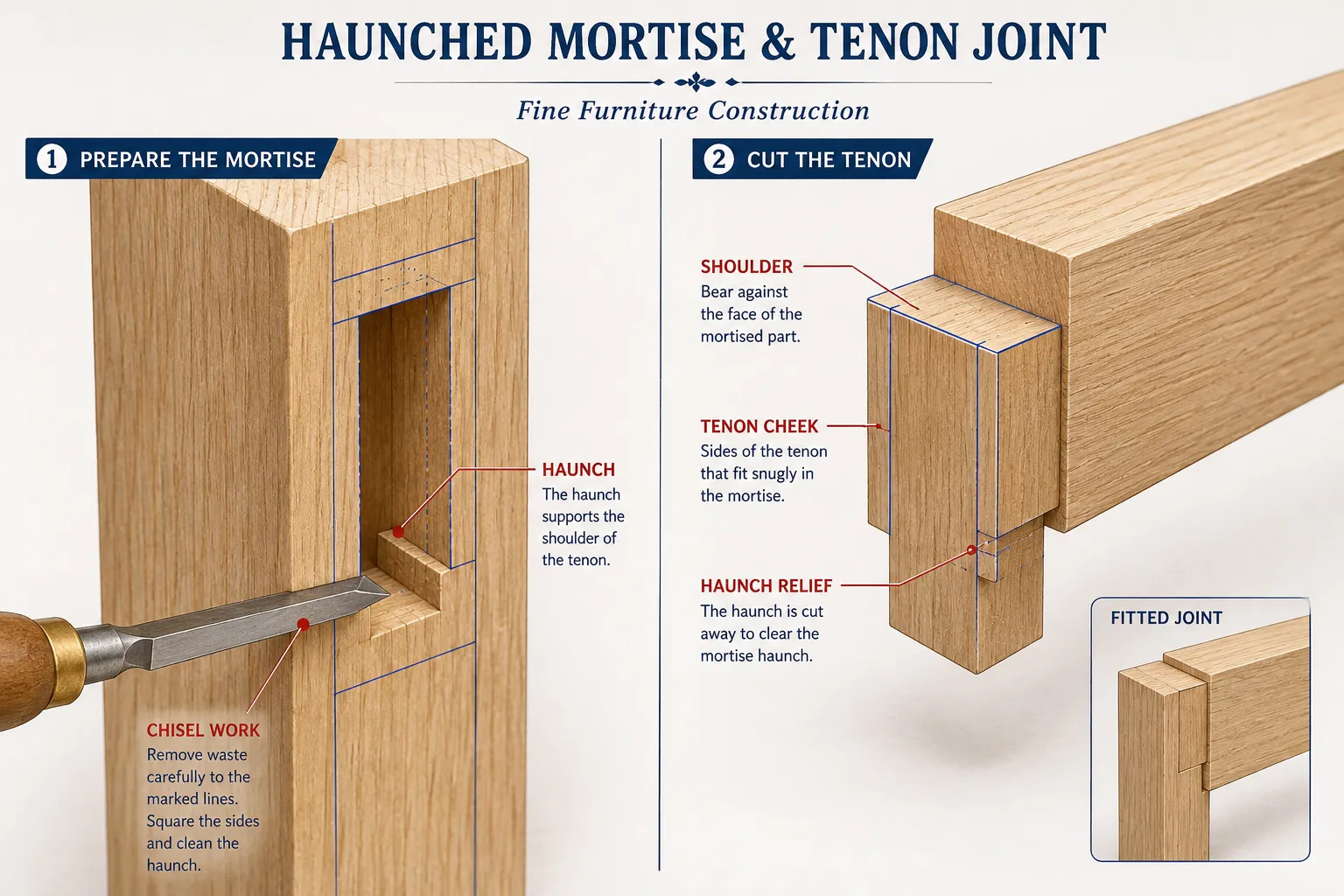
- Haunched Mortise and Tenon: Used primarily in frame-and-panel construction where a rail meets a stile at an end. The tenon has a smaller, shorter “haunch” that fills the groove cut for the panel, preventing the rail from twisting and offering additional glue surface.
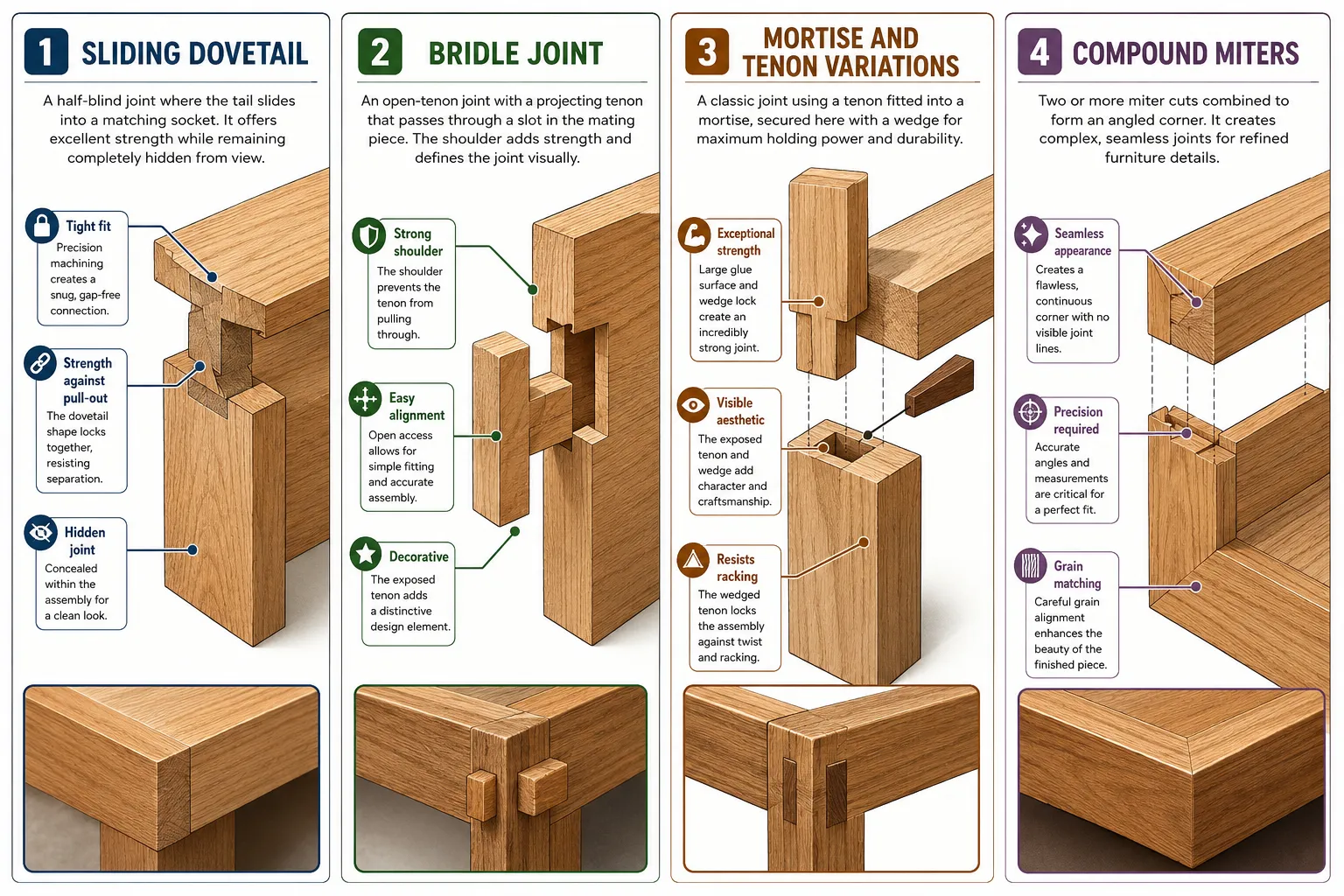
- Wedged Through Mortise and Tenon: A highly secure and often decorative joint where wedges are driven into saw kerfs cut into the end of a through tenon. This expands the tenon within the mortise, creating an incredibly tight and strong mechanical lock. The contrasting wood used for wedges can also create a beautiful visual accent.
| Joint Type | Primary Use Case | Strength Profile | Aesthetic Potential |
|---|---|---|---|
| Through Mortise and Tenon | Frame & panel, table/chair legs | Excellent, resists racking | Visible, can be decorative with wedges or pins |
| Blind Mortise and Tenon | Leg/apron connections, hidden framework | Excellent, highly resistant to racking | Hidden, creates clean, seamless surfaces |
| Haunched Mortise and Tenon | Frame & panel where rail meets stile end | Very good, prevents rail twisting | Typically hidden, contributes to structural integrity |
| Wedged Through M&T | High-stress joints, decorative components | Exceptional, mechanical lock, extreme resistance | Highly visible, can be a focal point with contrasting wood |
Advanced Dovetail Variations
While basic through and half-blind dovetails are foundational, several advanced variations offer unique structural and aesthetic benefits for Advanced Wood Joinery for Fine Furniture: Beyond Basic Dovetails for Strength and Aesthetics.
- Sliding Dovetail: This joint involves a dovetail-shaped tongue sliding into a matching groove. It’s incredibly strong, especially in resisting pull-out, and is perfect for attaching shelves to cabinet sides, securing dividers, or even connecting table legs to aprons where a hidden yet strong joint is needed. It allows for disassembly or wood movement in one direction while remaining rigid in others.
- Stopped Sliding Dovetail: A variation where the dovetail groove does not extend through the full length of the piece, allowing for a clean, visible face on one end.
- Tapered Sliding Dovetail: The dovetail is slightly wider at one end, creating a wedging action as it’s driven in, ensuring a very tight fit and eliminating the need for glue in some applications.
Bridle Joints
Bridle joints are essentially an open mortise and tenon, often used for connecting rails to legs or in frame construction. They offer excellent glue surface area and good resistance to racking.
- Through Bridle: The tenon passes completely through the mating piece, offering strong glue surface and a distinct visual.
- Corner Bridle: Used to join two pieces at a corner, often in frames. The end of one piece forms a tenon that fits into a mortise cut into the end of the other, creating a strong corner connection with a larger gluing surface than a miter.
Mitered Joinery with Reinforcement
While a simple miter joint (a 45-degree cut joining two pieces at a 90-degree corner) offers a beautiful, continuous grain wrap, its inherent weakness is the limited end-grain gluing surface. Advanced techniques reinforce these joints for fine furniture.
- Splined Miter: A thin strip of wood (spline) is inserted into opposing grooves cut into the mitered faces, significantly increasing the gluing surface and strength. This is excellent for carcass construction and crafting custom wooden display cases for collectibles.
- Keyed Miter: Similar to a splined miter, but small, often decorative, keys are cut and inserted through the corner after assembly. These keys add tremendous strength and can be made from contrasting wood for aesthetic appeal.
- Dovetail Miter (Secret Miter Dovetail): This highly complex joint combines the beauty of a miter with the strength of a dovetail. The dovetails are hidden within the mitered corner, resulting in a joint that looks like a simple miter on the outside but is incredibly strong due to the internal dovetail structure.
Precision, Tools, and Materials for Advanced Wood Joinery for Fine Furniture
Executing advanced joinery demands meticulous attention to detail, a deep understanding of wood, and proficiency with both hand and power tools. The selection of wood species for visible joinery is also critical, as different woods behave differently and offer varying aesthetic qualities.
The Role of Precision
Accuracy is paramount. Even a hair’s breadth of error can compromise the strength and appearance of an advanced joint.
- Measurement: Precision rules, marking gauges, and squares are essential. Digital calipers can offer an extra layer of accuracy.
- Marking: Sharp pencils, marking knives, and fine-point awls create crisp, accurate lines that guide cuts.
- Cutting:
- Hand Tools: Chisels, saws (dovetail saws, tenon saws, frame saws), and hand planes allow for the ultimate control and finesse, especially for intricate details and fine tuning. Many master craftsmen prefer hand tool joinery for crafting strong and beautiful joints.
- Power Tools: A table saw with a high-quality blade for consistent dados and rebates, a router (both handheld and table-mounted) for grooves, mortises, and dovetail jigs, and a bandsaw for shaping and resawing are invaluable. Mastering tools like the band saw can greatly improve efficiency and precision.
- Jigs and Fixtures: Custom-made or commercial jigs significantly enhance accuracy and repeatability for complex cuts.
Wood Selection
The type of wood used directly impacts both the workability of the joint and its final appearance.
- Hardwoods: Maple, cherry, walnut, and oak are excellent choices for fine furniture. They offer stability, durability, and a pleasing aesthetic. Their density allows for crisp, clean cuts essential for tight-fitting joints. For 2026 projects, consider premium wood selection to truly elevate your craftsmanship.
- Wood Movement: All wood expands and contracts with changes in humidity. Advanced joinery must account for this movement to prevent cracking or joint failure. For example, a sliding dovetail is often designed to allow for movement across the grain while restricting it along the length. Understanding hardwoods vs. softwoods is crucial here.
- Grain Direction: The orientation of the grain is critical for joint strength. Joints should be designed so that glue adheres grain-to-grain rather than end-grain to end-grain, which provides a much weaker bond.
Integrating Aesthetics and Structure in Fine Furniture Joinery
The true artistry in Advanced Wood Joinery for Fine Furniture: Beyond Basic Dovetails for Strength and Aesthetics lies in the seamless integration of structural integrity with visual appeal. A well-executed joint should not only hold the piece together but also contribute to its overall design narrative.
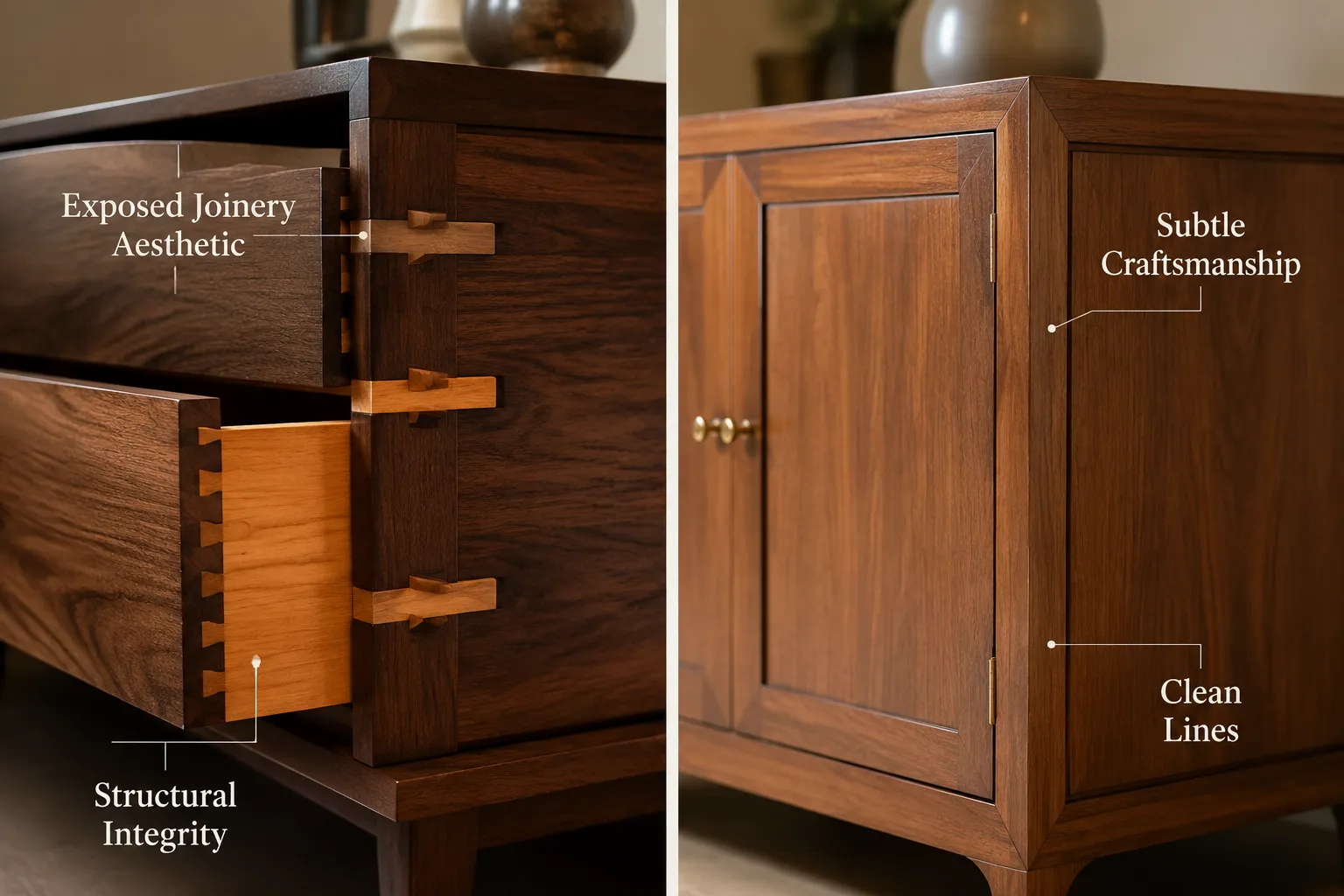
For example, a series of precisely cut, exposed through-tenons with contrasting wedges can become a defining visual feature on a handcrafted cabinet. The careful alignment of grain patterns across a mitered corner, reinforced with subtle internal splines, creates an illusion of a continuous, flowing surface. A sliding dovetail used to secure a shelf can create a clean, elegant line that speaks to thoughtful construction without overtly drawing attention to itself.
The decision to expose or hide a joint often depends on the desired aesthetic. Scandinavian and Shaker designs often embrace exposed joinery, celebrating the honesty of construction. Modern and contemporary pieces might favor hidden joints for sleek, uninterrupted lines. In either case, the quality of the execution dictates the success of the aesthetic. Poorly fitting or sloppily cut advanced joints detract from the piece, regardless of how complex they are.
Finishing techniques also play a role. A natural oil finish can highlight the grain and the subtle nuances of a joint, while a painted finish might conceal it, emphasizing form over construction details. Ultimately, the choice of advanced joinery is a thoughtful decision, balancing the functional requirements of strength and durability with the artistic vision for the finished piece.
Conclusion
Mastering advanced wood joinery techniques is an enduring pursuit that transforms ordinary woodworking into the creation of fine furniture. By moving beyond basic dovetails and embracing the complexity of sliding dovetails, various mortise and tenon configurations, bridle joints, and reinforced miters, woodworkers in 2026 can craft pieces that offer unparalleled strength, exceptional durability, and profound aesthetic appeal. These joints are not merely structural necessities; they are declarations of craftsmanship, visible or hidden, that speak to the quality and artistry embedded in every curve and joint. The journey into advanced joinery is one of continuous learning, demanding precision, patience, and a deep respect for the material. The result, however, is furniture that stands the test of time, both functionally and artistically, becoming cherished heirlooms for generations.
To embark on this rewarding path, begin by practicing individual joints with scrap wood, focusing on accuracy and fit. Invest in quality tools and learn to sharpen them meticulously. Study examples of fine furniture, both historical and contemporary, to understand how master craftsmen integrate joinery into their designs. Seek out resources on specific joint techniques and consider taking advanced woodworking courses. Your dedication to mastering these techniques will unlock new levels of creativity and capability in your fine furniture projects.