
The subtle creak of a drawer that no longer slides smoothly, the hairline crack appearing in a cherished tabletop, or the slight warp in a cabinet door—these are not always signs of poor craftsmanship, but often the inevitable consequences of wood’s inherent dynamic nature. Wood is a hygroscopic material, constantly exchanging moisture with its environment, leading to dimensional changes that can challenge even the most experienced furniture makers. Mastering the principles of Understanding Wood Movement: How to Design Furniture That Lasts a Lifetime is fundamental to creating pieces that remain stable, beautiful, and functional for generations.
Key Takeaways
- Wood continuously expands and contracts due to changes in humidity, primarily across its grain.
- Movement is most significant tangentially (along the growth rings), less so radially (across growth rings), and negligible longitudinally (along the length of the grain).
- Proper wood seasoning and moisture content stabilization are crucial first steps in mitigating excessive movement.
- Designing with wood movement in mind involves selecting appropriate joinery, construction methods, and hardware.
- Finishes play a vital role in slowing down moisture exchange, offering a protective barrier.
The Science Behind Wood Movement: Understanding Its Fundamental Principles
Wood movement is a fundamental concept for anyone working with timber. It refers to the expansion and contraction of wood as it gains or loses moisture. This isn’t just a minor detail; it’s a powerful force that can warp, crack, and destroy poorly designed or constructed furniture. To truly grasp Understanding Wood Movement: How to Design Furniture That Lasts a Lifetime, one must first appreciate the cellular structure of wood.
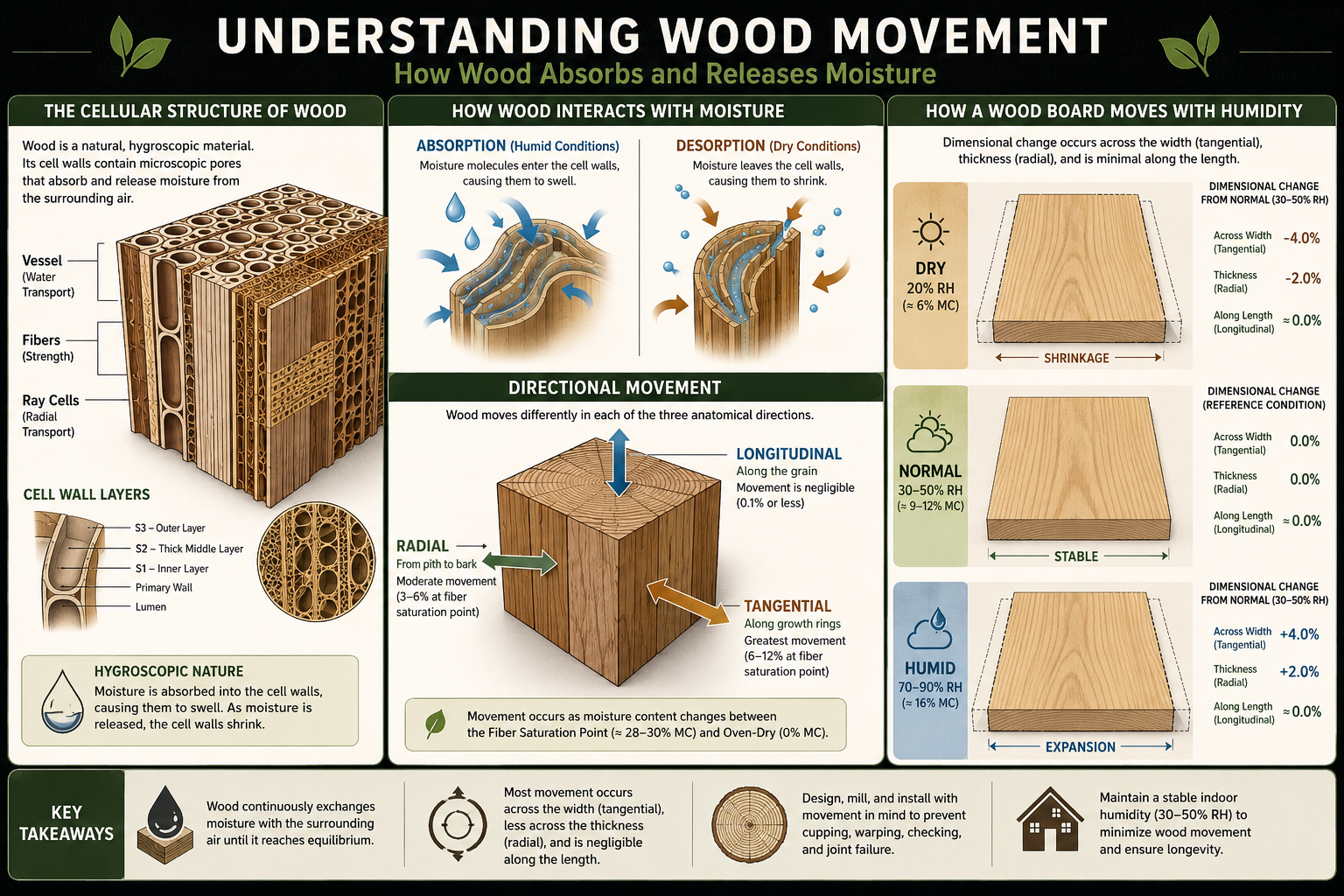
Wood cells are essentially tiny tubes that absorb and release water. When the humidity in the surrounding air increases, wood absorbs moisture, causing its cells to swell. Conversely, when humidity decreases, wood releases moisture, and its cells shrink. This process is known as hygroscopicity. The critical factor is that this movement is not uniform in all directions.
Anisotropic Movement: Different Directions, Different Changes
Wood is an anisotropic material, meaning its properties vary depending on the direction relative to its grain. For wood movement, this translates into three primary directions:
- Tangential Movement: This occurs parallel to the growth rings. It is the direction where wood exhibits the most significant change in dimension—typically 5-10% for common hardwoods between oven-dry and fiber saturation point.
- Radial Movement: This occurs perpendicular to the growth rings, across the rays of the wood. Movement in this direction is less than tangential movement, usually about half as much (2-5%).
- Longitudinal Movement: This occurs along the length of the wood grain. Movement in this direction is almost negligible, often less than 0.1% for practical purposes. This is why long grain glue joints are so strong and stable.
Think of a flat-sawn board. The wide face will experience significant tangential movement, while the thickness will experience radial movement. Quarter-sawn boards, with their growth rings largely perpendicular to the wide face, primarily experience radial movement on their wide face, making them inherently more stable in terms of overall width changes.
Moisture Content and Equilibrium
The amount of water in wood is expressed as its moisture content (MC), a percentage of the wood’s oven-dry weight. Wood aims to reach an equilibrium moisture content (EMC) with its environment. For example, wood stored in a heated indoor environment in North America typically stabilizes at 6-8% MC, while outdoor conditions might lead to 12-18% MC.
- Dry environment (e.g., heated indoor spaces in winter): Wood loses moisture, shrinks, and MC decreases.
- Humid environment (e.g., summer, unheated spaces): Wood gains moisture, swells, and MC increases.
It’s crucial to allow wood to acclimatize to the environment where the finished furniture will reside before beginning construction. Using wood with an unsuitable MC for the final environment is a common cause of future problems. For detailed information on preparing materials, consider exploring guides on Live Edge Slab Selection and Preparation: From Raw Material to Finished Showpiece.
| Movement Direction | Relative Change | Implications for Design |
|---|---|---|
| Longitudinal | Very Low | Stable length, strong long-grain glue joints. |
| Radial | Moderate | Less movement in quarter-sawn boards. |
| Tangential | High | Most critical for width changes in flat-sawn boards. |
Understanding these fundamental principles is the cornerstone of designing furniture that lasts, ensuring that the inherent characteristics of wood are respected rather than fought against.
Designing Furniture to Accommodate Wood Movement: Practical Strategies
Designing furniture that truly lasts a lifetime requires deliberate consideration of wood movement at every stage. Ignoring this natural phenomenon will inevitably lead to structural failures, cracks, and unsightly warps. The goal is not to stop wood movement—which is impossible—but to manage and accommodate it gracefully.
Strategic Joinery Choices
The right joinery is paramount for Understanding Wood Movement: How to Design Furniture That Lasts a Lifetime. Joints must be strong but also allow for movement.
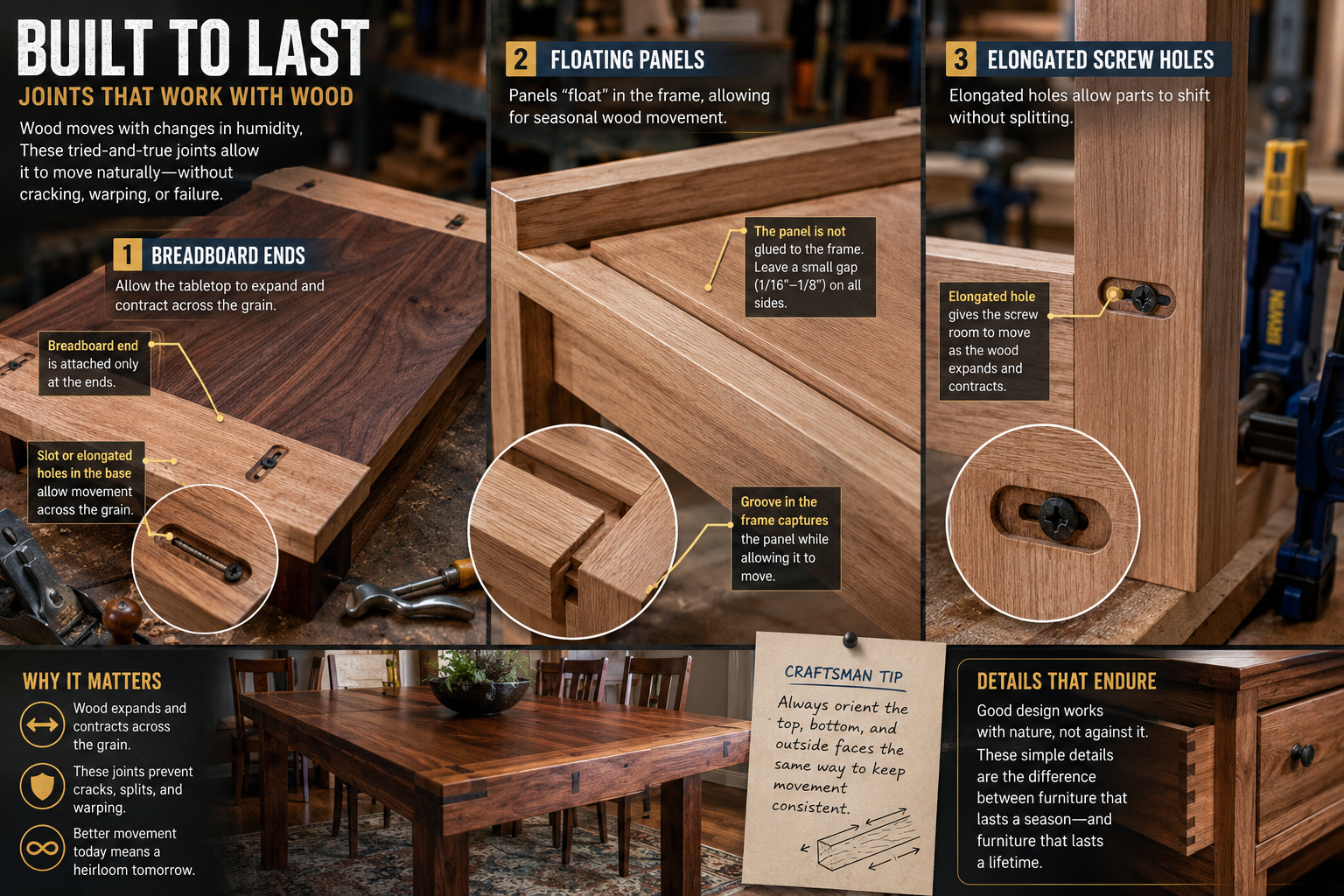
- Breadboard Ends: A classic solution for tabletops and cabinet doors, breadboard ends prevent cupping across the width of a wide panel while allowing the panel itself to expand and contract. The breadboard is typically glued only in the center, with elongated holes for screws or pegs at the ends to permit lateral movement.
- Frame-and-Panel Construction: This method, commonly used for cabinet doors and chests, is highly effective. A thin, solid wood panel (or plywood) “floats” within a rigid frame. The panel’s edges are cut with a tongue that fits into a groove in the frame members. This allows the panel to expand and contract freely within the frame without stressing the joints, as long as it’s not glued rigidly in place.
- Floating Tenons/Dovetail Keys: For panels integrated into larger structures, floating tenons or dovetail keys can secure parts while allowing some movement. When crafting Mastering Dovetail Drawers for Cabinets, for instance, careful consideration of movement is essential for long-term stability.
- Elongated Screw Holes: When attaching wide tabletops or panels to a frame, elongated screw holes (also known as “figure-8” fasteners or table fasteners) are used. These allow screws to move with the expanding or contracting wood without pulling out or splitting the frame.
Grain Direction and Layout
Careful planning of grain direction is a simple yet powerful strategy.
- Alternate Growth Rings: When edge-gluing boards to create a wider panel, alternating the orientation of the growth rings can help balance out cupping tendencies, leading to a more stable panel.
- Matching Movement: Ensure that connecting components move in the same direction or that one component is allowed to move relative to the other. For example, a solid wood top glued rigidly to solid wood aprons that run perpendicular to its grain will inevitably crack the apron or the top.
Material Selection and Seasoning
- Stabilized Wood: Always use properly dried and seasoned lumber. Kiln-dried wood typically has a stable moisture content suitable for indoor furniture (around 6-8%).
- Plywood and Veneer: For certain applications, engineered wood products like plywood or MDF can be excellent choices. Plywood, being made of cross-banded layers, is exceptionally stable and does not exhibit significant dimensional changes due to moisture. Using veneer over a stable core can achieve the look of solid wood without its movement challenges.
- Species Selection: Some wood species are inherently more stable than others. For example, mahogany and cedar are known for their stability, while some oaks and maples can be more prone to movement.
Finishing and Maintenance
While finishes don’t stop wood movement, they significantly slow down the rate of moisture exchange, providing a buffer against rapid environmental changes.
- Even Finishing: It is critical to apply finish equally to all surfaces of a wooden component. Finishing only one side of a tabletop, for example, allows moisture to enter and exit the unfinished side more rapidly, creating an imbalance that can lead to cupping.
- Penetrating vs. Film Finishes: Penetrating oil finishes allow for more moisture exchange than film-building finishes like polyurethane or shellac. Consider the environment and desired protection when choosing. For options, refer to guides on Natural Wood Finishing Techniques.
- Environmental Control: Advise clients on maintaining stable humidity levels in their homes, especially for valuable pieces. Humidifiers in dry winters and dehumidifiers in humid summers can greatly contribute to furniture longevity. For pieces that need repair, remember that Restoring Antique Wooden Furniture: Techniques for Repairing can bring them back to life.
By integrating these practical strategies, woodworkers can confidently design and build furniture that not only looks beautiful but also withstands the test of time, proving a lasting testament to skilled craftsmanship in 2026.
Case Studies and Advanced Techniques for Long-Lasting Furniture
Even with a solid grasp of basic principles, applying Understanding Wood Movement: How to Design Furniture That Lasts a Lifetime in complex projects requires advanced thought and technique. Let’s examine how these principles are applied in real-world furniture design.
Case Study: A Solid Wood Dining Table
Consider a solid wood dining table, a common piece that often falls victim to wood movement. A typical tabletop might be 36 inches wide and 72 inches long, made from several boards glued edge-to-edge.
- Problem: A wide, flat-sawn panel will attempt to expand and contract across its width (tangential movement). If rigidly attached to a static base, it will crack or cup.
- Solution 1: Apron Attachment: Instead of gluing the tabletop directly to the apron, use specialized fasteners. Metal “figure-8” fasteners, Z-clips, or wooden buttons fit into dados or grooves in the apron and attach to the underside of the tabletop. The slotted holes in these fasteners allow the tabletop to slide slightly as it moves, while still holding it securely.
- Solution 2: Breadboard Ends: To prevent cupping and provide a visually appealing finished edge, a breadboard end can be integrated. This involves cutting a long tenon along the end grain of the tabletop panel, which slides into a deep mortise in the breadboard. The breadboard is typically glued to the center of the tenon, and the outer sections are secured with dowels or screws through elongated holes, allowing the main panel to move beneath.
This approach ensures the table remains flat and stable without developing cracks over time, even with seasonal humidity changes. For those looking to build their own, Building Live Edge Dining Tables with Reclaimed Wood: A 2026 Trend Guide for DIY Makers offers specific guidance.
Case Study: Frame-and-Panel Cabinet Doors
Cabinet doors with solid wood panels are another prime example.
- Problem: A solid panel glued into a rigid frame will cause the frame joints to fail or the panel to crack when it tries to move.
- Solution: Floating Panels: The panel is cut to allow a small gap (e.g., 1/16 to 1/8 inch) around its perimeter within the frame’s grooves. This “float” space accommodates expansion. Small rubber balls or space balls are sometimes inserted into the groove to prevent the panel from rattling, without restricting movement. The panel itself is typically not glued into the frame, or only glued along a very small section of one edge. This allows the panel to move independently while the frame remains dimensionally stable. This is also a key principle in crafting Mastering Dovetail Joinery for Drawers, where stability and precise fit are paramount.
Advanced Considerations for Specific Environments
- Outdoor Furniture: For outdoor pieces like Building Picnic Tables for Outdoor Gatherings, movement is even more pronounced due to wider humidity and temperature swings. Using naturally rot-resistant and stable woods (like teak or cedar) is critical, as are finishes designed for extreme exposure. Designs often feature slatted surfaces to allow for open air circulation and drainage, further minimizing stress.
- Veneering and Lamination: When seeking stability for large surfaces, veneering over stable core materials like plywood or MDF is a highly effective technique. The thin veneer itself has minimal movement, and the engineered core is nearly inert to moisture changes, offering a flat and stable surface ideal for sophisticated finishes.
- Controlling Shop Environment: For professional woodworkers, controlling the humidity in the workshop is a sophisticated strategy to ensure wood reaches an ideal EMC before construction. Using humidifiers or dehumidifiers to maintain 35-50% relative humidity can greatly minimize wood movement after the piece leaves the shop.
By embracing these advanced techniques and maintaining a vigilant awareness of wood’s dynamic nature, furniture makers in 2026 can create truly enduring pieces.
Conclusion
The journey to Understanding Wood Movement: How to Design Furniture That Lasts a Lifetime is an essential rite of passage for any serious woodworker. It moves beyond simply cutting and joining wood to a deeper appreciation of the material’s living, breathing nature. By acknowledging that wood will inevitably expand and contract with environmental changes, designers can proactively integrate solutions that manage these forces, rather than resisting them.
The key lies in three areas: understanding the anisotropic nature of wood movement, meticulous material preparation to achieve optimal moisture content, and, most critically, employing intelligent design and joinery that allows components to move freely without compromising structural integrity or aesthetic appeal. From floating panels and breadboard ends to strategically elongated screw holes, these techniques are not merely tricks; they are time-tested principles that underpin durable furniture construction.
As you embark on your next woodworking project in 2026, pause to consider the environment your piece will inhabit. Select your wood with care, allow it to acclimate, and choose joinery that respects its natural tendencies. By doing so, you will not only build stronger, more beautiful furniture, but you will also foster a deeper connection to the craft, creating heirloom pieces that stand as a testament to your skill and foresight for generations to come.
Meta Title: Wood Movement: Design Furniture That Lasts a Lifetime Meta Description: Master wood movement to design furniture that lasts generations. Learn joinery, material choice & strategies for durable, crack-free pieces.