
The persistent myth that serious woodworking requires a sprawling, dedicated garage or barn is debunked daily by countless makers transforming modest spaces into highly functional workshops. In 2026, efficiency and intelligent design triumph over sheer square footage, especially when it comes to safely and productively operating a table saw. A well-considered Small Shop Setup for Table Saw Projects: A Practical Layout for Safe Cuts, Outfeed, and Storage is not just about fitting tools; it’s about creating a workflow that enhances safety, precision, and enjoyment, even in the tightest quarters.
Key Takeaways
- Prioritize Safety First: Ensure clear operating zones, proper dust collection, and readily accessible safety gear are integrated into your layout from the start.
- Optimize for Workflow: Design your layout around the table saw’s infeed and outfeed requirements to facilitate smooth material handling.
- Embrace Mobility: Utilize mobile bases and folding solutions for tools and workstations to maximize flexibility in a small space.
- Strategic Storage: Implement vertical and multi-functional storage solutions for lumber, jigs, and accessories to keep the workspace clutter-free.
- Dust Control is Non-Negotiable: Integrate a robust dust collection system to protect health and maintain shop cleanliness.
Designing the Core: Safe Cuts and Outfeed in a Small Shop Setup for Table Saw Projects
At the heart of any woodworking shop, particularly a small one, is the table saw. Its placement dictates much of the workflow and safety considerations. For a Small Shop Setup for Table Saw Projects: A Practical Layout for Safe Cuts, Outfeed, and Storage, the primary challenge is to ensure adequate space around the saw for both infeed and outfeed, even when working with larger stock, without permanently sacrificing precious floor area.
Strategic Table Saw Placement
When planning your layout, consider the maximum length of material you realistically expect to cut. For many small shop projects, 8-foot sheet goods or lumber are common. This means you need roughly 8 feet of clear space in front of the blade for infeed and an equal amount behind for outfeed. Side clearances for ripping are also critical, though often less demanding than front-to-back.
One highly effective strategy for small shops is to place the table saw in the center of the available space, if possible, rather than against a wall. This allows for unrestricted movement around the tool. If a central placement isn’t feasible, consider pushing it closer to a garage door or a large clear opening that can be temporarily utilized for oversized cuts.
Table 1: Table Saw Placement Considerations
| Consideration | Benefit in Small Shop |
|---|---|
| Central Location | Maximum flexibility for infeed/outfeed from all sides |
| Against Wall | Frees up central space; requires dedicated outfeed support |
| Near Doorway | Allows temporary extension for very long stock |
| Mobile Base | Essential for repositioning and reclaiming space |
Always ensure your table saw is on a sturdy, locking mobile base. This allows you to reconfigure your shop for different tasks or even push the saw out of the way when not in use. This mobility is a cornerstone of efficient small shop design. For enhancing overall workshop organization, consider principles outlined in “Workshop Organization for High-Volume Small Project Production:” https://woodcraftwiz.com/workshop-organization-for-high-volume-small-project-production-space-efficient-layouts-tool-placement-and-jig-systems-for-batch-building-coasters-holders-and-organizers/.
Essential Outfeed Support Systems
Outfeed support is non-negotiable for safe and accurate table saw operations, especially when handling long or wide materials. A lack of proper outfeed can lead to kickback, poor cuts, and dangerous situations.
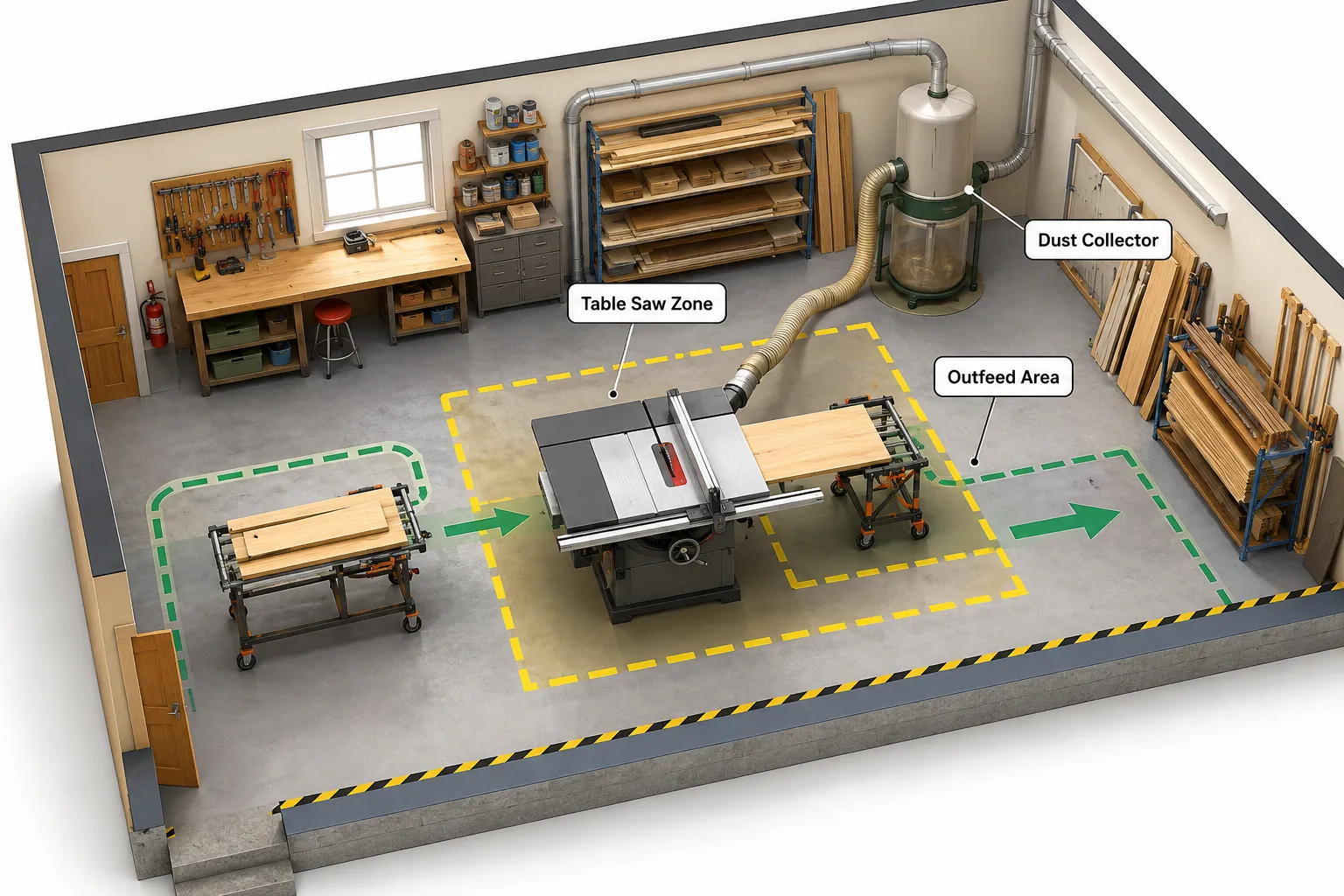
Outfeed Solutions for Compact Spaces:
- Folding Outfeed Table: A popular choice is a dedicated outfeed table on casters that can be folded down or collapsed when not in use. This can be built as a multi-purpose assembly table.
- Roller Stands: While effective, roller stands can be cumbersome to set up and adjust for every cut. They also don’t offer full support for sheet goods.
- Modular Workbench Extension: If you have a workbench that is the same height as your table saw, it can double as an outfeed table. Ensure it’s sturdy and can be perfectly aligned.
- Dedicated Outfeed Table with Storage: Many woodworkers build a custom outfeed table that also incorporates drawers or shelves for jigs, accessories, and even a router table insert. This maximizes the utility of its footprint.
“A well-designed outfeed solution for your table saw is not a luxury; it’s a safety imperative that doubles as a productivity booster in any small shop.”
When designing your outfeed, ensure its height matches your table saw’s top precisely. Even a slight height difference can cause issues. Consider building a custom solution, such as a portable folding workbench or a mobile assembly table, which can serve multiple purposes. Details on such versatile builds can be found in resources like “Building a DIY Portable Tool Cart and Assembly Table: Maximizing Versatility in a Small Workshop” https://woodcraftwiz.com/building-a-diy-portable-tool-cart-and-assembly-table-maximizing-versatility-in-a-small-workshop/.
Maximizing Space: Outfeed Integration and Dust Collection for Table Saw Projects
Integrating outfeed support seamlessly into your compact workshop and ensuring effective dust collection are crucial for both functionality and a healthy environment. A truly practical Small Shop Setup for Table Saw Projects: A Practical Layout for Safe Cuts, Outfeed, and Storage recognizes that these elements are not add-ons but fundamental parts of the overall design.
Integrated Outfeed and Assembly Stations
The best outfeed solutions for small shops are often multi-functional. An outfeed table can double as an assembly bench, a finishing station, or even house other tools.
Popular Multi-functional Outfeed Designs:
- Integrated Router Table: Many outfeed tables are designed with a router lift and fence system, allowing you to seamlessly transition from cutting to routing operations.
- T-Track and Clamp System: Incorporate T-tracks into your outfeed table surface for easy clamping during assembly, sanding, or routing tasks.
- Storage Beneath: Build drawers or shelves into your outfeed table’s base to store table saw jigs, blades, measuring tools, and other frequently used items.
- Folding Extensions: For even greater versatility, design your outfeed table with folding wings or extensions that can be deployed for extra-long material support and then collapsed to reclaim floor space.
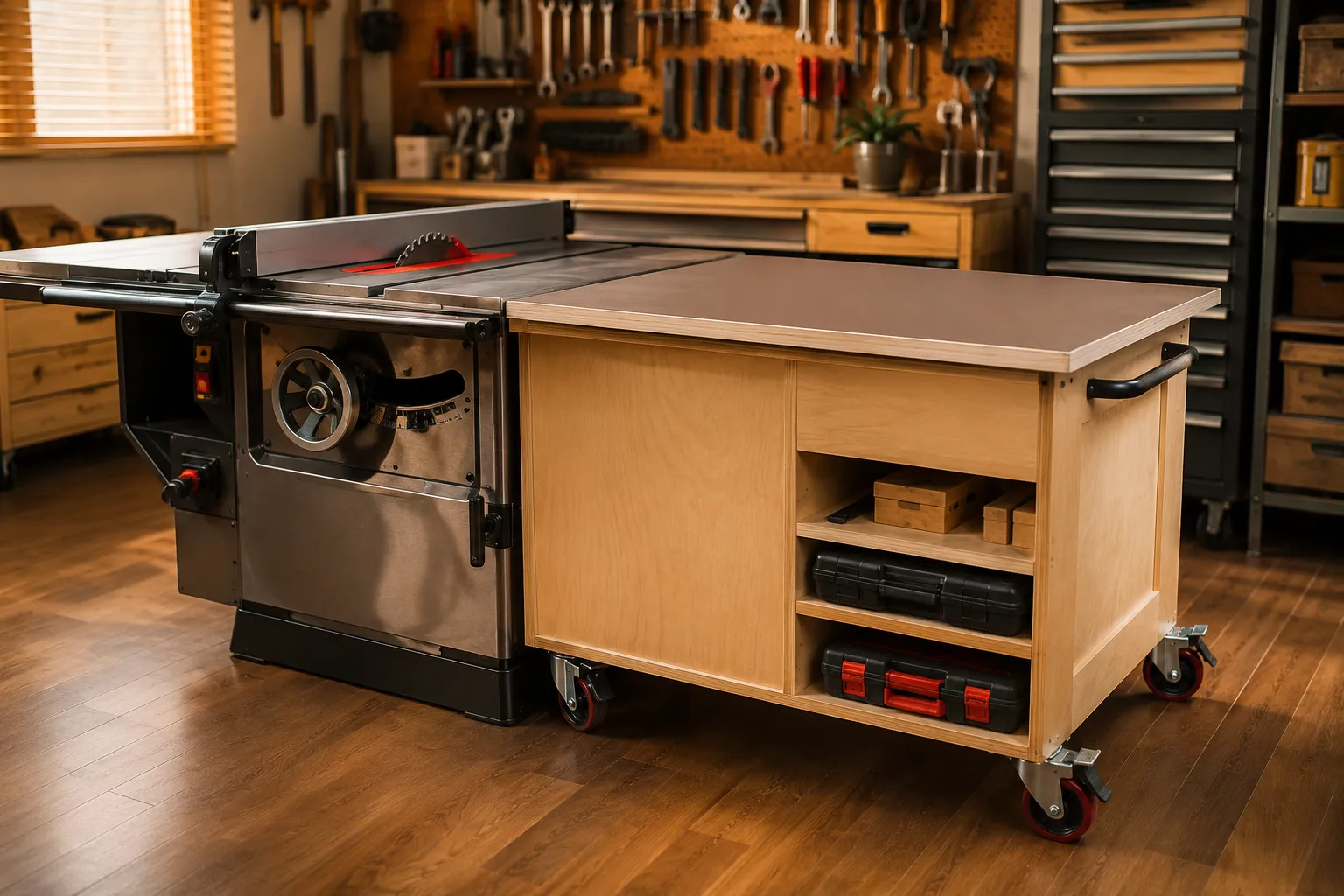
When space is at a premium, exploring options like “Building a Custom Fold-Down Crafting Table with Storage: Maximizing Small Workshop and Multi-Use Space” can provide inspiration for similar outfeed solutions. You can adapt these concepts to create a robust, yet compact, outfeed system.
Efficient Dust Collection
Table saws generate a significant amount of dust and chips, which is not only messy but also a health hazard. Effective dust collection is paramount in any shop, especially a small one where airborne particles can quickly accumulate.
Dust Collection Strategies for Small Shops:
- Dedicated Dust Collector: Invest in a dust collector with sufficient CFM (Cubic Feet per Minute) for your table saw. Position it as close as possible to the saw to minimize hose length and maximize suction. Look for models with mobile bases for flexibility.
- Short, Direct Runs: Use the shortest, most direct runs of ducting or hose possible. Avoid sharp 90-degree bends, which significantly reduce airflow. Flexible hose is convenient but use rigid pipe where possible for better performance.
- Hose Management: In a small shop, hoses can be tripping hazards. Consider overhead drops or ceiling-mounted reels to keep hoses off the floor.
- Integrated Dust Collection: Many modern table saws offer excellent dust ports. Ensure your dust collector hose connects directly and securely to these.
- Air Filtration System: Complement your dust collector with an ambient air filter. These units continuously clean the air, catching fine dust particles that escape the primary collection system. Mount it high and centrally for best results. For more on shop cleanliness, refer to “Small Workshop Dust Control Solutions Beyond the Dust Collector for Cleaner Air and Surfaces” https://woodcraftwiz.com/small-workshop-dust-control-solutions-beyond-the-dust-collector-for-cleaner-air-and-surfaces/.
Smart Storage Solutions: Lumber, Jigs, and Accessories for Table Saw Projects
Effective storage is the unsung hero of a productive small workshop. For a Small Shop Setup for Table Saw Projects: A Practical Layout for Safe Cuts, Outfeed, and Storage, clever storage keeps your workspace clear, your tools safe, and your materials accessible. This is especially true for lumber, jigs, and the myriad accessories that come with a table saw.
Lumber Storage in Confined Spaces
Storing lumber efficiently is one of the biggest challenges in a small shop. Leaving boards scattered on the floor is not only a tripping hazard but also prevents you from fully utilizing your space.
Innovative Lumber Storage Ideas:
- Vertical Racks: Build or buy racks that store lumber vertically against a wall. Cantilevered racks are excellent for storing longer pieces horizontally, high up on a wall, keeping them out of the way.
- Under-Bench Storage: If you have a workbench or outfeed table, utilize the space underneath for storing smaller cut-offs or project-specific pieces.
- Mobile Lumber Cart: A dedicated cart on casters can hold a significant amount of lumber and be moved out of the way when not needed. These can be designed to hold various lengths and widths.
- Ceiling Racks: For really long stock that you don’t access frequently, ceiling-mounted racks can be a lifesaver, provided your ceiling joists can support the weight.
- Cut-off Bins: Dedicate specific bins or crates for small offcuts, organized by species or size, to avoid waste and make finding usable pieces easier. Consider “Turning Offcuts Into Feature Details: Zero-Waste Design Strategies” https://woodcraftwiz.com/turning-offcuts-into-feature-details-zero-waste-design-strategies-for-sustainable-woodworking/ for inspiration on utilizing these smaller pieces.
Jigs and Accessories Organization
Table saw jigs (crosscut sleds, dado sleds, tenoning jigs) are indispensable but can take up considerable space. The same goes for blades, push sticks, featherboards, and safety equipment.
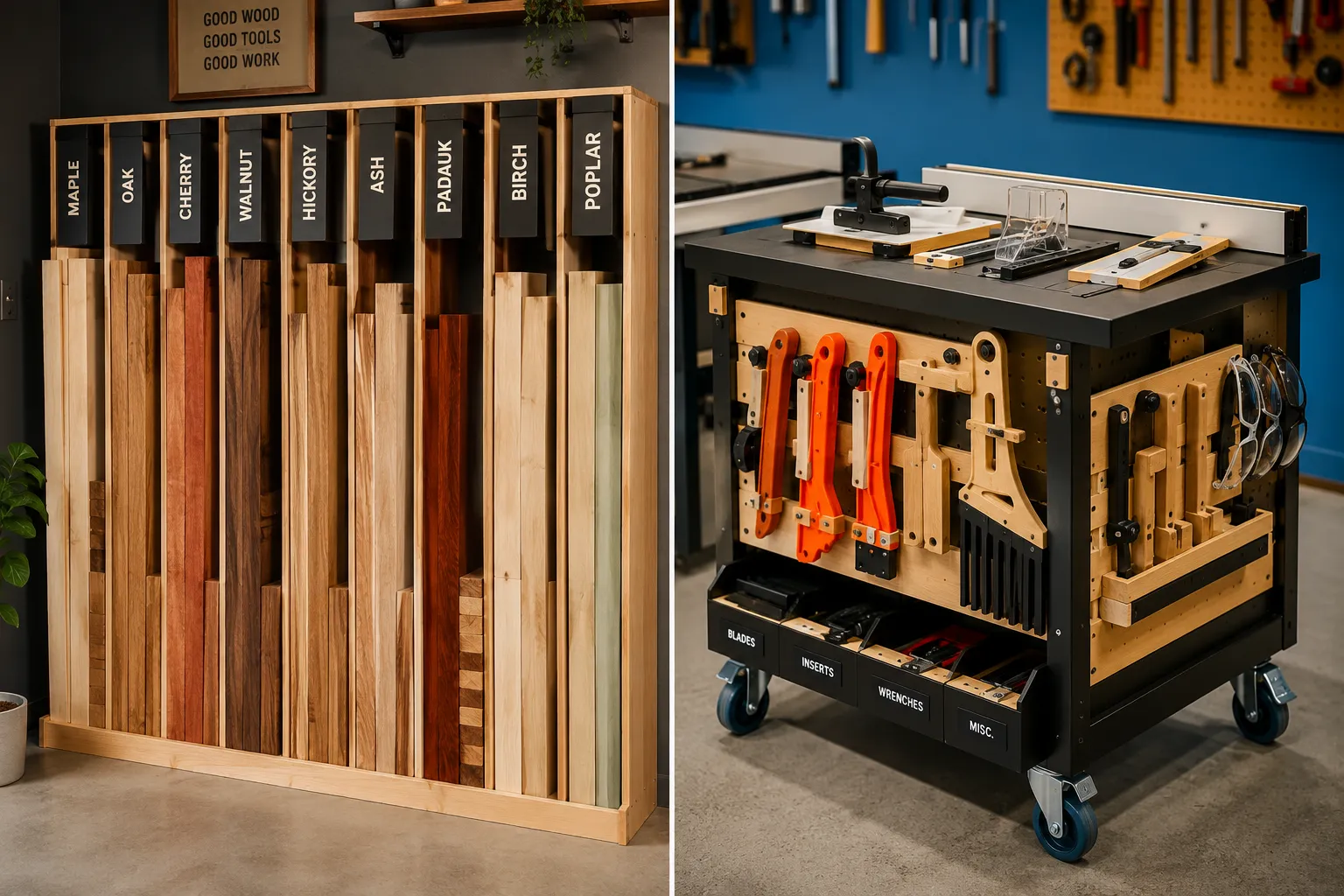
Jig and Accessory Storage Solutions:
- Wall-Mounted French Cleat System: This highly versatile system allows you to hang jigs, clamps, and even small tools on custom hangers that can be easily rearranged. It keeps items off the floor and within reach.
- Dedicated Cabinetry/Shelving: Build shallow cabinets or shelves near your table saw for frequently used items. Custom inserts or dividers can keep blades and small accessories organized and protected.
- Mobile Tool Cart: A rolling cart designed to hold table saw accessories, push sticks, and even a small shop vac can be kept right next to the saw during operation and then neatly tucked away. For ideas, check out “Building a DIY Portable Tool Cart and Assembly Table: Maximizing Versatility in a Small Workshop” https://woodcraftwiz.com/building-a-diy-portable-tool-cart-and-assembly-table-maximizing-versatility-in-a-small-workshop/.
- Under-Saw Storage: If your table saw stand or cabinet has space, utilize it for storing blades, wrenches, and other immediate necessities.
- Magnetic Strips: Mount magnetic strips on a wall or inside a cabinet door to hold smaller metal items like wrenches, hex keys, or even push sticks.
“Every item in a small shop should have a designated home. If it doesn’t, it becomes clutter, consuming valuable space and hindering workflow.”
Safety gear, such as push sticks, push blocks, safety glasses, and hearing protection, should always be stored within arm’s reach of the table saw. Consider a small hook or shelf directly adjacent to the saw for these critical items. For more on maximizing minimal spaces, “The Rise of Micro-Workshops: Maximizing Productivity and Safety in Extremely Small Spaces” https://woodcraftwiz.com/the-rise-of-micro-workshops-maximizing-productivity-and-safety-in-extremely-small-spaces/ offers additional insights into efficient layouts.
Conclusion
Creating an efficient and safe Small Shop Setup for Table Saw Projects: A Practical Layout for Safe Cuts, Outfeed, and Storage is entirely achievable with careful planning and smart design choices. By prioritizing mobility for your table saw, implementing multi-functional outfeed solutions, ensuring robust dust collection, and employing clever storage strategies for lumber and accessories, woodworkers can transform even the most compact spaces into highly productive and enjoyable environments. The key is to think vertically, embrace mobility, and demand that every inch of your shop earns its keep.
Actionable Next Steps:
- Measure Your Space: Accurately map out your workshop, noting dimensions, door swings, and electrical outlets.
- Sketch Your Layout: Draw several potential layouts, experimenting with table saw placement and outfeed options. Consider flow lines for material.
- Invest in Mobility: If your table saw isn’t on a mobile base, make that your first upgrade.
- Plan Your Outfeed: Decide on an outfeed solution that maximizes utility and can integrate storage or other functions.
- Assess Dust Collection: Review your current dust collection setup and identify areas for improvement, focusing on short, direct runs and an ambient air filter.
- Organize Vertically: Start building or installing wall-mounted storage for lumber, jigs, and accessories.
By systematically addressing these areas, your small shop can become a powerhouse for table saw projects, proving that big woodworking doesn’t require a big footprint in 2026.
References
- Duginske, M. (1998). The Table Saw Book. Taunton Press.
- Monk, J. (2018). The Weekend Woodworker: 101 Simple Projects. F+W Media.
- O’Connell, K. (2020). Working in a Small Shop: Building a High-Performance Workspace. Popular Woodworking Books.