
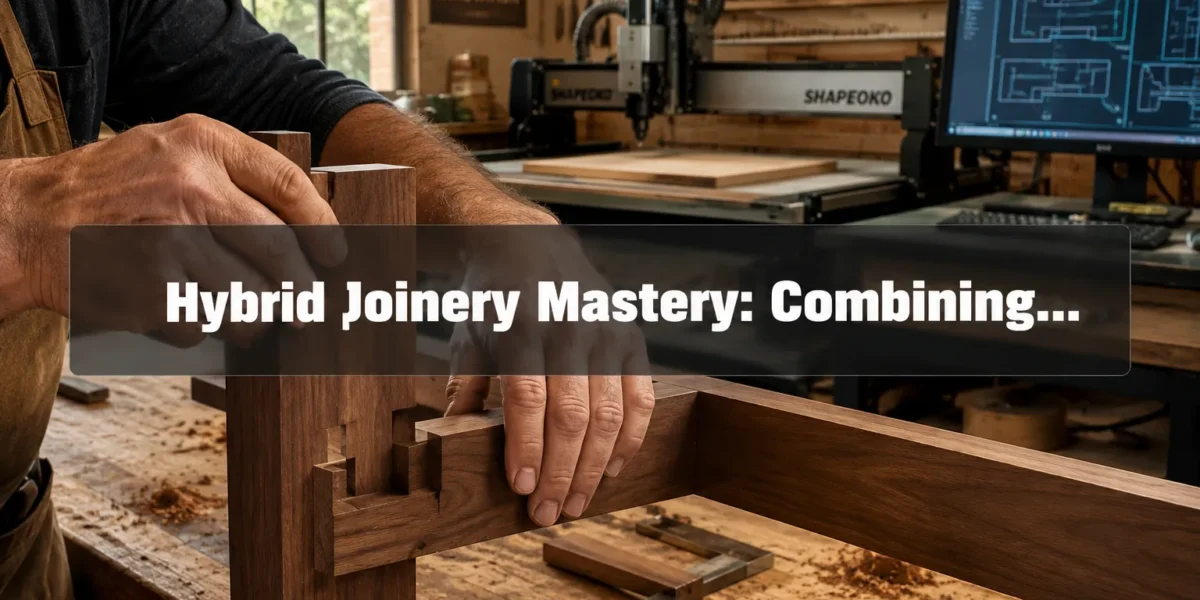
The notion that traditional hand-cut joinery and modern CNC milling are mutually exclusive is a misconception that limits countless woodworking projects. In 2026, many master woodworkers are discovering that the true frontier of craftsmanship lies in a symbiotic relationship between the two. This article explores Hybrid Joinery Mastery: Combining Hand-Cut Mortise-and-Tenon With CNC-Milled Pockets, a powerful approach that leverages the irreplaceable strength and aesthetic of classic joints while embracing the unparalleled precision and efficiency of digital manufacturing. By strategically blending these methods, woodworkers can achieve levels of accuracy, speed, and design complexity previously unattainable, crafting furniture that stands as a testament to both timeless skill and contemporary innovation.
Key Takeaways
- Hybrid Joinery Defined: It’s the strategic fusion of traditional hand-cut joints, like the mortise-and-tenon, with CNC-milled components, such as pockets or rebates, within a single project.
- Leveraging Strengths: Hand-cut techniques offer superior aesthetic appeal, tactile feedback, and precise fit for critical load-bearing connections, while CNC provides unparalleled accuracy, repeatability, and efficiency for complex or repetitive tasks.
- Optimized Workflow: Hybrid methods streamline production by offloading tedious or highly precise operations to the CNC, allowing craftsmen to focus their hand-tool skills on the areas that benefit most from human touch.
- Enhanced Precision and Tolerances: CNC milling ensures exact pocket dimensions, simplifying the subsequent hand-cutting of tenons for a perfect, gap-free fit.
- Design Flexibility: This approach opens doors to intricate designs and complex assemblies that might be prohibitively difficult or time-consuming with either method alone.
Understanding the Synergy: Hand-Cut Mortise-and-Tenon Meets CNC Pockets
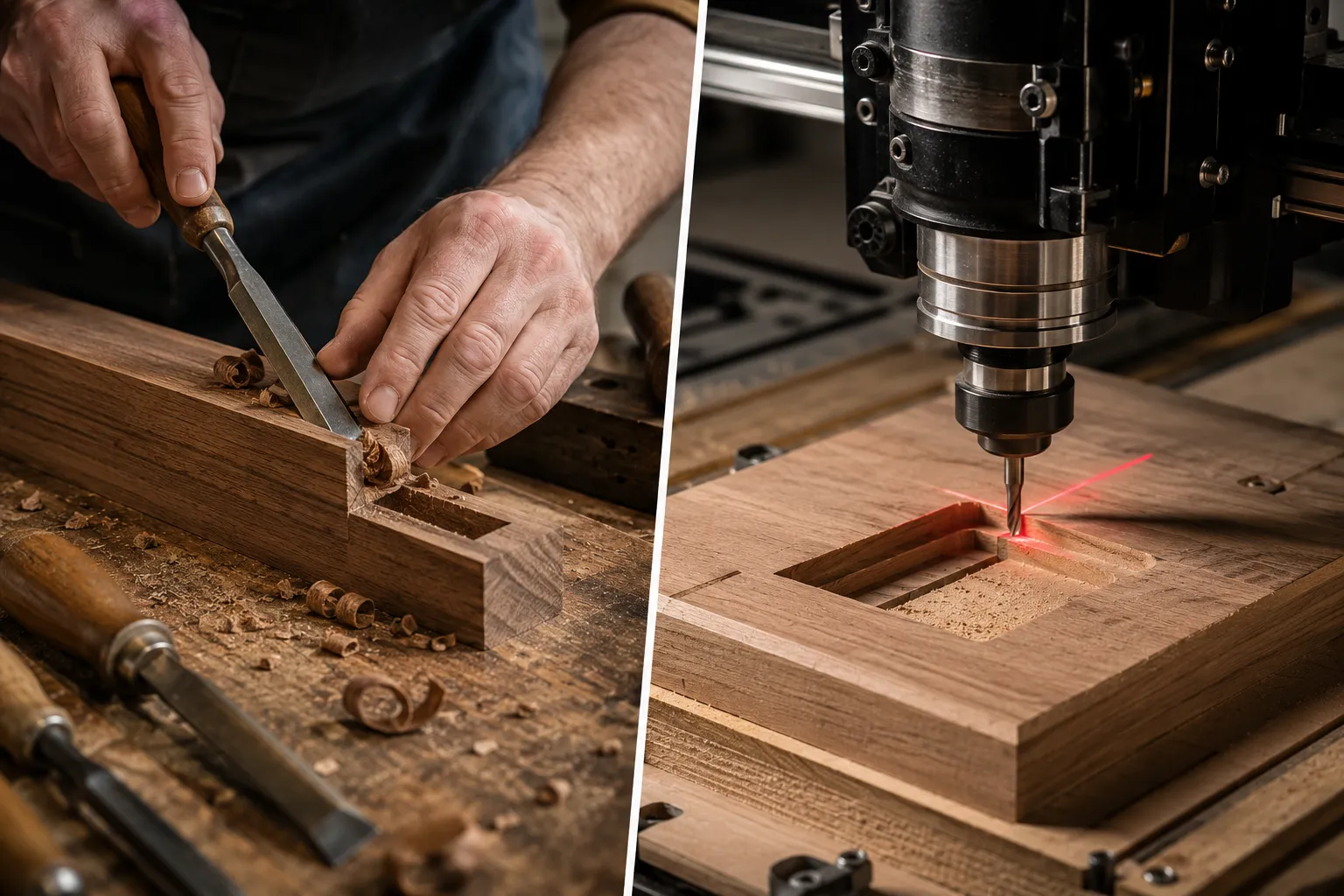
The bedrock of robust furniture construction often relies on the venerable mortise-and-tenon joint. Renowned for its mechanical strength, large gluing surface, and resistance to racking, it’s a staple in fine woodworking. Traditionally, both the mortise (the female slot) and the tenon (the male projection) are meticulously cut by hand using chisels, saws, and mallets. This process requires significant skill, patience, and practice to achieve a perfect, tight-fitting joint. The beauty of a hand-cut mortise-and-tenon lies not just in its strength but also in the subtle imperfections and the visible evidence of human craftsmanship, which adds character and value to a piece. For an in-depth look at traditional techniques, refer to our guide on introduction to traditional hand-tool joinery.
Conversely, Computer Numerical Control (CNC) milling brings a new paradigm of precision and repeatability to the workshop. A CNC router can cut complex shapes, pockets, and dados with tolerances measured in thousandths of an inch, executing intricate designs consistently across multiple pieces. When applied to joinery, a CNC excels at operations that demand exact dimensions and perfect replication, such as milling the precise mortise pockets or dadoes into a component.
The genius of Hybrid Joinery Mastery: Combining Hand-Cut Mortise-and-Tenon With CNC-Milled Pockets lies in identifying where each method offers a distinct advantage. Instead of seeing them as competitors, we view them as complementary forces. Imagine a scenario where the CNC machine accurately and quickly mills all the mortise pockets to exact specifications on multiple cabinet rails or table aprons. This eliminates the most challenging and time-consuming part of creating the mortise, which often dictates the accuracy of the overall joint.
With the mortises perfectly established by the CNC, the woodworker can then focus their hand-tool skills on cutting the tenons. This approach allows for a slightly oversized tenon to be quickly rough-cut on the bandsaw or table saw, and then precisely trimmed and fitted by hand using a shoulder plane, chisel, or even a specialized tenon saw. The tactile feedback of the hand plane, feeling the wood shave away until a perfect, friction-fit tenon is achieved, is immensely satisfying and ensures a joint that is both strong and aesthetically pleasing. This blend elevates the craft, marrying the digital accuracy of the machine with the discerning eye and delicate touch of the human artisan. This approach is particularly valuable when crafting custom pieces where slight variations in wood grain or dimension might necessitate fine-tuning that a fully automated process cannot accommodate.
The Workflow and Practicalities of Hybrid Joinery Mastery
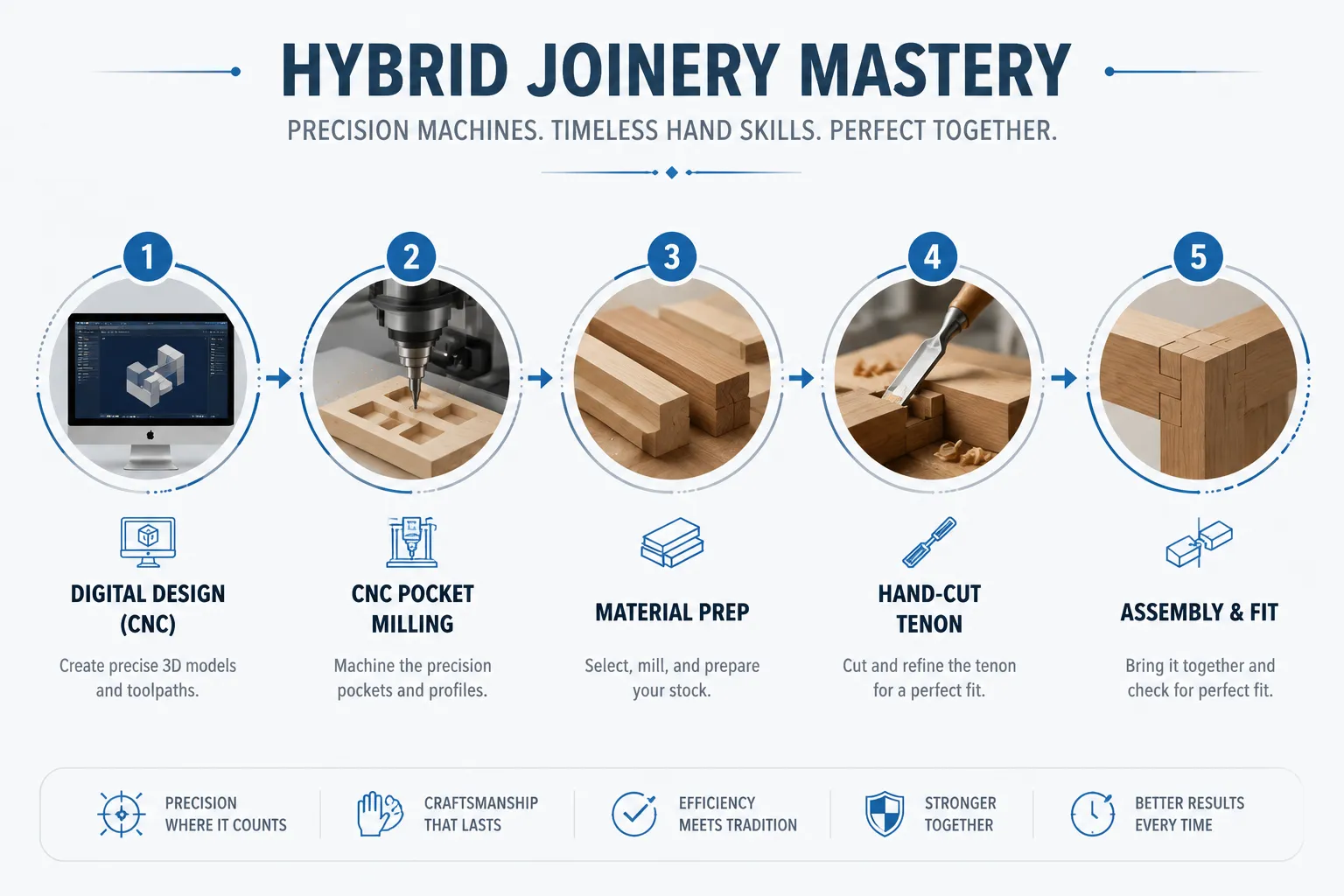
Implementing Hybrid Joinery Mastery: Combining Hand-Cut Mortise-and-Tenon With CNC-Milled Pockets effectively requires a thoughtful workflow and a keen understanding of both machines and hand tools. The process typically begins in the design phase, where joints are designed with this hybrid approach in mind.
Design and Digital Preparation
- Joint Design: Decide which part of the joint will be CNC-milled and which will be hand-cut. For mortise-and-tenon, it’s usually more efficient to CNC-mill the mortise (the pocket) and hand-cut the tenon. This is because creating clean, precise internal corners for a mortise by hand is often more challenging than shaping an external tenon.
- CAD/CAM Software: Design your components in CAD software (e.g., Fusion 360, VCarve Pro). Precisely define the dimensions and locations of all mortise pockets to be milled by the CNC. Remember to account for the router bit’s diameter, especially for internal corners, which will always have a radius. If square corners are desired, these can be squared up later by hand with a chisel.
- Toolpath Generation: Generate the G-code for your CNC machine. This involves selecting appropriate end mills, cutting depths, and feed rates. For mortises, a simple pocketing operation is usually sufficient.
CNC Milling the Pockets
Once the digital preparation is complete, the physical work begins with the CNC machine.
- Material Fixturing: Securely clamp your workpieces to the CNC bed. Accurate workholding is paramount for precision.
- Milling Mortises: Run the CNC program to mill all the mortise pockets. The CNC will execute this quickly and with exact repeatability across multiple pieces. Ensure the pockets are slightly deeper than the intended tenon length to allow for glue squeeze-out.
- Inspection: After milling, inspect the CNC-cut pockets for accuracy, depth, and cleanliness. At this stage, you might use a chisel to square up any internal corners if perfectly square mortises are desired.
Hand-Cutting the Tenons and Final Fit
With the CNC-milled mortises ready, the focus shifts to hand-tool work for the tenons.
- Stock Preparation: Ensure the mating tenon stock is dimensionally accurate and square.
- Marking Out: Transfer the exact dimensions of the CNC-milled mortise to the tenon stock. This is a critical registration step. Often, it’s wise to measure the actual CNC-cut mortise rather than relying solely on digital dimensions, accounting for any minor machine calibration variations.
- Rough Cutting: Use a bandsaw or table saw to rough-cut the tenon shoulders and cheeks, leaving them slightly oversized (e.g., 1/32″ to 1/16″ larger than the mortise opening).
- Fine-Tuning: This is where the mastery comes in. Using hand tools like a shoulder plane, chisel, or even a traditional hand plane, pare the tenon cheeks until they slide into the CNC-milled mortise with a perfect, snug friction fit. The goal is a joint that can be pushed together by hand, but still holds itself without clamping pressure. This stage allows for subtle adjustments to account for wood movement or slight variations.
- Test Fit and Assembly: Perform a dry fit of all components to ensure everything aligns perfectly before applying glue. This step is indispensable, particularly in projects with multiple joints.
This blend of machine and hand ensures efficiency where it counts (repetitive, precise mortise milling) and allows for the refined touch and critical fitting by hand where it truly elevates the craftsmanship. For projects involving intricate joinery, adapting classic techniques with modern tools can be explored further in mastering modern hand-cut joinery.
When Hybrid Joinery Makes Sense in Furniture Builds
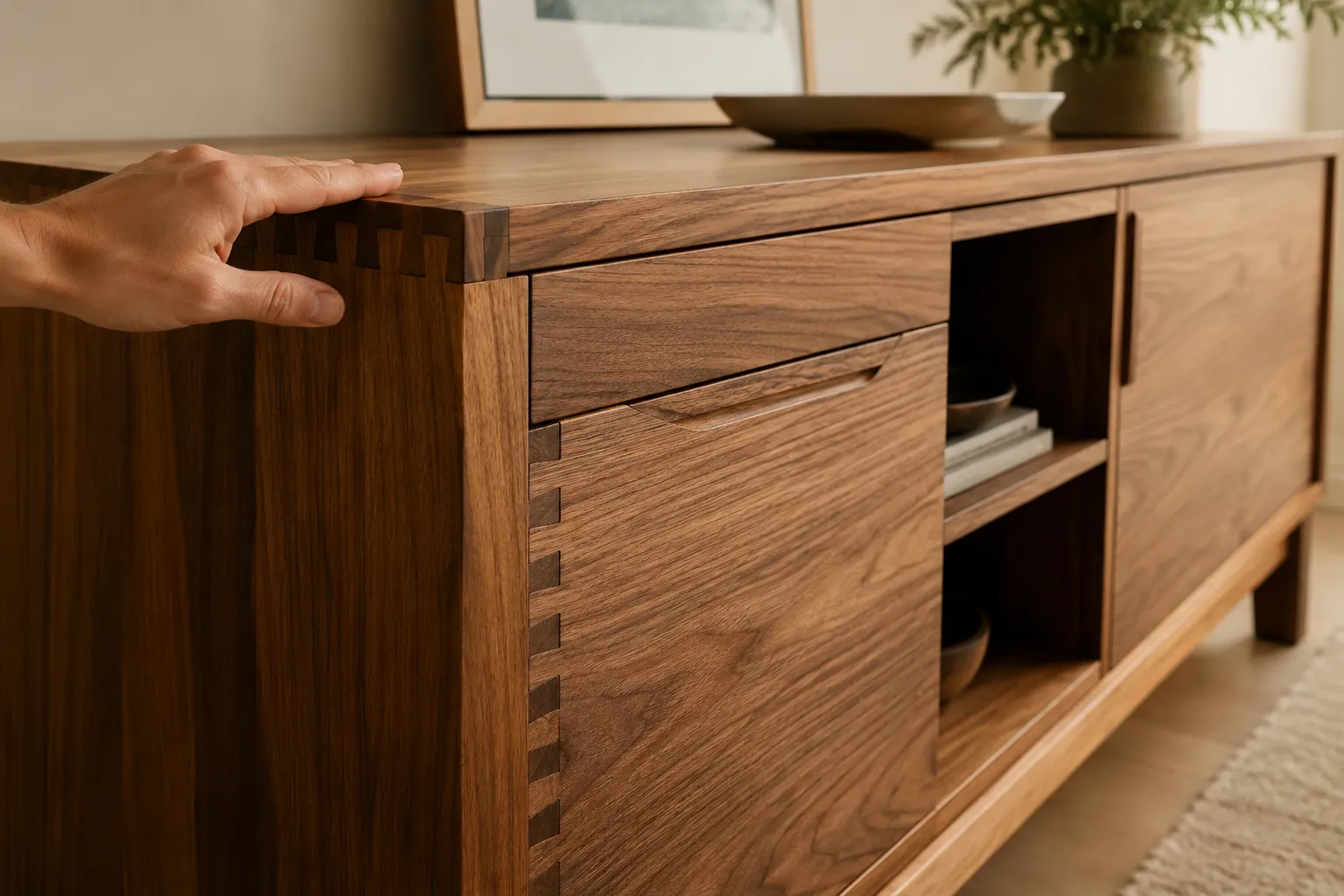
The decision to adopt Hybrid Joinery Mastery: Combining Hand-Cut Mortise-and-Tenon With CNC-Milled Pockets is not one-size-fits-all. It’s most beneficial in specific scenarios where the strengths of both methodologies create a superior outcome or streamline production significantly.
Consider large-scale furniture production or batch work. Building a dozen dining chairs, for instance, involves hundreds of mortise-and-tenon joints. Manually cutting all those mortises to perfect consistency is incredibly time-consuming and labor-intensive. A CNC machine can mill all the mortises for an entire batch in a fraction of the time, with unwavering accuracy. The woodworker can then efficiently process the tenons by hand, ensuring that critical fit and finish that defines custom furniture. This approach dramatically increases output without compromising quality.
For complex designs with unusual angles, curved elements, or non-standard joint geometries, the CNC becomes an invaluable ally. While a traditional mortise-and-tenon is usually rectilinear, a CNC can mill angled mortises or mortises that follow a curve, which would be exceedingly difficult or impossible to execute by hand. The tenons for these complex mortises can then be shaped by hand, perhaps with custom jigs, to achieve the perfect mating surface. This opens up new avenues for artistic expression and structural innovation in furniture design. Imagine crafting DIY modern nightstands with uniquely angled legs that integrate seamlessly with the top.
Furthermore, hybrid joinery is ideal for projects requiring extremely tight tolerances and repeatable precision. In situations where components must interchange or where multiple sub-assemblies need to fit together perfectly, the CNC’s ability to hold exact dimensions is critical. This is especially true for built-in cabinetry, modular furniture, or intricate box constructions where consistency is key. Even for simpler projects like DIY wooden birdhouses with advanced designs, leveraging a CNC for repetitive cuts can save time and improve consistency across multiple units.
However, for a simple, one-off project or when the primary goal is to fully immerse oneself in traditional hand-tool woodworking, a purely hand-cut approach might still be preferred. The joy of creating every part of a joint by hand is a fundamental aspect of the craft for many. The choice of hybrid joinery should always align with the project’s requirements, the desired level of precision, production volume, and the woodworker’s personal goals. For any serious woodworker looking to scale their craft in 2026, or achieve new levels of precision and design complexity, mastering this hybrid approach is an essential skill. Understanding the properties and applications of different wood species can also greatly influence joinery choices; explore the essential guide to wood species for more context.
Conclusion
Hybrid Joinery Mastery: Combining Hand-Cut Mortise-and-Tenon With CNC-Milled Pockets represents a forward-thinking approach to woodworking that honors tradition while embracing technological advancement. By intelligently assigning tasks to either the precision of a CNC machine or the nuanced skill of hand tools, woodworkers can achieve unparalleled strength, accuracy, and aesthetic beauty in their projects. This method not only optimizes workflow and reduces production time for repetitive or complex cuts but also empowers artisans to focus their finite hand-tool expertise on the critical fitting and refined finishes that truly distinguish exceptional craftsmanship.
In 2026, integrating CNC-milled pockets with hand-cut tenons is no longer a niche technique but a powerful strategy for those seeking to push the boundaries of furniture design and construction. It’s about leveraging the best of both worlds to create pieces that are structurally superior, visually compelling, and efficiently produced.
Actionable Next Steps:
- Invest in Learning: If you’re new to CNC, explore beginner guides and software tutorials for CAD/CAM. If new to hand tools, practice your mortise-and-tenon cutting skills.
- Start Small: Begin with a simple project that incorporates one or two hybrid joints. Perhaps a small stool or a simple frame.
- Experiment with Tolerances: Understand how to design your CNC pockets slightly undersized or oversized to facilitate hand-fitting, or how to leave sufficient material on tenons for fine-tuning.
- Refine Your Workflow: Develop a systematic approach for switching between machine work and hand work, including setup, registration, and cleanup.
- Join a Community: Engage with other woodworkers experimenting with hybrid joinery to share knowledge and troubleshoot challenges.
SEO Meta Title: Hybrid Joinery Mastery: CNC Pockets & Hand-Cut Tenons for Precision SEO Meta Description: Learn Hybrid Joinery Mastery in 2026. Combine CNC-milled pockets with hand-cut mortise-and-tenon for ultimate strength, precision, and craftsmanship.