
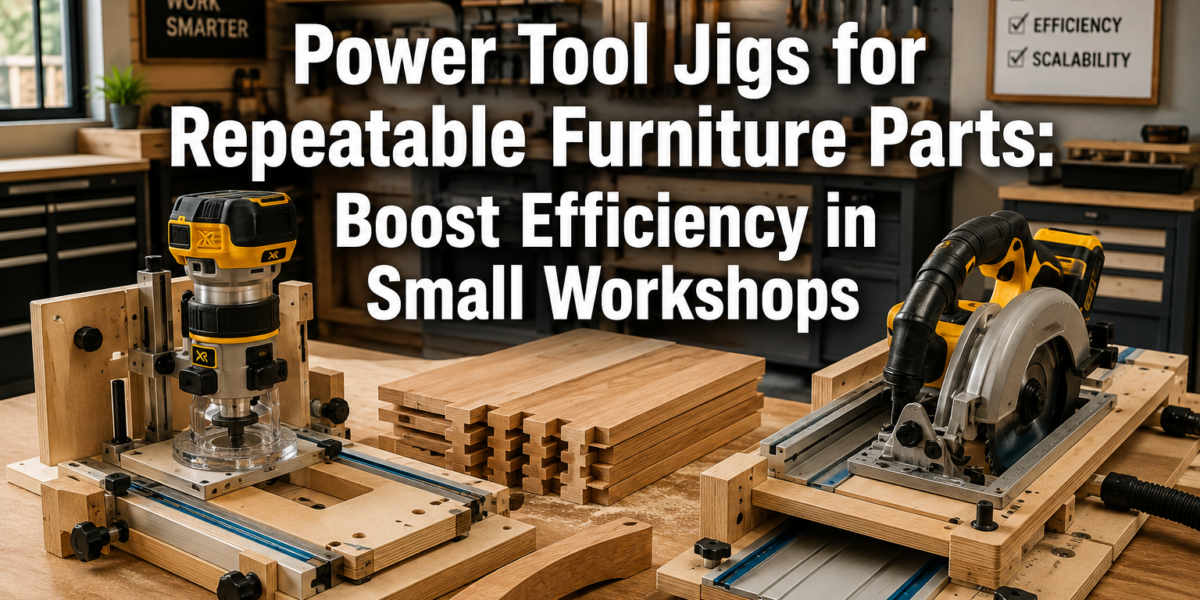
The notion that high-volume, precision furniture production is exclusive to large factories is a common misconception among woodworkers. In reality, leveraging custom Power Tool Jigs for Repeatable Furniture Parts can radically transform a small workshop into a highly efficient, scalable production hub, especially with the advanced cordless tools available in 2026. This article will explore how smart jig design, particularly for critical elements like chairs, cabinets, and tables, enables consistent, accurate joinery, boosting efficiency and opening avenues for greater output without the immense investment in CNC machinery.
Key Takeaways
- Custom jigs are essential for achieving repeatable accuracy in small-batch furniture production.
- Integrating 2026’s cordless power tool advancements into jig design enhances mobility and efficiency.
- Well-designed jigs streamline complex joinery, ensuring consistency across multiple furniture parts.
- Implementing a jig system can significantly reduce errors, waste, and production time.
- Focusing on chairs, cabinets, and tables provides a strong foundation for scalable furniture making.
The Foundation: Why Power Tool Jigs for Repeatable Furniture Parts Are Critical
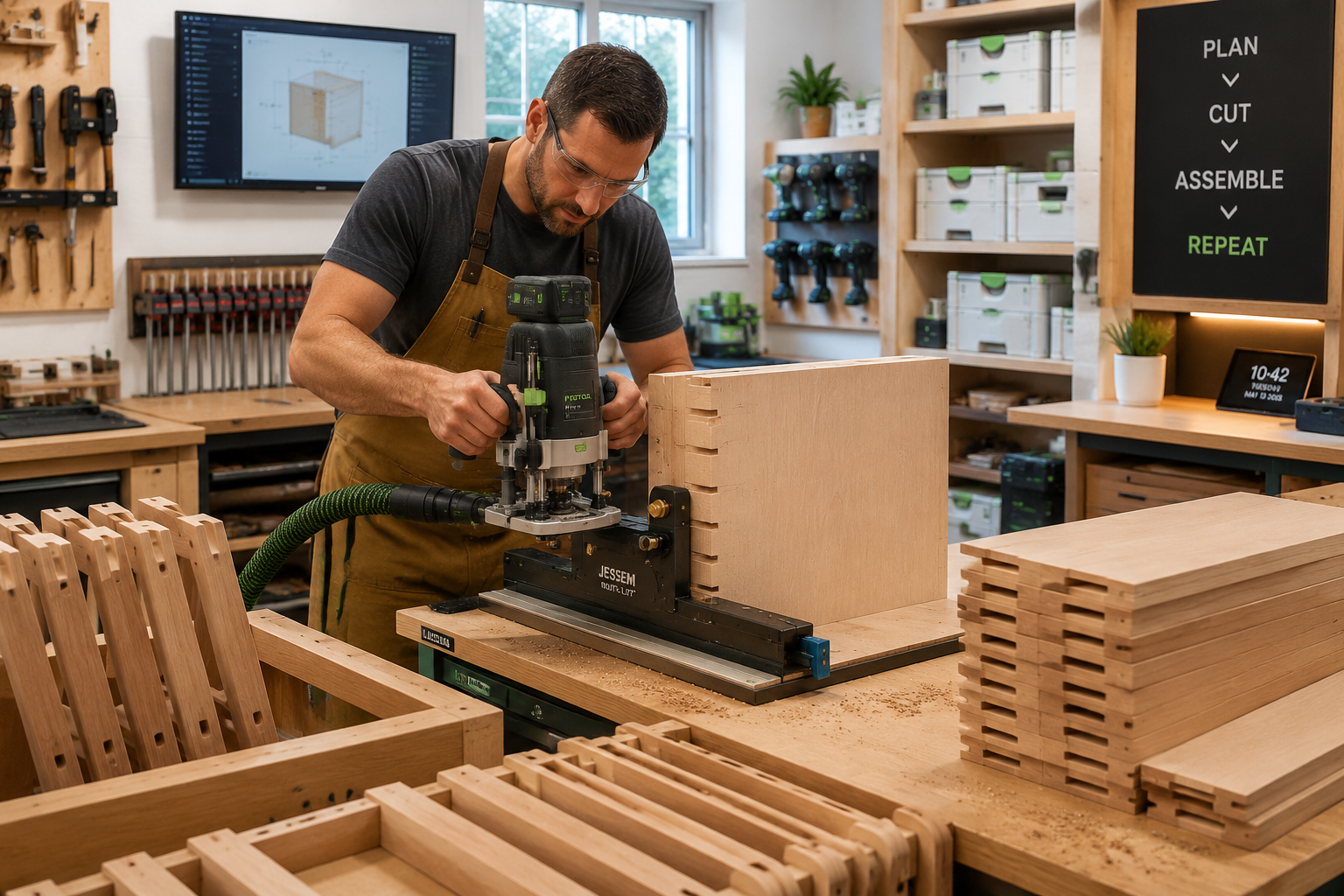
For any woodworker aiming to produce more than a single custom piece, repeatability is paramount. Imagine building four identical chairs, each requiring eight mortise and tenon joints, four identical legs, and two identical rails. Without jigs, each cut and joint would need to be measured and marked individually, a process prone to subtle variations. These small differences compound, leading to ill-fitting parts, wobbly assemblies, and a significant drain on time and materials. This is where Power Tool Jigs for Repeatable Furniture Parts become indispensable.
Jigs provide a fixed reference point, guiding your power tools to make the same cut, drill the same hole, or shape the same profile, precisely, every single time. This consistency not only ensures higher quality finished products but also drastically speeds up the production process. Instead of constant measuring and checking, you can focus on setup and execution, allowing for a rhythm that boosts overall efficiency.
The evolution of cordless power tools by 2026 further enhances the utility of these jigs. A cordless router, for example, can be swiftly moved from one jig setup to another without cable management hassles, making batch processing of parts even more fluid. Cordless track saws, miter saws, and even some compact drill presses now offer the precision and power previously reserved for corded counterparts, integrating seamlessly into a jig-based workflow.
Overcoming Small Workshop Limitations with Smart Jig Design
Small workshops often face constraints in space and machinery. A full-sized CNC machine is out of reach for many. However, custom jigs effectively mimic some of the precision benefits of CNC by making standard power tools perform like highly specialized equipment.
For instance, a simple crosscut sled for a table saw can achieve perfect 90-degree and often 45-degree cuts with unmatched accuracy. A router table, when paired with specialized fences and featherboards, becomes a joinery workhorse capable of creating consistent dados, rabbets, and profiles.
“The true magic of jigs lies in their ability to democratize precision, allowing small-scale artisans to compete with larger manufacturers in terms of quality and consistency.”
When designing jigs, consider the following principles:
- Safety First: Jigs should secure the workpiece and keep hands clear of blades or bits.
- Repeatability: The design must ensure identical results with each use.
- Durability: Built to withstand repeated use without losing accuracy.
- Ease of Use: Simple setup and operation reduce fatigue and errors.
- Versatility: Can the jig be adapted for slightly different tasks or dimensions?
Investing time in building well-thought-out jigs is an investment in your workshop’s future efficiency and the quality of your output. It’s a foundational step towards scalable production. For those new to jig building, our Beginner’s Guide to Essential Woodworking Jigs: Improve Accuracy and Safety for Common Cuts offers a great starting point.
Essential Jigs for Chairs, Cabinets, and Tables
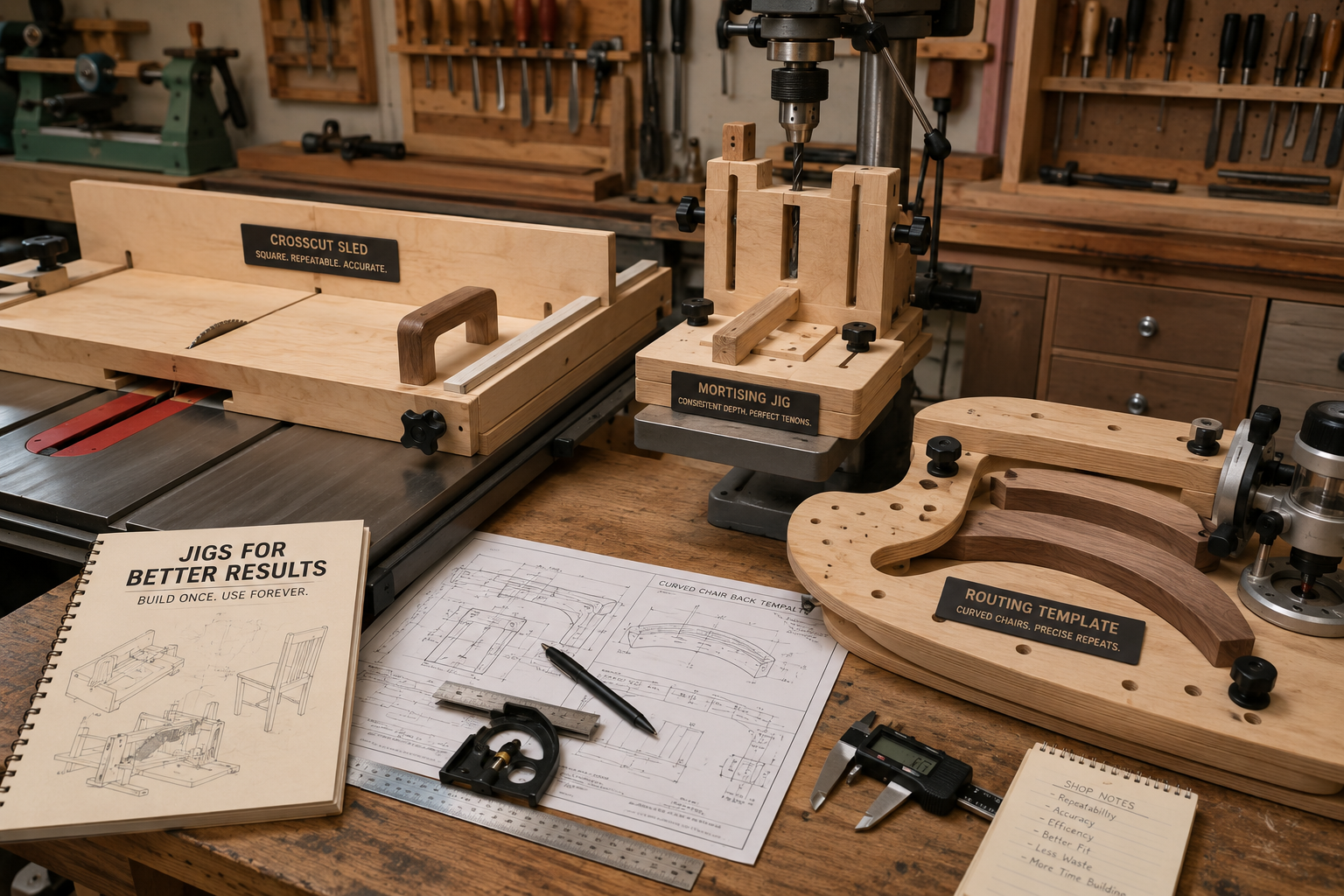
Focusing on these three furniture types allows us to explore a range of common woodworking challenges that jigs can elegantly solve. Each category presents unique opportunities for increasing repeatability and precision in your small workshop.
Chairs: Mastering Angles and Joinery
Chairs are perhaps the most demanding furniture pieces due to their intricate joinery, compound angles, and the need for structural integrity. Each component – legs, rails, stretchers, and back supports – must be identical for stability and aesthetic appeal.
Key Jigs for Chair Making:
- Tapering Jig: Used with a table saw to cut perfectly consistent tapers on chair legs. This jig ensures all four legs are precisely the same length and taper, a critical factor for stability.
- Mortising Jig for Drill Press/Router: Creating identical mortises for rail and stretcher tenons is simplified with a jig. A drill press jig might use a fence and stops to position the workpiece, while a router jig often employs a template guide for precise routing of mortises. For more on advanced joinery, explore Mastering Dovetail Drawers for Cabinets: Hand-Cut and Router Jigs for Seamless Furniture Integration, which includes router jig concepts applicable to other joinery types.
- Angle-Setting Jig: For cutting compound angles on chair back components, a specialized jig for your miter saw or table saw is invaluable. This allows you to quickly and accurately reproduce complex angles across multiple pieces.
- Spindle Duplication Jig (for Lathe): If your chairs feature turned elements, a duplication jig for your lathe can help create identical spindles or legs after the first one is perfected.
Cabinets: Precision Panels and Joinery
Cabinetry relies on accurate panel sizing, precise joinery for carcass assembly, and consistent drawer and door construction. Even a small error can lead to gaps, misalignment, and frustrating installations.
Key Jigs for Cabinet Making:
- Panel Cutting Jig (Track Saw Guide): While not strictly a jig, a track saw system with a precisely guided rail is indispensable for cutting large sheets of plywood or MDF into exact cabinet parts. This replaces the need for a large panel saw. Our article on DIY Smart Workshop Storage Solutions: Maximizing Space and highlights the importance of precise cuts for fitted solutions.
- Dado and Rabbet Jig for Router Table: Creating repeatable dados for shelves or cabinet backs, and rabbets for carcass joinery, becomes effortless with a router table fence and stop blocks. This ensures all dados are the same width and depth, perfectly aligned.
- Drawer Box Jig: For repeatable drawer boxes, jigs for dovetails (using a router or dedicated jig) or simple dado/rabbet joints are crucial. This ensures every drawer glides smoothly and fits perfectly.
- Door and Face Frame Jig: A simple jig for drilling pocket holes or guiding tenons for cabinet face frames ensures consistent dimensions and flush joints.
Tables: Flatness, Joinery, and Assembly
Tables, from coffee tables to dining tables, demand flat surfaces, strong joinery, and consistent leg and apron construction.
Key Jigs for Table Making:
- Router Planing Sled: For flattening wide or irregular slabs without a large planer, a router planing sled (or “slab flattening mill”) is a game-changer. It ensures perfectly flat surfaces, crucial for table tops.
- Tapering Jig (for Table Legs): Similar to chair legs, table legs often require tapers. A robust tapering jig for the table saw ensures all legs are identical. For more projects involving tables, see our guide on High-Demand Woodworking Projects for 2026: Coffee Tables, Wi.
- Mortise and Tenon Jig: For connecting aprons to legs, a consistent mortise and tenon jig (either router-based or for a drill press) provides strong, repeatable joints.
- Doweling Jig: For simple, strong tabletop glue-ups or attaching aprons, a doweling jig ensures perfectly aligned holes for precise dowel placement.
By strategically building and utilizing these specific jigs, even a modest small workshop can produce furniture parts with an accuracy and consistency that rivals larger, more automated operations.
Implementing Jigs for Enhanced Workflow and Scalability

Integrating custom Power Tool Jigs for Repeatable Furniture Parts into your daily workflow requires thoughtful planning and an iterative approach. It’s not just about having the jigs, but about how they fit into your overall production strategy to truly boost efficiency in small workshops.
Designing Your Jigs for 2026’s Cordless Tools
When designing and building your jigs, consider the characteristics of modern cordless tools:
- Ergonomics: Jigs should accommodate the tool’s balance and weight.
- Clearance: Ensure ample space for battery packs and tool handles.
- Dust Collection: Incorporate dust ports or design the jig to minimize chip build-up, especially for routers and saws, which is critical for maintaining visibility and workshop air quality. Building a DIY Smart Workshop Dust Collection System: Integrating IoT offers relevant insights.
- Mounting: Design jigs with quick-release mechanisms or easy clamping solutions for tools that need to be swapped in and out.
- Precision and Stability: Despite portability, cordless tools still demand jigs that provide rock-solid stability and precise guidance. Use high-quality materials like Baltic birch plywood or MDF for jig construction.
For example, a universal router jig could be designed with a base plate that accepts various cordless routers, allowing for quick swaps depending on the bit or power needed. Similarly, crosscut sleds can be optimized for cordless miter saws, ensuring consistent cuts without the cord interfering.
Streamlining Production: From One-Off to Batch Production
The true efficiency gain from jigs comes from moving beyond making one piece at a time. With well-designed jigs, you can adopt a batch production mindset.
- Cut List Optimization: Create a precise cut list for all parts of a furniture piece.
- Rough Milling: Mill all lumber to rough dimensions.
- Batch Processing:
- Dimensioning: Use table saw jigs (like crosscut sleds, tapering jigs) to bring all similar parts to final dimensions.
- Joinery: Use mortising jigs, doweling jigs, or dovetail jigs to cut all corresponding joints on batches of parts.
- Shaping/Profiling: Use router jigs for any decorative or functional profiles.
- Sanding/Finishing Prep: Perform initial sanding or surface preparation on batches of parts before assembly.
This process significantly reduces setup time between operations and minimizes errors, as each jig setup is verified once for an entire batch of parts. The uniformity provided by the jigs ensures that when it comes time for assembly, parts fit together seamlessly, much like a factory-produced product.
The Role of Jigs in Small Workshop Scalability
Jigs are a powerful tool for scalability in small workshops without the need for massive capital expenditure. They allow for:
- Consistent Quality: Every piece in a batch meets the same high standard.
- Reduced Waste: Fewer errors mean less wasted material.
- Faster Production Times: Efficient batch processing increases output.
- Lower Labor Costs: Less time spent on individual measurements and corrections.
- Increased Profitability: Higher output of quality products leads to better revenue.
For example, if you’re building a series of console tables, having dedicated jigs for the leg joinery, apron cutting, and shelf dados means you can produce multiple sets of components quickly and accurately. This allows you to fulfill larger orders or build inventory efficiently. Our guide on Power Tool Mastery for Building Console Tables: Modern Entryway Furniture for Small Spaces further illustrates this concept.
Ultimately, integrating well-designed Power Tool Jigs for Repeatable Furniture Parts into your small workshop transforms it from a custom-order-only operation to one capable of efficient, small-batch production. This not only boosts your productivity but also elevates the professional quality of your work.
Advanced Jigging Techniques and Future Considerations
As your skills and production needs grow, so too can your jigging sophistication. Advanced techniques can further refine your process and open up new design possibilities.
Universal Jigs and Modular Systems
Instead of building a separate jig for every single task, consider designing universal jigs that can be adapted for multiple operations. For example, a single router base jig could accept various sub-bases for different templates, or a table saw sled could have interchangeable fences for diverse angles. Modular jig systems, where components can be reconfigured, offer flexibility and save space – a crucial factor in a small workshop. Think about a Building a Portable Workbench: Designs for Small Spaces and On-the-Go that integrates modular jig components directly into its design.
Material Selection for Jigs
The material you choose for your jigs impacts their accuracy and longevity.
- MDF (Medium Density Fiberboard): Excellent stability, flat, and relatively inexpensive. Great for templates and general-purpose jigs.
- Baltic Birch Plywood: Strong, stable, multi-ply construction makes it resistant to warping. Ideal for fences, sled bases, and high-wear areas.
- Phenolic Plywood: Extremely hard-wearing, low-friction surface, and highly stable. Excellent for router table inserts and precision sliding components.
- Aluminum Extrusions: Can be incorporated for fences, clamping mechanisms, and T-track systems, offering durability and adjustability.
Always consider the tool contact points and areas of wear. Adding replaceable sacrificial fences or wear strips can extend the life of your jigs significantly.
Maintenance and Calibration
Even the best jigs need periodic maintenance and calibration.
- Cleanliness: Keep jigs free of sawdust and glue residue, which can affect accuracy.
- Squareness/Parallelism Checks: Regularly check that fences are square to blades, and guides are parallel to cuts. Even slight shifts can lead to errors.
- Hardware Inspection: Tighten fasteners, replace worn-out clamps, and lubricate moving parts.
A small investment in jig maintenance ensures continued accuracy and reliability, preventing costly mistakes down the line.
Integrating Digital Design and Manual Jigging
While this article emphasizes manual jigging to avoid CNC, digital design tools (CAD software) can still play a crucial role. You can design your furniture pieces and then plan your jigs digitally, ensuring precise dimensions before you ever cut a piece of wood. Some advanced jig concepts might even involve laser-cut templates or 3D-printed components to enhance their accuracy and functionality. This hybrid approach combines the accessibility of manual woodworking with the precision of digital planning.
The adaptability and cost-effectiveness of custom jigs make them an enduring asset for any woodworker focused on Power Tool Jigs for Repeatable Furniture Parts. As new cordless power tool innovations emerge in 2026 and beyond, the potential for creative and efficient jig solutions will only expand, ensuring that even the smallest workshop can achieve remarkable levels of precision and productivity.
Conclusion
The pursuit of excellence in woodworking, particularly when producing multiple pieces, hinges on consistency and precision. Power Tool Jigs for Repeatable Furniture Parts are not merely accessories; they are foundational tools that unlock efficiency and scalability for small workshops. By meticulously designing and implementing jigs for critical operations in furniture making—especially for chairs, cabinets, and tables—woodworkers can transcend the limitations of manual measurement and achieve factory-level accuracy and repeatability without the prohibitive cost of CNC machinery.
The current landscape of cordless power tool technology in 2026 further empowers this approach, offering unparalleled mobility, precision, and ease of use. This synergy between advanced tools and smart jig design reduces errors, minimizes waste, and dramatically cuts down production time, directly translating into higher quality products and increased profitability. For any woodworker aspiring to elevate their craft and boost their output, embracing a comprehensive jigging strategy is an actionable and rewarding next step.
To truly capitalize on these benefits, start by identifying repetitive tasks in your most common furniture projects. Then, design or adapt jigs that address these specific challenges, focusing on safety, durability, and ease of use. Regularly calibrate and maintain your jigs, and don’t hesitate to experiment with modular designs to maximize their versatility. By committing to a jig-centric workflow, your small workshop will not only enhance its productive capacity but also solidify its reputation for delivering consistently high-quality, precision-made furniture.
SEO Meta Title: Power Tool Jigs: Boost Small Workshop Efficiency in 2026 SEO Meta Description: Master Power Tool Jigs for repeatable furniture parts like chairs, cabinets, and tables. Boost efficiency in your small workshop with 2026 cordless tool upgrades.