
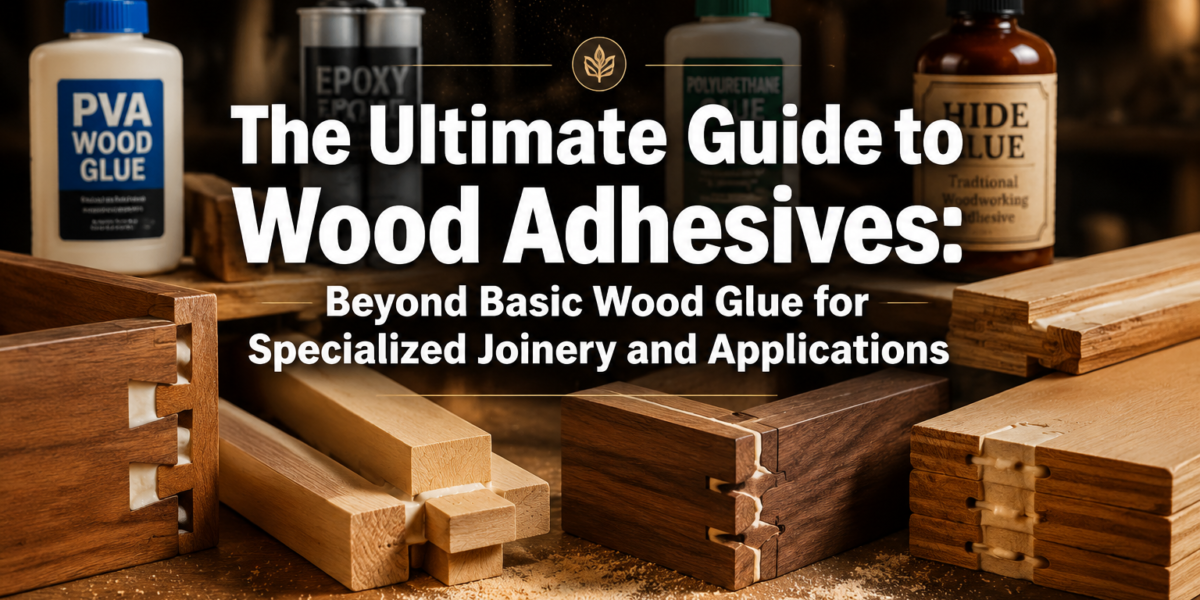
The average woodworker might assume a bottle of yellow PVA glue is sufficient for almost any project. However, this narrow perspective often leads to compromised joints, failed projects, and a fundamental misunderstanding of wood’s inherent complexities. In reality, the world of wood adhesives is far more diverse and specialized, offering tailored solutions that go significantly “Beyond Basic Wood Glue for Specialized Joinery and Applications.” Selecting the correct adhesive is as critical as choosing the right wood or the appropriate joinery technique. This guide will explore the often-overlooked distinctions between various wood glues, revealing how different formulations excel in specific conditions, from high-stress structural applications to delicate veneer work and projects exposed to the elements.
Key Takeaways
- Diverse Adhesives for Diverse Needs: Beyond standard PVA, specialized glues like epoxy, polyurethane, CA glue, and hide glue offer unique properties essential for specific woodworking challenges.
- Matching Glue to Joinery: The type of joint (e.g., dovetail, mortise and tenon, laminations) dictates the ideal adhesive, considering factors like gap-filling, open time, and ultimate strength.
- Environmental Factors are Crucial: Water resistance, temperature fluctuations, and UV exposure necessitate specific adhesive types, particularly for outdoor or marine applications.
- Understanding Wood Properties: Different wood species and their movement characteristics influence adhesive choice, with some glues offering greater flexibility or better adhesion to oily woods.
- Application Techniques Matter: Proper surface preparation, clamping, and cure times are vital for achieving the strongest bond, regardless of the adhesive used.
Delving Into Adhesive Chemistry: Beyond PVA for Specialized Joinery and Applications
While PVA (polyvinyl acetate) glues, commonly known as carpenter’s glue, are workhorses in many shops due to their ease of use, strong bond, and non-toxic nature, they represent only a fraction of what’s available. To truly master woodworking, one must understand the properties and applications of a broader range of adhesives. This understanding is particularly crucial for “The Ultimate Guide to Wood Adhesives: Beyond Basic Wood Glue for Specialized Joinery and Applications.”
Polyvinyl Acetate (PVA) Glues
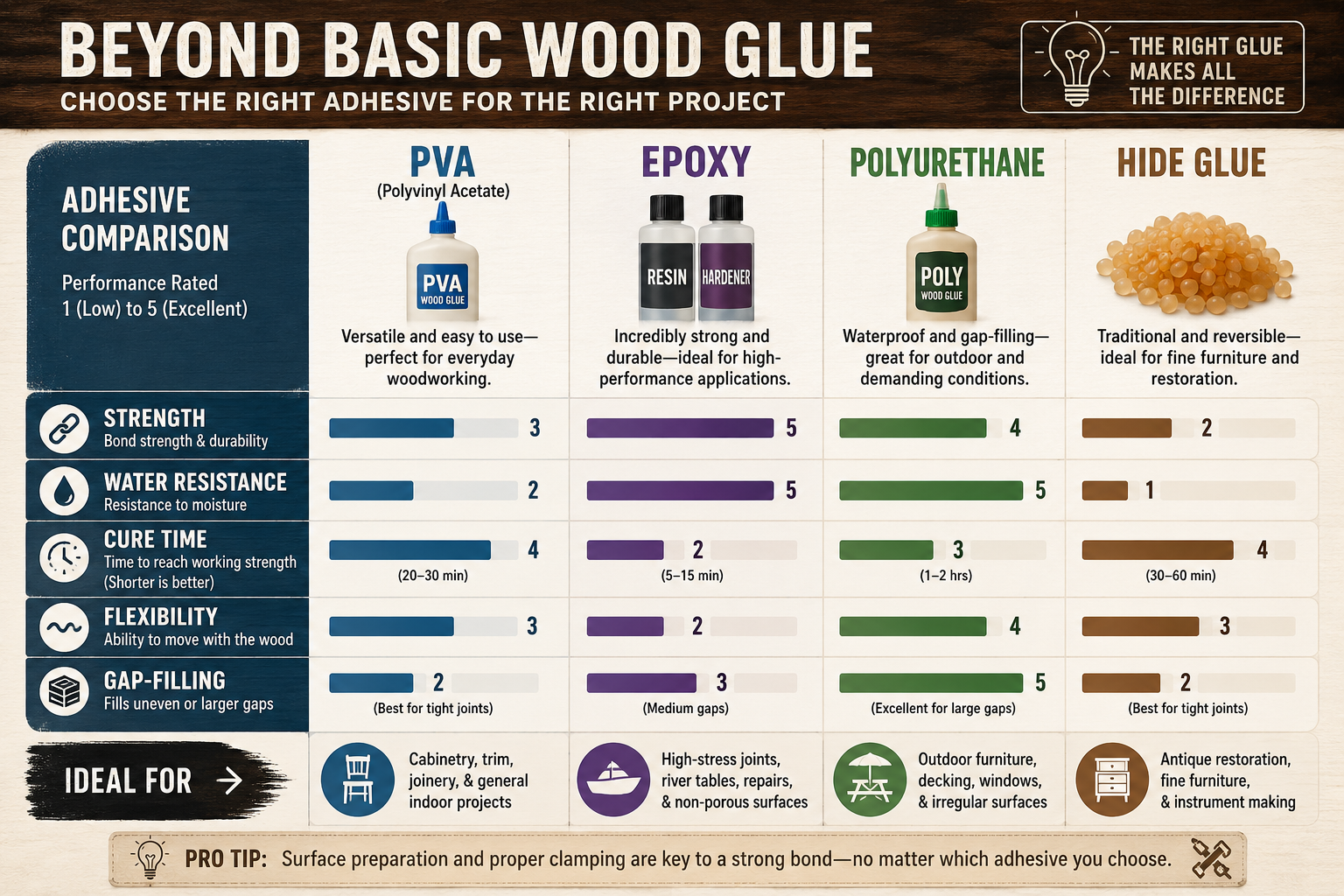
PVA glues are water-based and cure by evaporation. They offer good bond strength, are easy to clean up with water, and are generally food-safe once cured (though not typically for direct food contact surfaces unless specified). Different formulations exist:
- Type I (Titebond I, Elmer’s Wood Glue): Standard interior glue, good for general furniture and cabinetry. Not water-resistant.
- Type II (Titebond II): Water-resistant, suitable for interior projects that might see occasional moisture exposure, like kitchen cabinets or bathroom vanities.
- Type III (Titebond III): Waterproof, making it ideal for outdoor furniture, cutting boards, and projects exposed to the elements. It also has a longer open time and cures harder than Type I or II.
While versatile, PVA glues don’t fill gaps well and are generally inflexible once cured, making them less suitable for joints with imprecise fit or applications requiring some movement.
Epoxy Adhesives
Epoxy is a two-part adhesive consisting of a resin and a hardener that, when mixed, undergo a chemical reaction to create a very strong, rigid, and often waterproof bond.
- Strengths: Exceptional strength, excellent gap-filling capabilities, waterproof, and can bond dissimilar materials. They also resist heat and many chemicals. This makes them indispensable for structural joinery, boat building, and repairing damaged wood, including filling large voids.
- Weaknesses: Longer cure times, more complex mixing ratios, higher cost, and can be messy. Some epoxies are brittle, though flexible formulations exist.
- Applications: Ideal for marine projects, large structural laminations, securing hardware into wood, and repairing rotted wood. For projects like building a custom wood workbench, epoxy can reinforce critical joints.
Polyurethane (PU) Glues
Polyurethane glues are moisture-curing adhesives known for their incredible strength, flexibility, and waterproof properties. They expand slightly as they cure, which helps fill small gaps.
- Strengths: Waterproof, very strong, good flexibility, excellent adhesion to a wide range of materials, including oily woods, and good gap-filling due to expansion.
- Weaknesses: Requires moisture to cure (can be a double-edged sword), can stain wood, requires good ventilation, and cleanup is difficult once cured.
- Applications: Excellent for outdoor furniture, boat repairs, bonding oily or exotic woods, and applications where some flexibility is desired. Their expansion can be beneficial for slightly imperfect joints.
Cyanoacrylate (CA) Glues (Super Glue)
CA glues are fast-acting, high-strength adhesives that cure rapidly in the presence of moisture (even ambient humidity).
- Strengths: Extremely fast cure time, good for small, precise bonds, and excellent for veneer repairs or securing small parts. Available in thin, medium, and thick viscosities.
- Weaknesses: Brittle, poor gap-filling (unless specific gap-filling formulations are used), short open time, and can bond skin instantly. Not suitable for large structural joints.
- Applications: Perfect for attaching small details, quick fixes, stabilizing cracks before filling, or assisting in the assembly of intricate wooden gift boxes where instant tack is beneficial.
Hide Glues
Traditional hide glue is a protein-based adhesive derived from animal collagen. It is applied warm and gels as it cools, then cures by drying. Modern liquid hide glues are available but offer different characteristics.
- Strengths (Traditional): Reversible with heat and moisture (ideal for repairs and antique restoration), long open time when warm, creeps very little under stress, excellent for invisible glue lines, and allows for disassembly.
- Weaknesses (Traditional): Requires heating, susceptible to moisture, and has a learning curve. Liquid hide glue has less strength and reversibility.
- Applications: Historically significant for fine furniture making, instrument building, and antique restoration where reversibility is critical. Also used in veneering.
Specialized Adhesives and Considerations
Beyond these main categories, other specialized glues cater to niche applications:
- Contact Cement: Used for bonding large, thin sheets like laminates or veneers. It bonds instantly on contact.
- Construction Adhesives: Often polyurethane-based, these are heavy-duty, gap-filling adhesives for construction and rough carpentry, not typically fine woodworking.
- Hot Melt Glue: Provides quick, temporary bonds for jigs, fixtures, or holding parts while a stronger glue cures.
Choosing the right adhesive is a cornerstone of successful woodworking, ensuring the longevity and integrity of your creations. Consider the project’s environment, the type of joinery, and the wood species involved to make an informed decision.
Matching Adhesives to Specialized Joinery and Applications in 2026
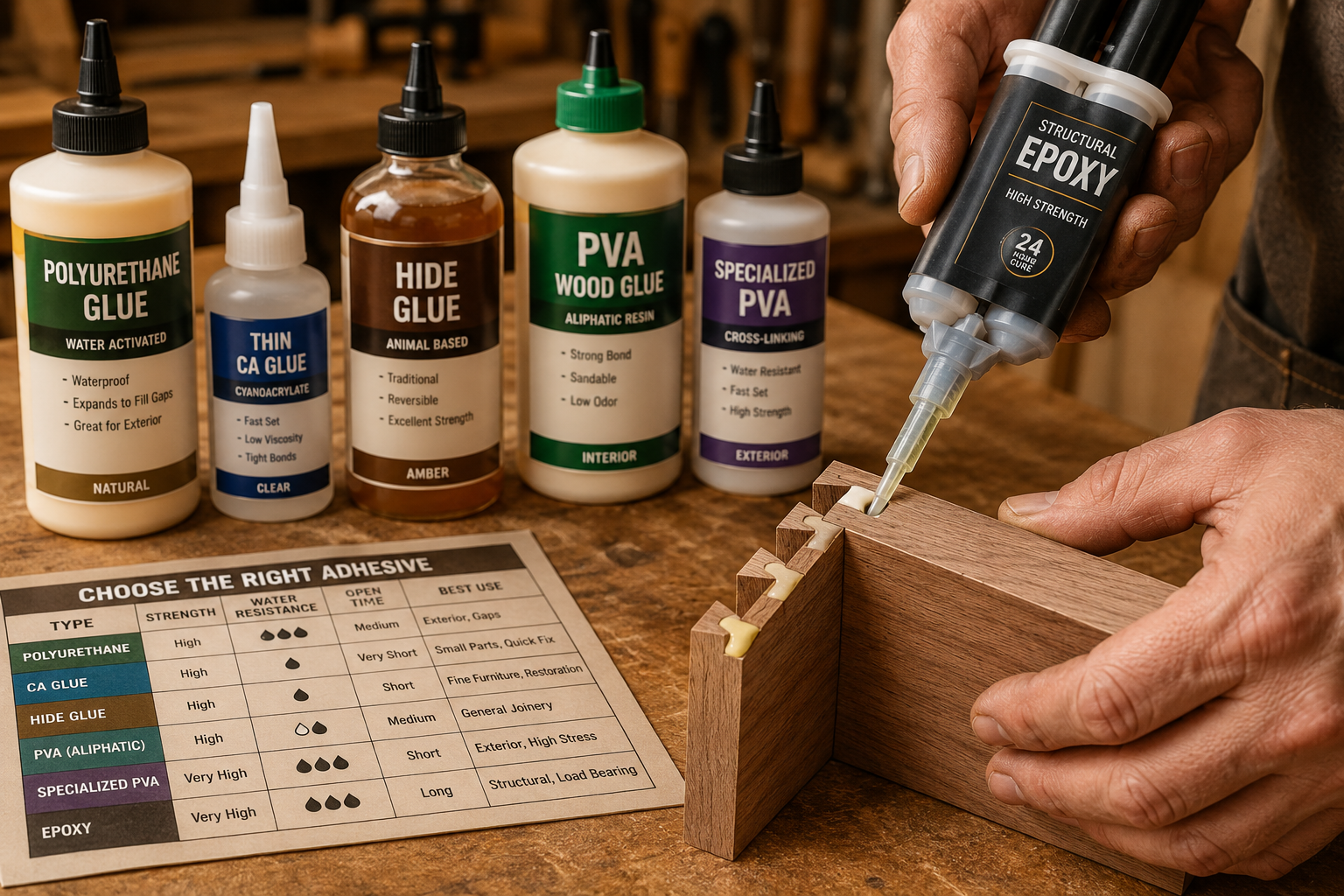
The effectiveness of a wood joint hinges not just on its design but crucially on the adhesive binding it. For “The Ultimate Guide to Wood Adhesives: Beyond Basic Wood Glue for Specialized Joinery and Applications,” understanding this synergy is paramount in 2026. Different joinery types present unique challenges and opportunities for various glues.
Precision Joinery: Dovetails, Mortise and Tenon, Box Joints
For these classic, tightly fitting joints, where wood-to-wood contact is maximized, the goal is often maximum bond strength with minimal glue line visibility.
- PVA Glues (Type I or II): Excellent choice for most interior furniture. They offer strong bonds when clamped tightly and excess squeeze-out is easily cleaned. For example, when crafting visible joints like those discussed in Hand Tool Joinery for Visible Wood Joints, a clean glue line is paramount.
- Hide Glue (Traditional or Liquid): Particularly for fine furniture, hide glue is preferred for its reversibility and ability to produce nearly invisible glue lines. Its long open time (when hot) allows careful assembly of complex joints.
- Epoxy (Thin Viscosity): While overkill for most standard dovetails, a thin epoxy can be used for very strong structural joints, especially in situations where some minor gaps might be present, or extreme durability is needed.
Laminations and Gluing Up Panels
When joining multiple boards edge-to-edge or face-to-face for tabletops, thick slabs, or bent laminations, consistent strength across a large surface area is key.
- PVA Glues (Type II or III): The go-to for panel glue-ups due to their ease of use, strong bond, and cost-effectiveness. Type III is ideal for cutting boards or outdoor tabletops where moisture exposure is expected, as highlighted in the Ultimate Guide to Wooden Cutting Boards.
- Epoxy: For structural laminations, boat building, or situations demanding maximum strength and waterproof integrity (e.g., curved laminations that will be stressed), epoxy is unmatched. Its slower cure time allows for careful alignment of large components.
Outdoor and Marine Applications
Projects exposed to moisture, UV radiation, and temperature fluctuations demand highly durable, waterproof adhesives.
- PVA Glue (Type III): The minimum requirement for outdoor projects. It offers good water resistance but is not suitable for continuous immersion.
- Polyurethane Glue: Excellent for outdoor applications, especially with oily woods, due to its waterproof nature and flexibility. Its expanding foam can help fill small voids.
- Epoxy: The gold standard for marine projects, boats, and any structural outdoor application. It offers superior waterproof performance, gap-filling, and structural integrity.
Repair and Restoration
For fixing broken pieces, filling voids, or reattaching veneers, specific adhesive properties are invaluable.
- CA Glues: Ideal for quickly reattaching small, delicate splinters, fixing veneer bubbles (using a thin viscosity), or stabilizing hairline cracks.
- Epoxy: Indispensable for repairing larger breaks, filling significant voids, consolidating rotted wood, or reattaching broken parts where structural integrity is critical. Various fillers can be added to epoxy to match color or create a thick paste.
- Hide Glue (Traditional): The preferred choice for antique furniture restoration, as its reversibility allows for non-damaging repairs and future interventions.
Specialized Bonding Challenges
Some situations call for adhesives with unique properties.
- Oily or Exotic Woods: Polyurethane glues and specific epoxy formulations often perform better on oily woods that can inhibit the bond of PVA glues.
- Metal-to-Wood or Plastic-to-Wood: Epoxy excels here, providing strong bonds between dissimilar materials.
- Veneering: Traditional hide glue is excellent for its reversibility. PVA glues are common, but contact cement is also used for large, flat applications. For securing mirrors to wood, specialized adhesives for mirrors on wood are recommended.
Understanding the specific demands of each project and selecting the appropriate adhesive ensures not just a strong bond, but a lasting, high-quality result.
Essential Techniques for Optimal Adhesion: The Ultimate Guide to Wood Adhesives
Even the best adhesive will fail if not applied correctly. Achieving maximum bond strength and a professional finish requires attention to detail, proper preparation, and understanding the curing process. This section of “The Ultimate Guide to Wood Adhesives: Beyond Basic Wood Glue for Specialized Joinery and Applications” focuses on the practical techniques vital for success in 2026.
Surface Preparation
Clean, properly prepared surfaces are fundamental to strong glue bonds.
- Cleanliness: Wood surfaces must be free of dust, grease, wax, old finishes, and dirt. A quick wipe with a damp cloth (for water-based glues) or a solvent (for polyurethane or epoxy) can be beneficial, ensuring the surface is dry before application.
- Freshly Milled Surfaces: Adhesives bond best to freshly cut or sanded wood. Avoid trying to glue surfaces that have been left exposed for too long, as oxidation or absorption of ambient moisture/oils can affect adhesion.
- Fit: Good joinery dictates that parts fit snugly. Gaps larger than a few thousandths of an inch significantly reduce the strength of PVA bonds. While gap-filling adhesives like epoxy or polyurethane can tolerate larger gaps, striving for a tight fit is always best for ultimate strength.
Application and Open Time
The way glue is applied and the time allowed before clamping are critical.
- Even Spread: Apply an even, thin coat of glue to both surfaces of the joint. Too little glue leads to “starved joints,” while too much can create hydraulic pressure, preventing a tight clamp, and excessive squeeze-out.
- Open Time: This is the time between applying the glue and bringing the parts together. Each adhesive has a specific open time (check manufacturer’s instructions). Exceeding this time causes the glue to partially cure, resulting in a weak bond. For slow-setting glues like traditional hide glue, a longer open time is an advantage.
- Assembly Time: This is the total time from glue application until clamping pressure is fully applied. It encompasses open time and the time it takes to assemble the joint.
Clamping and Pressure
Proper clamping ensures intimate contact between surfaces for the glue to bond effectively.
- Sufficient Pressure: Apply enough clamping pressure to bring the joint surfaces into full contact and achieve a small, even bead of squeeze-out. Over-clamping can starve a joint of glue.
- Even Distribution: Use cauls or clamp pads to distribute pressure evenly and prevent denting the wood.
- Duration: Keep clamps on for the recommended clamping time, which can range from 30 minutes to several hours depending on the glue, temperature, and humidity. Even after removing clamps, the glue is still curing, so avoid stressing the joint for at least 24 hours. For advanced techniques, proper clamping complements sharp tools, as explored in The Ultimate Guide to Sharpening Woodworking Chisels and Planes.
Curing and Cleanup
The final stages involve allowing the glue to fully cure and cleaning up excess.
- Full Cure Time: This is the time it takes for the adhesive to reach its maximum strength, often 24-72 hours. Do not expose the joint to stress or moisture before full cure.
- Temperature and Humidity: These factors significantly impact cure times. Most glues prefer moderate temperatures (65-75°F / 18-24°C) and average humidity. High humidity can accelerate polyurethane cure, while low temperatures slow down most adhesives.
- Cleanup:
- PVA Glues: Wipe off squeeze-out with a damp cloth immediately. Once cured, it’s harder to remove and can interfere with finishes.
- Epoxy/Polyurethane: Clean wet squeeze-out with appropriate solvents (denatured alcohol for some epoxies, mineral spirits for polyurethane). Once cured, removal usually requires mechanical means like scraping or sanding.
- Hide Glue: Warm water will dissolve both wet and cured hide glue.
By adhering to these fundamental techniques, woodworkers can ensure their joints are not just strong, but structurally sound and aesthetically pleasing, reinforcing the comprehensive nature of “The Ultimate Guide to Wood Adhesives: Beyond Basic Wood Glue for Specialized Joinery and Applications.”
Conclusion
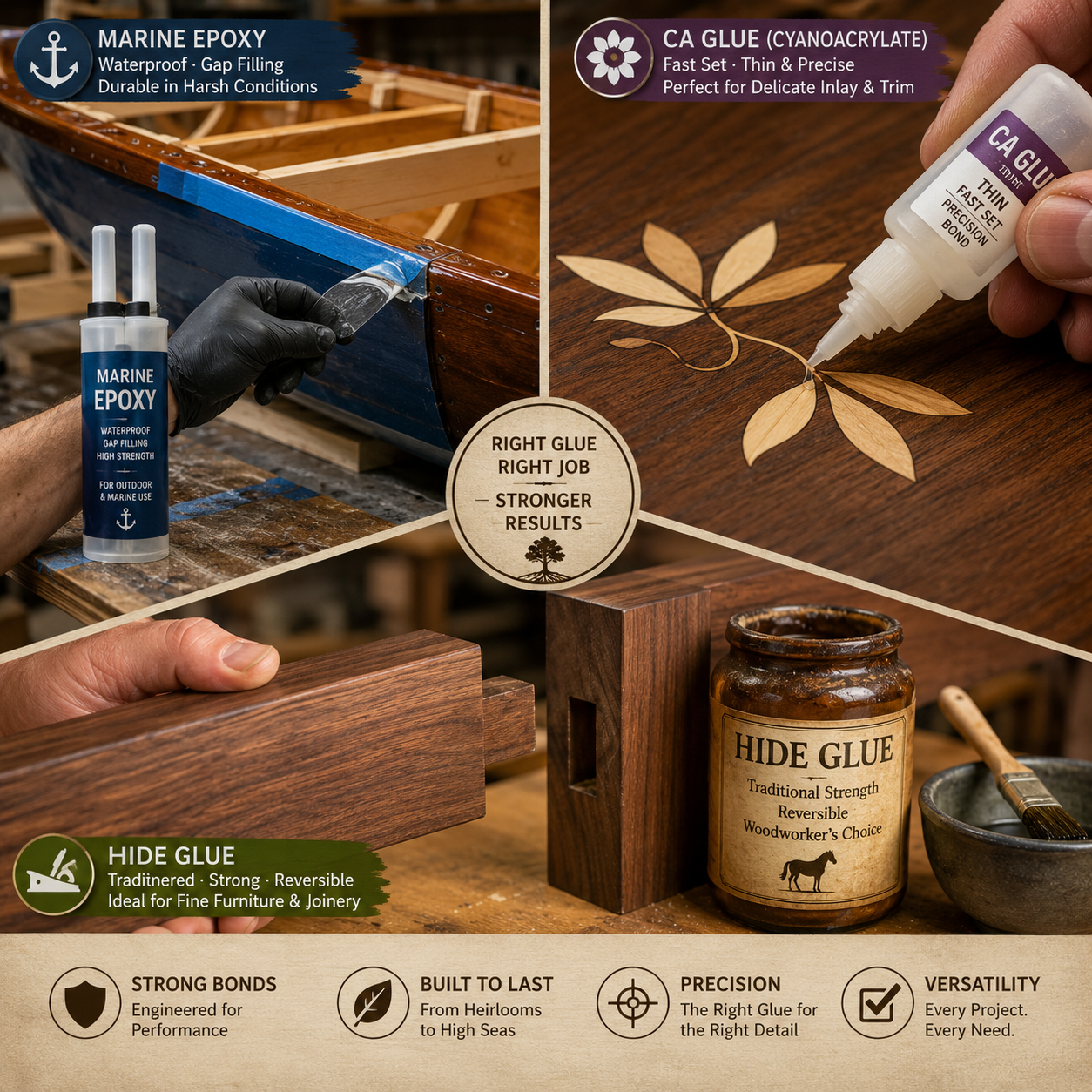
The journey through “The Ultimate Guide to Wood Adhesives: Beyond Basic Wood Glue for Specialized Joinery and Applications” reveals that mastery in woodworking extends far beyond the cut of a joint to the very bond that holds it together. Relying solely on a single type of wood glue, however versatile, limits the potential for durable, high-performance, and specialized projects. From the waterproof resilience of epoxy and polyurethane for outdoor and marine applications, to the fast-acting precision of CA glue for delicate work, and the reversible, historically significant bonds of hide glue for fine furniture and restoration, each adhesive plays a crucial role.
The informed woodworker in 2026 recognizes that selecting the right adhesive is a critical design decision, influencing a project’s strength, longevity, and resistance to environmental factors. It requires an understanding of not just the glue’s properties, but also the specific demands of the joinery, the characteristics of the wood, and the intended use of the finished piece. By meticulously preparing surfaces, applying adhesives correctly, ensuring proper clamping, and allowing for full cure, one can unlock the full potential of these specialized bonds.
To elevate your craftsmanship, make it a practice to evaluate each project’s adhesive needs thoroughly. Experiment with different glues on scrap pieces to understand their working properties. Embrace this diverse arsenal of adhesives, and your woodworking projects will undoubtedly achieve new levels of strength, beauty, and resilience.