
In a world increasingly dominated by power tools, the true artisan knows that ultimate precision, sensitivity, and the tactile connection to wood often lie in the judicious use of hand tools. While a table saw might rip a board in seconds, it cannot replicate the delicate paring action of a finely tuned chisel, nor can a router match the whisper-thin shavings of a hand plane bringing a surface to a lustrous finish. This article delves into Hand Tool Mastery for Detail Work: Chisels, Hand Planes, and Rasps for Refined Joinery and Finishing, offering a comprehensive guide to embracing these foundational instruments for unparalleled craftsmanship in 2026. For woodworkers seeking to elevate their skill, move beyond rough cuts, and achieve truly refined results, understanding these tools is not merely an option—it’s essential.
Key Takeaways
- Precision and Control: Hand tools like chisels, planes, and rasps offer unmatched control for achieving tight-fitting joints and silky-smooth surfaces, often surpassing what power tools can accomplish in detail work.
- Essential Tool Selection: Choosing the right type of chisel, hand plane, or rasp for specific tasks is crucial for efficient and effective detail work.
- The Art of Sharpening: A sharp edge is non-negotiable for hand tool performance. Mastering sharpening techniques ensures clean cuts, reduces effort, and enhances safety.
- Applications in Joinery: Chisels are indispensable for joinery, allowing for precise fitting of mortises, tenons, and dovetails, while hand planes achieve perfect flushness and crisp edges.
- Refining Surfaces and Shaping: Hand planes provide the ultimate smooth finish, eliminating machine marks, and rasps are fundamental for shaping curves and intricate details with control.
The Foundation of Hand Tool Mastery for Detail Work: Selecting and Preparing Your Instruments
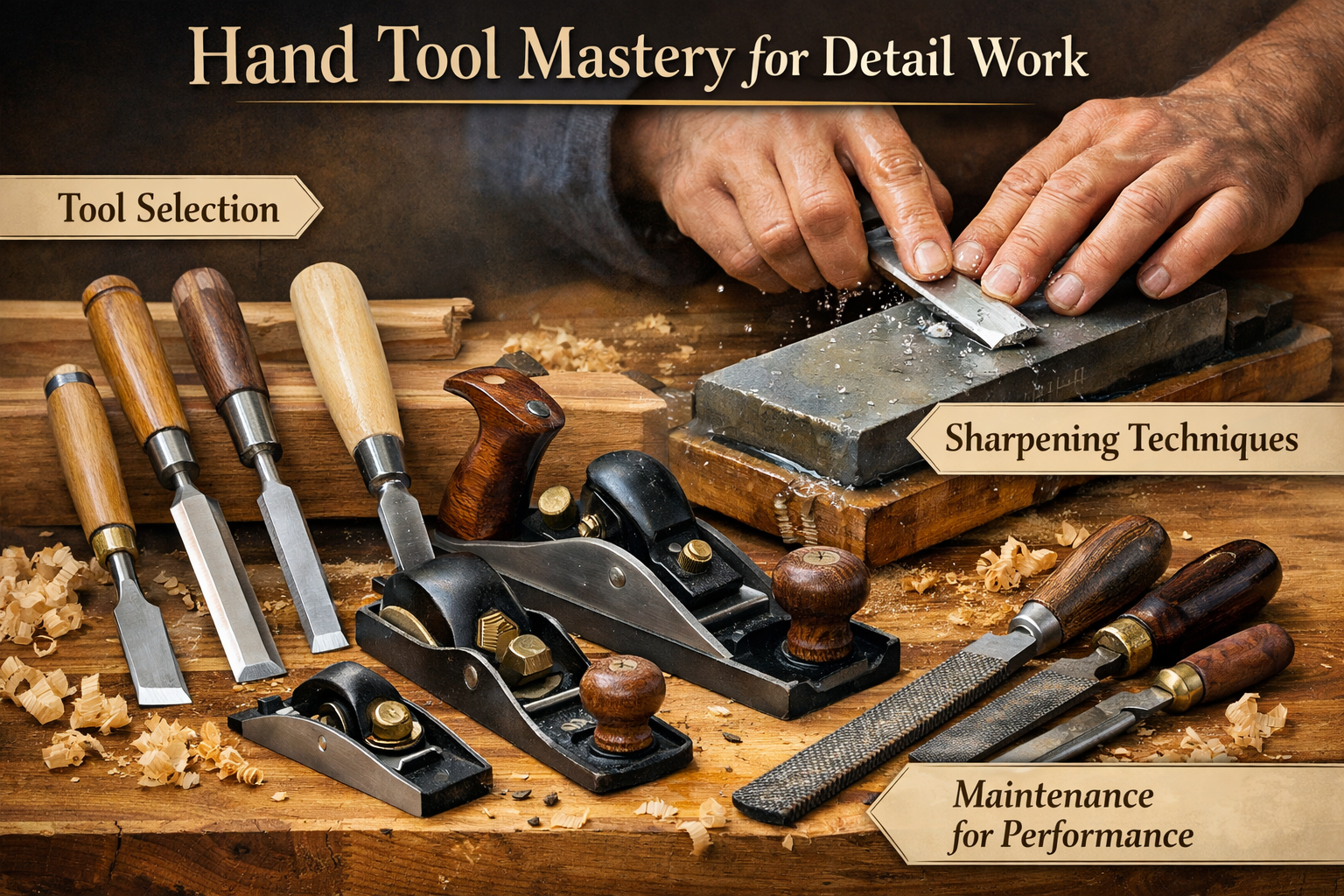
Achieving Hand Tool Mastery for Detail Work: Chisels, Hand Planes, and Rasps for Refined Joinery and Finishing begins with a thoughtful selection of tools and, critically, their meticulous preparation. A dull tool is not just inefficient; it’s dangerous and frustrating. Investing in quality tools and maintaining them properly is paramount.
Understanding Chisels: Types and Their Uses
Chisels are perhaps the most versatile of hand tools for detail work. They come in various forms, each designed for specific tasks:
- Bench Chisels: The most common type, with a bevelled edge, ideal for general-purpose work, paring, and chopping. They range in width from 1/8 inch to 2 inches.
- Paring Chisels: Longer and thinner than bench chisels, designed for delicate shaving and precise fitting of joints where utmost control is required. Their long handles allow for a two-hand grip, providing leverage and finesse.
- Mortise Chisels: Heavy-duty chisels with thick, strong blades, designed to withstand the leverage needed for chopping out deep mortises. Their robust construction prevents bending or breaking.
- Dovetail Chisels: Feature very thin sides that allow them to reach into the acute angles of dovetail joints, cleaning up corners without bruising adjacent wood.
| Chisel Type | Primary Use | Key Feature |
|---|---|---|
| Bench Chisel | General paring, chopping, cleaning | Bevelled edge, versatile widths |
| Paring Chisel | Fine shaving, precise joint fitting | Long, thin blade; extended handle |
| Mortise Chisel | Chopping deep mortises | Thick, robust blade; strong ferrule |
| Dovetail Chisel | Cleaning dovetail angles | Very thin, undercut sides |
Hand Planes: Shaping and Finishing
Hand planes are essential for bringing surfaces to a true, flat, and smooth finish, as well as for precise sizing and shaping.
- Block Planes: Small, one-handed planes, excellent for chamfering edges, fitting small parts, and planing end grain. Their low angle makes them effective on difficult grain.
- Smoothing Planes: Typically 9-10 inches long, used for final surfacing work to remove machine marks and bring a board to a silky smooth finish. They often have a slightly cambered iron.
- Rabbet Planes: Designed for cutting rabbets (shoulders) and dados. Some even feature adjustable fences and depth stops for accuracy.
- Specialty Planes: This category includes jointing planes (for truing edges), spokeshaves (for curved work), and various smaller planes for specific detailing.
For more on fine woodworking, explore this guide on fine woodworking detail crossword clue: unraveling the puzzle.
Rasps: The Sculptor’s Friend
Rasps are the unsung heroes of shaping wood by hand. Unlike files, which have individual teeth that cut, rasps have individual, raised cutting teeth that are formed by punching the steel. This makes them ideal for aggressive material removal on curves and irregular shapes, yet with careful application, they can achieve surprising levels of refinement.
- Wood Rasps: Available in various coarseness levels (coarse, cabinet, regular) and shapes (flat, half-round, round, rat-tail). Essential for shaping curves, removing excess material quickly, and refining contours.
- Auriou or Liogier Rasps: High-end, hand-stitched rasps known for their exceptional cutting ability and smooth finish. Each tooth is individually created by hand, allowing for a much cleaner cut than machine-made rasps.
The Non-Negotiable Step: Sharpening and Honing
Regardless of the tool, its effectiveness hinges on its sharpness. A truly sharp edge slices wood fibers cleanly, leaving a smooth surface and requiring less effort. Dull tools tear fibers, leave ragged surfaces, and are prone to slipping.
“A sharp tool is a safe tool. It cuts where you intend it to, with less force, reducing the chance of error and injury.”
Key elements of sharpening include:
- Grinding: To establish the primary bevel (typically 25-30 degrees for chisels and plane irons). This is often done on a grinding wheel or a coarse diamond plate.
- Honing: Using progressively finer sharpening stones (waterstones, oilstones, diamond stones) to refine the edge and remove the burr, culminating in a highly polished, razor-sharp edge. Angles typically range from 30-35 degrees for the secondary bevel.
- Stropping: The final step, using a leather strop charged with honing compound, to remove any microscopic burr and polish the edge to an incredible keenness.
Regular maintenance, including light honing after each use and a full sharpening cycle as needed, ensures your tools are always ready for precision work.
Hand Tool Mastery for Refined Joinery and Finishing: Chisels and Planes in Action
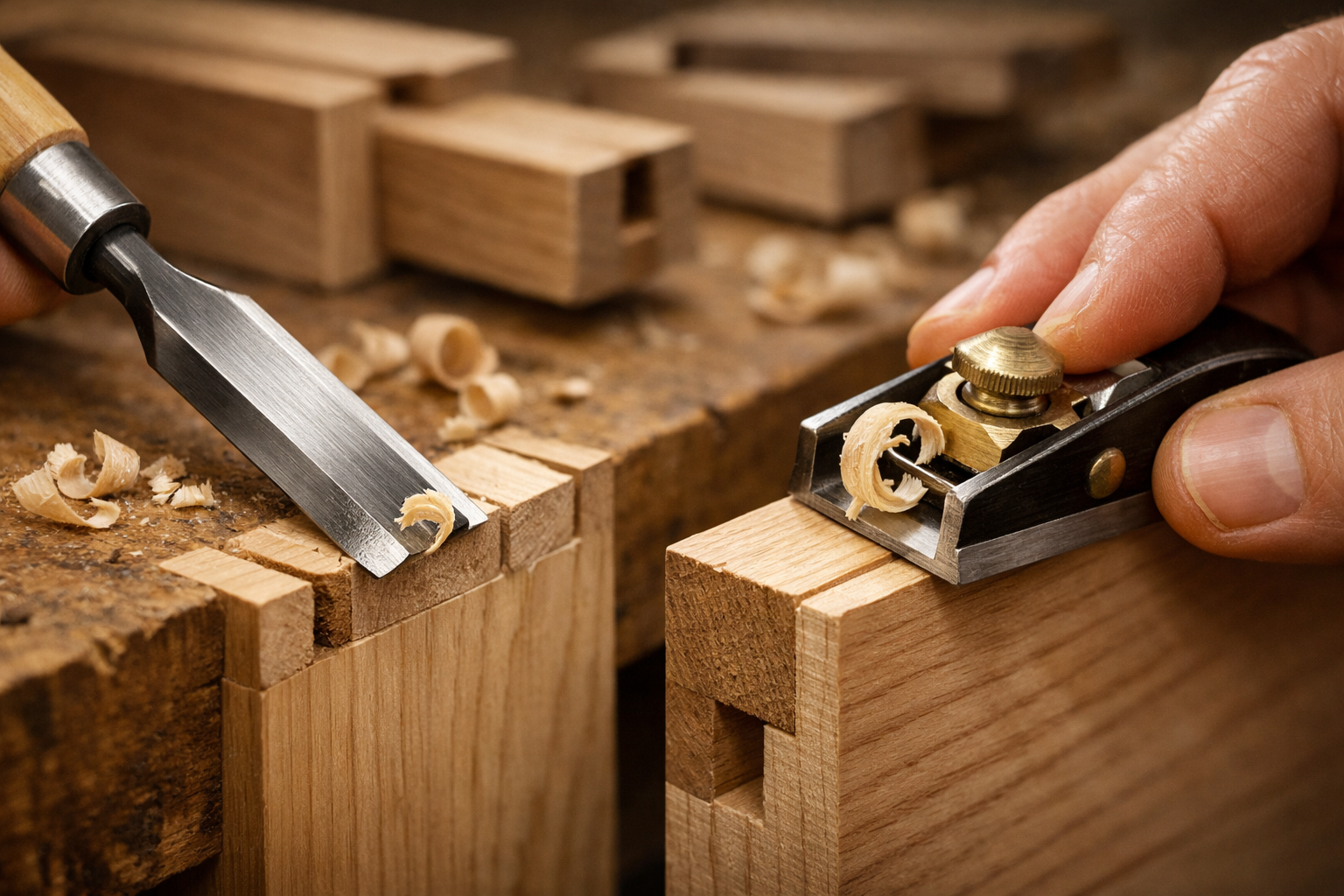
With properly sharpened tools, the world of refined joinery and finishing opens up. This section explores how to leverage chisels and hand planes to create joints that fit perfectly and surfaces that gleam.
Precision Joinery with Chisels
Chisels are indispensable for crafting strong, aesthetically pleasing joints.
- Dovetails: The hallmark of fine woodworking, dovetails are almost exclusively finished with chisels. After sawing the initial waste, paring chisels are used to clean up pin and tail sockets to the scribe lines, ensuring a tight, gap-free fit. Ultimate DIY End Tables often feature dovetail drawers.
- Mortise and Tenon Joints: While mortises can be drilled, a mortise chisel is used to square the ends and clean the walls, ensuring the tenon fits snugly. Paring chisels then refine the tenon shoulders for a perfect fit against the mortise.
- Laps and Rabbets: Chisels are vital for cleaning out corners and squaring shoulders of these simpler joints, guaranteeing accuracy and strength.
Techniques for Chisel Use:
- Paring: Holding the chisel with both hands, guiding the bevel down, and using body weight or hand pressure to slice off thin shavings. This requires extreme sharpness and control.
- Chopping: For heavier waste removal, such as in mortises, the chisel is held perpendicular to the wood, and struck with a mallet. It’s crucial to chop in from both sides to prevent blow-out.
- Shearing Cut: Angling the chisel slightly to the direction of cut, allowing the edge to slice through fibers rather than push directly. This results in a cleaner cut and less effort.
Achieving Superior Finishes with Hand Planes
Hand planes are unmatched for creating surfaces that are truly flat, smooth, and free of defects, providing the perfect foundation for any finish.
- Flattening and Truing: Larger planes (jointer planes) can be used to true up rough stock, but smoothing planes are critical for eliminating saw marks, planer snipe, and other imperfections from machine planing. They reveal the true beauty of the grain.
- Flush Trimming: After assembly, hand planes excel at bringing adjacent surfaces perfectly flush. A block plane or a small smoothing plane can be used to carefully shave off proud edges, creating a seamless transition.
- Chamfers and Bevels: Block planes are ideal for quickly and cleanly adding decorative chamfers or functional bevels to edges, giving a finished look to components.
Tips for Effective Planing:
- Read the Grain: Always plane with the grain to prevent tear-out. If tear-out occurs, reverse direction or try a skewing cut.
- Sharp Iron: A truly sharp, finely honed plane iron is paramount. It should produce thin, translucent shavings that curl effortlessly.
- Proper Setup: Ensure the plane iron is set just proud of the sole for fine cuts. The mouth opening should be adjusted to be as tight as possible to prevent tear-out, especially on figured woods.
- Consistent Pressure: Apply even pressure over the sole of the plane to prevent “rocking” and creating an uneven surface.
Once a surface is perfectly planed, the finishing process can begin. For insights into enhancing wood’s natural beauty, consider exploring maple wood finishing techniques or oak wood finishing techniques.
Shaping Curves and Adding Decorative Details with Rasps and Other Hand Tools
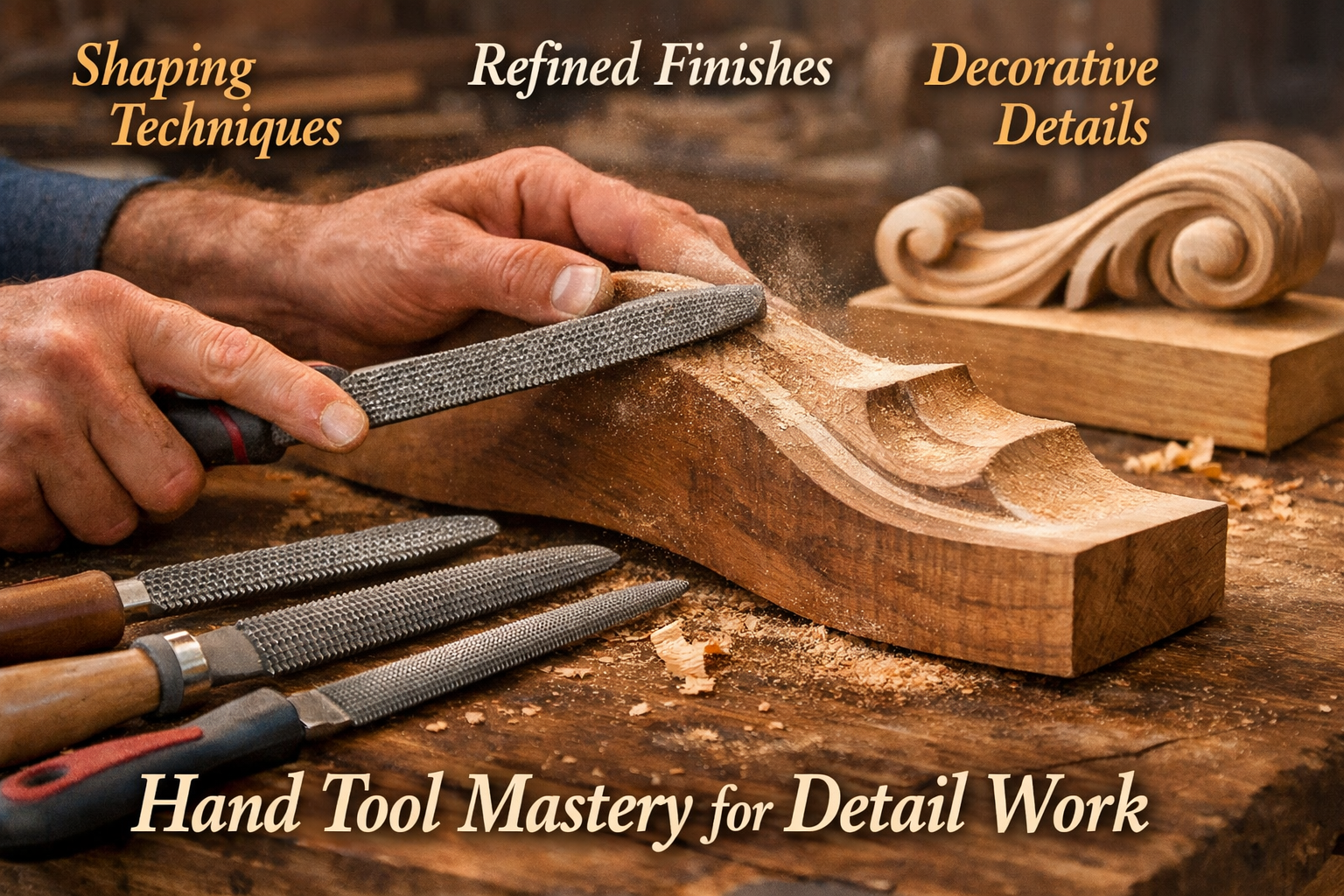
While chisels and planes excel at straight lines and flat surfaces, rasps, along with other specialized hand tools, are the masters of curves, contours, and intricate decorative elements that power tools often struggle to achieve.
Shaping with Rasps: From Rough to Refined
Rasps allow woodworkers to sculpt wood with an organic feel that cannot be replicated by machinery.
- Initial Shaping: For significant material removal on curves, a coarser rasp (e.g., a half-round cabinet rasp) is used. It quickly removes wood, allowing the user to establish the overall form. The key is to work progressively, gradually approaching the final line.
- Refining Contours: As the desired shape emerges, switch to finer rasps. Hand-stitched rasps, in particular, excel here, leaving a remarkably smooth surface that requires minimal sanding. The individual teeth cut rather than tear, providing excellent control.
- Creating Sculptural Elements: Rasps are indispensable for crafting delicate curves on furniture legs, chair backs, or any component requiring a flowing, ergonomic shape.
Effective Rasping Techniques:
- Support the Work: Securely clamp the workpiece to prevent movement.
- Use Long, Even Strokes: This helps to maintain a consistent curve and avoid creating flat spots.
- Work Progressively: Start with coarse, then medium, then fine rasps.
- Rotate the Work: Regularly turn the piece to view the curve from different angles, ensuring symmetry and flow.
- Clean the Rasp: Periodically clean the rasp’s teeth with a stiff brush to prevent clogging, which reduces cutting efficiency.
Adding Decorative Touches and Finishing Details
Beyond shaping, hand tools are perfect for adding the subtle, decorative elements that elevate a piece of furniture.
- Carving and Inlay: Small chisels, gouges, and knives are used for intricate carving, creating textures, patterns, or even functional elements like handholds. Similarly, these tools are essential for cutting precise recesses for inlay work. Learn more about unlocking the secrets of brackets woodworking for decorative applications.
- Moldings and Profiles: While routers can create moldings, specialty hand planes (e.g., molding planes) or even a simple chamfer plane combined with chisels can create custom profiles with a crispness and character often unmatched by machine-cut versions.
- Scrapers for Ultimate Smoothness: After planing and even fine sanding, card scrapers are invaluable for achieving an incredibly smooth, burnished surface, particularly on figured or difficult grain. They lift a microscopic shaving, avoiding the scratching inherent in sanding.
Table: Hand Tool Applications in Detail Work
| Task | Primary Tool(s) | Benefit |
|---|---|---|
| Precise Joint Fitting | Paring Chisels, Dovetail Chisels | Gap-free, strong joinery |
| Flattening & Smoothing | Smoothing Planes, Block Planes | Silky-smooth, true surfaces for finishing |
| Aggressive Curve Shaping | Coarse Wood Rasps (half-round, round) | Rapid material removal, establishment of form |
| Fine Curve Refining | Fine Wood Rasps (hand-stitched), Files | Smooth contours, reduced sanding post-rasping |
| Chamfering & Beveling | Block Planes, Chamfer Planes, Chisels | Crisp, clean edge details |
| Intricate Carving | Chisels, Gouges, Carving Knives | Unique decorative elements, textured surfaces |
| Removing Tear-out / Grain Reversal | Card Scrapers, High-angle Planes | Impeccable surface quality on challenging woods |
Embracing these techniques allows woodworkers to inject a level of bespoke craftsmanship into their projects that resonates with quality and attention to detail. This focus on hand work truly distinguishes the master craftsman.
Conclusion
The pursuit of Hand Tool Mastery for Detail Work: Chisels, Hand Planes, and Rasps for Refined Joinery and Finishing is a journey that transcends mere technique; it’s a philosophy. In an era where efficiency often overshadows artistry, purposefully slowing down to engage with the wood on a more intimate level through hand tools allows for a depth of craftsmanship unparalleled by machines. By carefully selecting and maintaining your tools, by patiently learning the nuances of sharpening, and by diligently practicing the subtle actions of paring, planing, and rasping, woodworkers in 2026 can achieve truly exceptional results.
The precision offered by a razor-sharp chisel ensures perfectly fitting joinery, the whisper of a hand plane brings a surface to an almost liquid smoothness, and the controlled aggression of a rasp sculpts organic curves with elegance. These are not merely alternative methods; they are often the only methods for achieving the highest standard of refined joinery, flawless surfaces, and intricate decorative details. Embrace the satisfaction that comes from creating something truly exquisite with your own hands, and watch your woodworking transform.
Actionable Next Steps:
- Invest in Quality: Start with a good quality bench chisel, a block plane, and a half-round wood rasp.
- Master Sharpening: Dedicate time to learning and practicing sharpening techniques until your tools are consistently razor-sharp.
- Practice Fundamental Cuts: Work on paring end grain, planing a thin shaving, and shaping a simple curve.
- Apply to Small Projects: Begin integrating these hand tools into smaller projects like cutting boards, boxes, or the details on a beginner’s guide to building Adirondack chairs to build confidence and skill.