

The average household in 2026 faces a myriad of small, daily frustrations, tangled charging cables, overflowing bookshelves, awkward empty corners, or the perpetual hunt for keys. These aren’t just minor annoyances; they are untapped opportunities for ingenuity and craftsmanship. Far from being relegated to hobbyists creating decorative pieces, woodworking offers a powerful, practical avenue to enhance daily living. This article, “The Crafty Woodworker’s Idea Bank: How to Turn Everyday Household Needs into Practical Woodworking Projects,” provides a systematic approach for transforming these common household pain points into satisfying, functional, and aesthetically pleasing wooden creations, suitable for various skill levels.
Key Takeaways
- Systematic Problem Identification: Learn to identify daily household frustrations as potential woodworking projects.
- Idea Generation Framework: Utilize a structured approach to brainstorm and develop practical solutions from observed needs.
- Project Categorization: Understand how to classify projects by skill level, from simple organizers to complex furniture.
- Material and Tool Selection: Discover how to choose appropriate woods and tools for different project types.
- Cost-Effective Crafting: Leverage woodworking to create custom solutions that are often more durable and personal than store-bought alternatives.
Unlocking The Crafty Woodworker’s Idea Bank: Identifying Household Needs
The journey into practical woodworking begins not with a blueprint, but with observation. Every cluttered countertop, every unused nook, every item without a designated home represents a design challenge waiting for a wooden solution. By consciously evaluating the functionality and aesthetics of your living space, you can populate “The Crafty Woodworker’s Idea Bank: How to Turn Everyday Household Needs into Practical Woodworking Projects” with a wealth of ideas.
Consider the common pain points that resonate in most homes:
- Storage Deficiencies: Are there items that constantly accumulate in the wrong places? Mail on the kitchen counter, shoes by the door, remote controls scattered across the coffee table? These signal a need for dedicated storage solutions.
- Ergonomic Issues: Does your workspace cause discomfort? Is your monitor at the wrong height, or are your tools inconveniently stored? Woodworking can create custom ergonomic aids, like monitor stands or workshop organizers.
- Aesthetic Gaps: Are there bland spaces that could benefit from a touch of warmth or personality? Bare walls, empty corners, or generic store-bought decor can be replaced or complemented by unique wooden pieces.
- Organizational Hurdles: Do specific activities lead to disarray? Charging multiple devices, cooking, or managing craft supplies often benefits from tailored organizational structures.
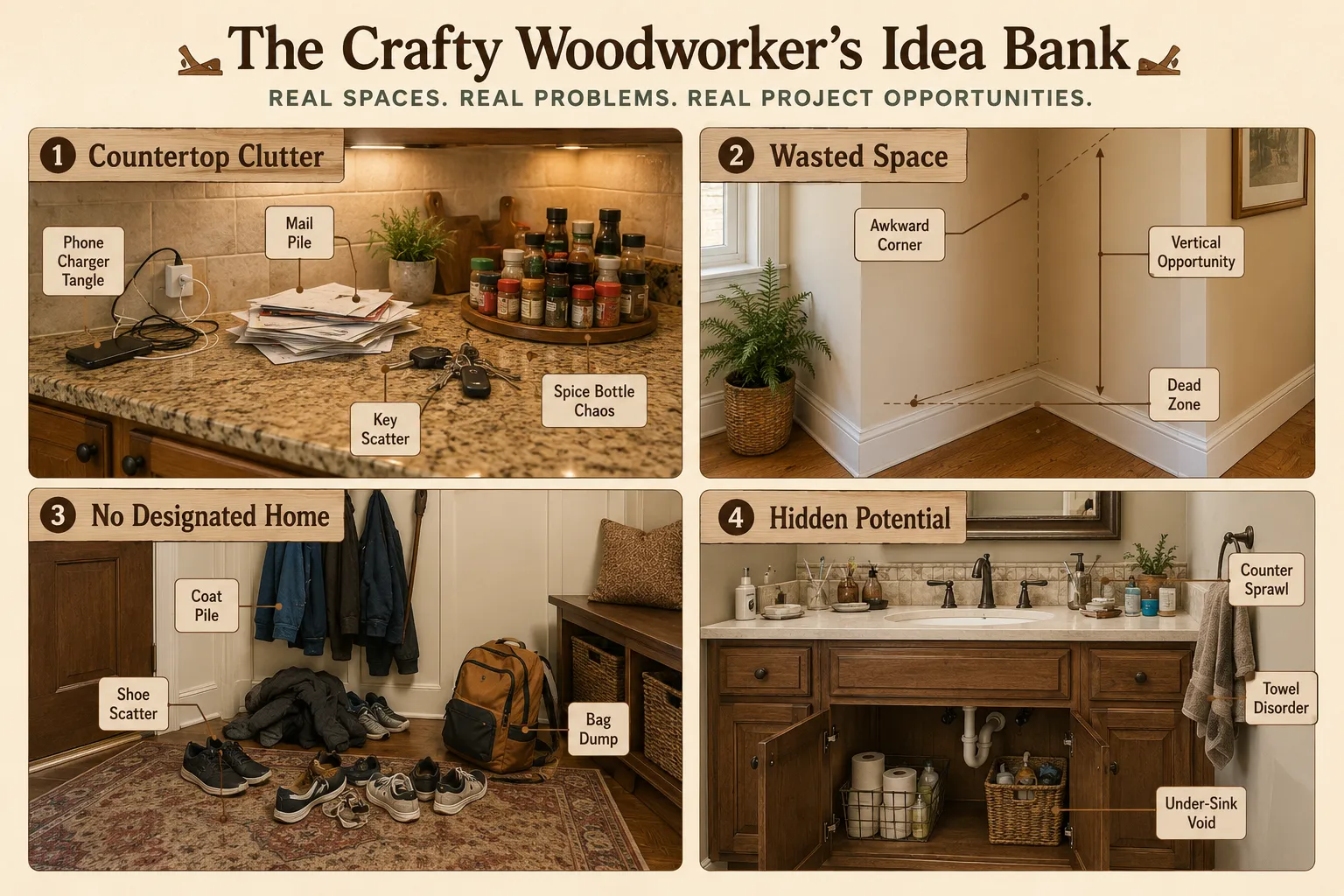
A simple exercise is to walk through each room of your home with a notebook. Jot down every minor inconvenience or visual dissatisfaction. For instance:
- Kitchen: “Always misplacing spices,” “No good place for cutting boards,” “Fruit bowl takes up too much counter space.”
- Living Room: “Remotes always lost,” “Books piled on floor,” “Blankets scattered.”
- Bedroom: “Jewelry tangled,” “No bedside storage,” “Shoes cluttering closet floor.”
- Entryway: “Keys and mail pile up,” “No place for umbrellas,” “Shoes everywhere.”
- Office/Workshop: “Cables are a mess,” “Tools aren’t organized,” “Too little desk space.”
This systematic observation forms the foundation for practical woodworking projects. The goal is to move beyond generic solutions and craft items that perfectly fit your specific space and habits.
Building Your Idea Generation Framework for Practical Woodworking Projects
Once you’ve identified a list of household needs, the next step is to translate these problems into tangible woodworking project ideas. This framework helps you systematically approach problem-solving with wood.
- Define the Problem Precisely: Don’t just say “clutter.” Specify: “My phone, smartwatch, and earbuds all need charging overnight, and their cables create a messy tangle on the nightstand.”
- Brainstorm Wooden Solutions: Think about how wood can solve this. A box? A stand? A combination? Consider different forms: “A simple wooden box with holes for cables,” “A tiered stand for each device,” “A bedside caddy that mounts to the bed frame.” For more inspiration on organizing tech clutter, consider exploring ideas for custom wooden charging stations.
- Consider Functionality: What specific features does the solution need? “Holds three devices,” “Hides cables,” “Has a small tray for keys/wallet,” “Accessible charging ports.”
- Evaluate Aesthetics: How should it look? “Modern and minimalist,” “Rustic farmhouse style,” “Blends with existing furniture,” “Natural wood finish.” The right wood choice can significantly impact the aesthetic; learn more about mastering the art of wood selection.
- Assess Skill Level and Resources:
- Simple: Can this be done with basic hand tools and minimal joinery (e.g., butt joints with screws and glue)?
- Intermediate: Does it require more precise cuts, basic power tools (e.g., a miter saw), or more robust joinery (e.g., dadoes, rabbets)?
- Advanced: Will it involve complex joinery (e.g., dovetails, mortise and tenon), intricate curves, or specialized power tools (e.g., router, planer)?
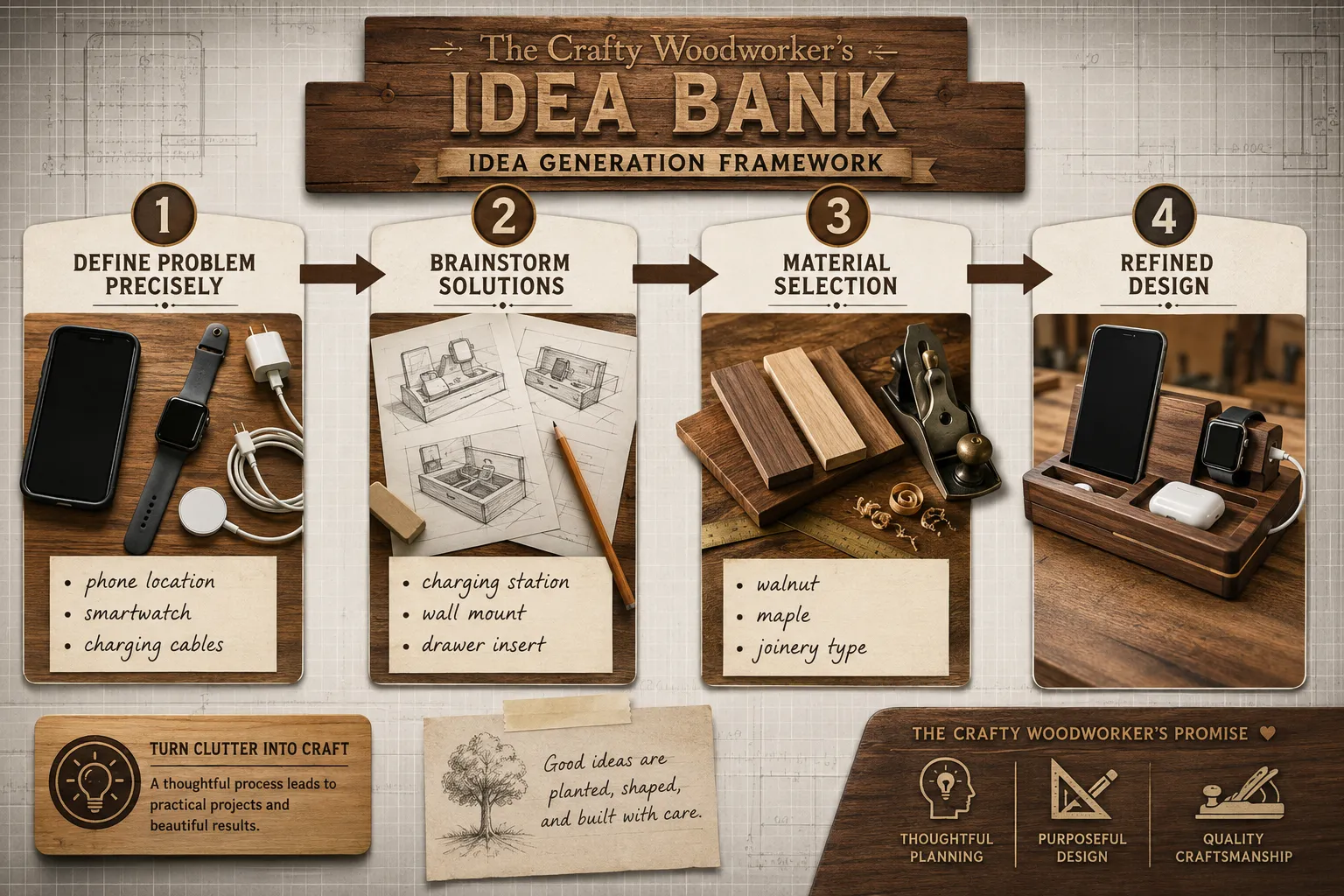
Let’s apply this framework to an example:
Problem: Books constantly spill off the small bedside table, creating disarray.
Brainstorm Wooden Solutions:
- A small, multi-tiered shelf unit.
- A floating shelf above the bed.
- A custom nightstand with integrated shelving.
- A wooden box with dividers to keep books upright.
Functionality: Needs to hold 5-7 books, ideally with a small surface for a lamp and alarm clock. Must be sturdy.
Aesthetics: Clean lines, stained to match bedroom decor, perhaps a minimalist design.
Skill Level & Resources: A simple floating shelf or a basic nightstand could be an intermediate project, involving accurate cuts and secure mounting. A more elaborate custom nightstand with drawers would be advanced. Learning about mastering shelf woodworking can provide specific guidance.
This systematic approach transforms vague dissatisfaction into a concrete project plan, making “The Crafty Woodworker’s Idea Bank: How to Turn Everyday Household Needs into Practical Woodworking Projects” a dynamic source of innovation.
The Crafty Woodworker’s Idea Bank: Project Examples for Every Skill Level
Whether you’re a novice with a few hand tools or an experienced artisan with a fully equipped shop, there’s a practical woodworking project to tackle everyday household needs. This section offers examples categorized by increasing skill demands.
Beginner-Friendly Projects (Basic Tools & Skills)
These projects often require simple cuts, basic joinery like butt joints, and fundamental assembly skills. They are excellent for learning the ropes of safe tool use, measuring, and finishing.
- Simple Spice Rack: A basic box-like structure or a series of small shelves to organize spices in a cabinet or on a counter. This is a great way to practice cutting to length and using wood glue and screws. Consider using the ultimate guide to wood glue for best results.
- Tablet/Phone Stand: A few pieces of wood cut at angles and glued together can create a functional stand for devices, keeping them upright and accessible.
- Wooden Coasters: Simple squares or circles cut from a larger piece of wood, sanded smooth, and finished. This project teaches sanding techniques and various wood finishes.
- Entryway Key Holder: A small board with hooks attached, perhaps with a routed slot for mail, can be mounted by the door.
- Small Bookends: Two simple L-shaped pieces of wood, weighted or designed to hold books upright.
Intermediate Projects (Some Power Tools & Intermediate Joinery)
These projects introduce more complex cuts, require better accuracy, and might involve a miter saw, jigsaw, or a basic router. Joinery could include dadoes, rabbets, or more robust fastened joints.
- Custom Bookshelves: Building a free-standing or wall-mounted bookshelf to fit a specific space. This involves accurate cutting of shelves and dados for support. More complex designs might benefit from understanding beginners guide to essential woodworking jigs.
- Monitor Stand with Storage: A monitor riser that elevates the screen to an ergonomic height and includes cubbies or a drawer underneath for desk organization.
- Entryway Bench with Shoe Storage: A sturdy bench that provides a place to sit and put on shoes, with open cubbies or a hinged lid for shoe storage beneath.
- Wall-Mounted Charging Station: A more elaborate box or shelf with multiple charging points, cable management channels, and perhaps a small integrated drawer.
- Small Wooden Planters: Custom-sized planters for indoor or outdoor use, potentially incorporating biophilic design elements. Learn more about creating custom wooden planters for indoor vertical gardens.
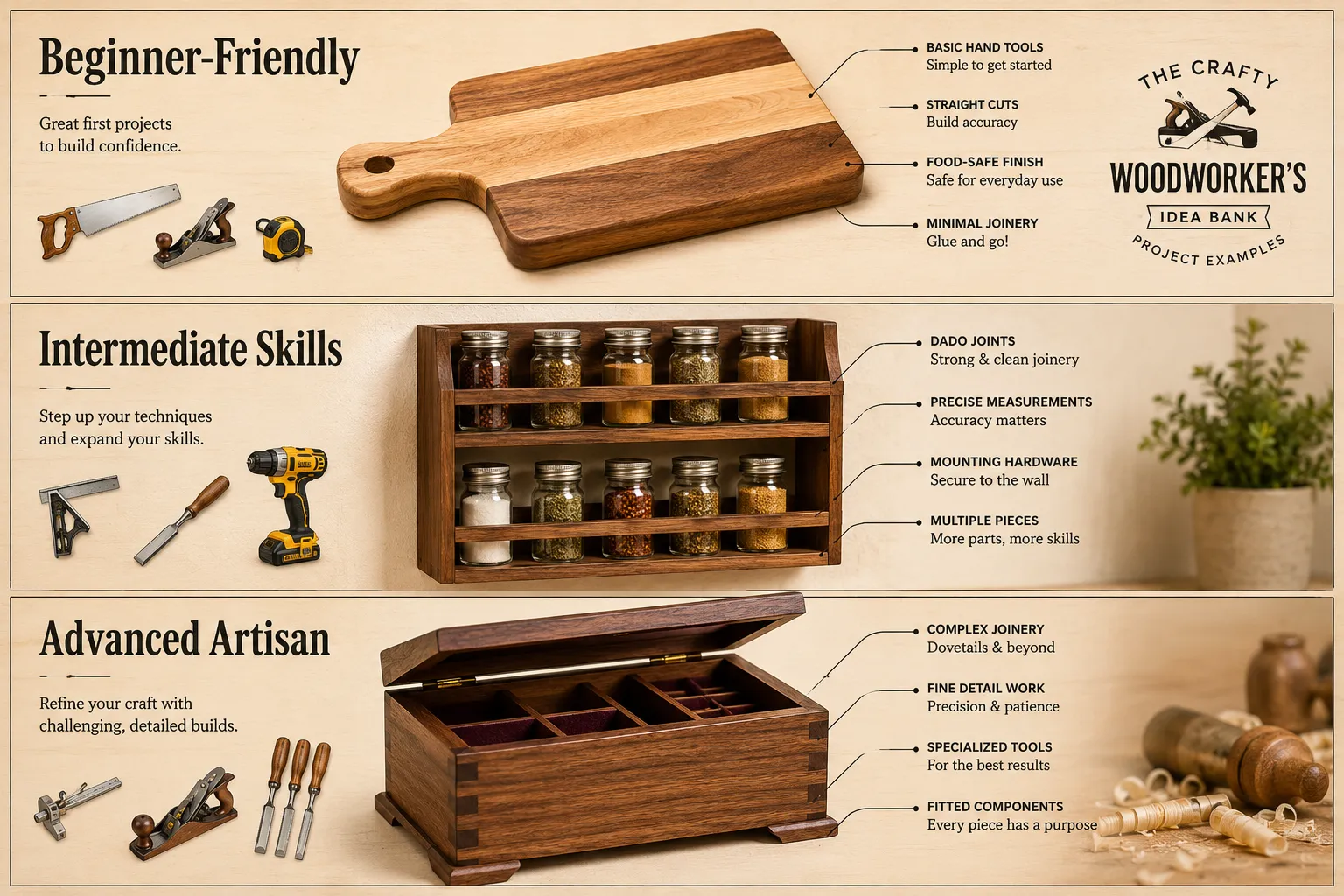
Advanced Projects (Specialized Tools & Complex Joinery)
Advanced projects demand precision, mastery of various tools, and often involve intricate joinery (e.g., dovetails, mortise and tenon), curves, or integration of multiple functions.
- Modular Workshop Storage System: Designing and building custom cabinets, drawers, and workbenches to maximize space and organization in a workshop. This is an excellent way to address specific storage needs, potentially using insights from building modular wood storage systems for small workshops.
- Custom Home Office Desk: A tailor-made desk that perfectly fits a space, incorporating drawers, cable management, and specific ergonomic features.
- Built-in Cabinetry: Custom-fitted cabinets or shelving units for awkward nooks, alcoves, or beneath stairs, requiring precise measurements and installation.
- Dining Room Table: Building a sturdy and aesthetically pleasing dining table, perhaps with unique joinery or a live-edge slab.
- Integrated Smart Home Hub Furniture: Combining woodworking with technology to create furniture that houses smart home devices discreetly, like a media console with hidden speakers or a DIY smart home automation hub from wood.
The key is to start with a real need, break down the solution into manageable steps, and select a project appropriate for your current skill set. As your “The Crafty Woodworker’s Idea Bank: How to Turn Everyday Household Needs into Practical Woodworking Projects” grows, so will your confidence and abilities.
Essential Considerations for Your Woodworking Projects
Before diving into sawdust, a few critical considerations will ensure your projects are successful, safe, and satisfying.
Safety First
Always prioritize safety. This includes:
- Wearing appropriate personal protective equipment (PPE): Safety glasses, hearing protection, and dust masks are non-negotiable.
- Understanding your tools: Read manuals, watch tutorials, and always operate tools correctly.
- Maintaining a clean and organized workspace: Reduce tripping hazards and ensure clear access to emergency stops.
- Securing your work: Use clamps and vises to hold your workpiece firmly.
Material Selection
Choosing the right wood is crucial for durability, aesthetics, and ease of working.
- Softwoods (Pine, Fir, Cedar): Generally more affordable, easier to cut and shape, but less durable and more prone to dents. Excellent for beginner projects or interior pieces not subject to heavy wear.
- Hardwoods (Oak, Maple, Cherry, Walnut): More expensive, harder to work with, but significantly more durable, stable, and aesthetically rich. Ideal for furniture, cutting boards, and items needing longevity.
- Plywood/MDF: Engineered wood products that offer stability and consistency, often used for cabinet carcasses, shelves, and jigs.
For detailed guidance on selecting the best lumber for your projects, consult resources on mastering the art of wood selection.
Tool Selection and Maintenance
Start with essential hand tools and gradually add power tools as your skills and project complexity grow.
- Hand Tools: Measuring tape, pencil, square, handsaw, chisels, planes, clamps, sandpaper. Learn about the ultimate guide to sharpening woodworking chisels and planes for optimal performance.
- Power Tools (Beginner/Intermediate): Circular saw, miter saw, jigsaw, drill, random orbit sander.
- Power Tools (Advanced): Table saw, router, planer, jointer, band saw.
Regular tool maintenance, including sharpening blades and bits, ensures accuracy and safety.
Finishing Your Projects
A good finish protects your woodworking project and enhances its beauty. Options include:
- Oils (Tung Oil, Linseed Oil): Penetrate the wood, providing a natural, matte finish that highlights grain. Easy to apply and repair.
- Waxes: Offer a soft, low-sheen finish, often used over oils or on decorative pieces.
- Shellac: A natural, fast-drying finish that provides a warm amber tone.
- Polyurethane/Varnish: Create a durable, protective film on the surface, available in various sheens. Excellent for high-wear items.
- Paints/Stains: Alter the color and appearance of the wood while providing some protection.
Explore options for budget friendly wood finishing for professional results without breaking the bank.
By keeping these essential considerations in mind, you can confidently turn your everyday household needs into successful, practical, and beautiful woodworking projects.
Conclusion
“The Crafty Woodworker’s Idea Bank: How to Turn Everyday Household Needs into Practical Woodworking Projects” is more than just a collection of ideas; it’s a methodology for intentional creation. By systematically identifying problems, applying a thoughtful idea generation framework, and understanding the scope of projects for various skill levels, you can transform frustrations into functional art. The satisfaction of building something with your own hands, perfectly tailored to your home and habits, far surpasses any off-the-shelf solution.
Start your woodworking journey today by simply looking around your home. What small annoyance could be solved with a piece of wood and some creativity? Pick a beginner-friendly project, gather your essential tools, and embrace the process of turning an everyday need into a handcrafted solution. As you gain experience, your “Idea Bank” will grow, and your home will gradually fill with pieces that reflect your unique skill and vision.
SEO Meta Title: Crafty Woodworker’s Idea Bank: Turn Needs into Projects 2026 SEO Meta Description: Unlock 2026’s Crafty Woodworker’s Idea Bank. Turn everyday household needs into practical woodworking projects with our expert guide & project ideas for all skill levels.