
The difference between a wobbly, inaccurate cut and a perfectly precise, joinery-ready edge often comes down to one simple factor: the use of woodworking jigs. For many beginners, the table saw and router can seem intimidating, powerful machines capable of great results but also significant mistakes. This comprehensive guide, “Beginner’s Guide to Essential Woodworking Jigs: Improving Accuracy and Safety on Table Saws and Routers,” aims to demystify these tools by introducing fundamental jigs that not only elevate the quality of your work but, more importantly, drastically enhance your safety in the workshop in 2026. Mastering these essential jigs is the cornerstone of moving from tentative cuts to confident, repeatable, and professional-looking results.
Key Takeaways
- Jigs are Fundamental: Essential woodworking jigs like cross-cut sleds and tapering jigs are crucial for beginner woodworkers to achieve consistent accuracy and repeatability.
- Safety First: Beyond accuracy, jigs significantly improve safety by securely holding workpieces, keeping hands away from blades, and providing predictable cutting paths.
- DIY Advantage: Many crucial jigs can be easily built in a home workshop using common materials, offering a cost-effective way to enhance capabilities.
- Table Saw Essentials: Cross-cut sleds and tapering jigs are indispensable for precise cross-cuts and angled cuts on the table saw.
- Router Precision: Router table fences and circle-cutting jigs transform a handheld router into a highly accurate, versatile machine for joinery and decorative work.
Understanding the Power of Jigs for Accuracy and Safety
In woodworking, a jig is a custom-made guide or device that holds a workpiece and directs a tool for a specific operation. Think of it as an extension of your machine, designed to make a particular task repeatable, precise, and safe. Without jigs, many cuts would be difficult, dangerous, or impossible to make accurately, especially for those new to woodworking.
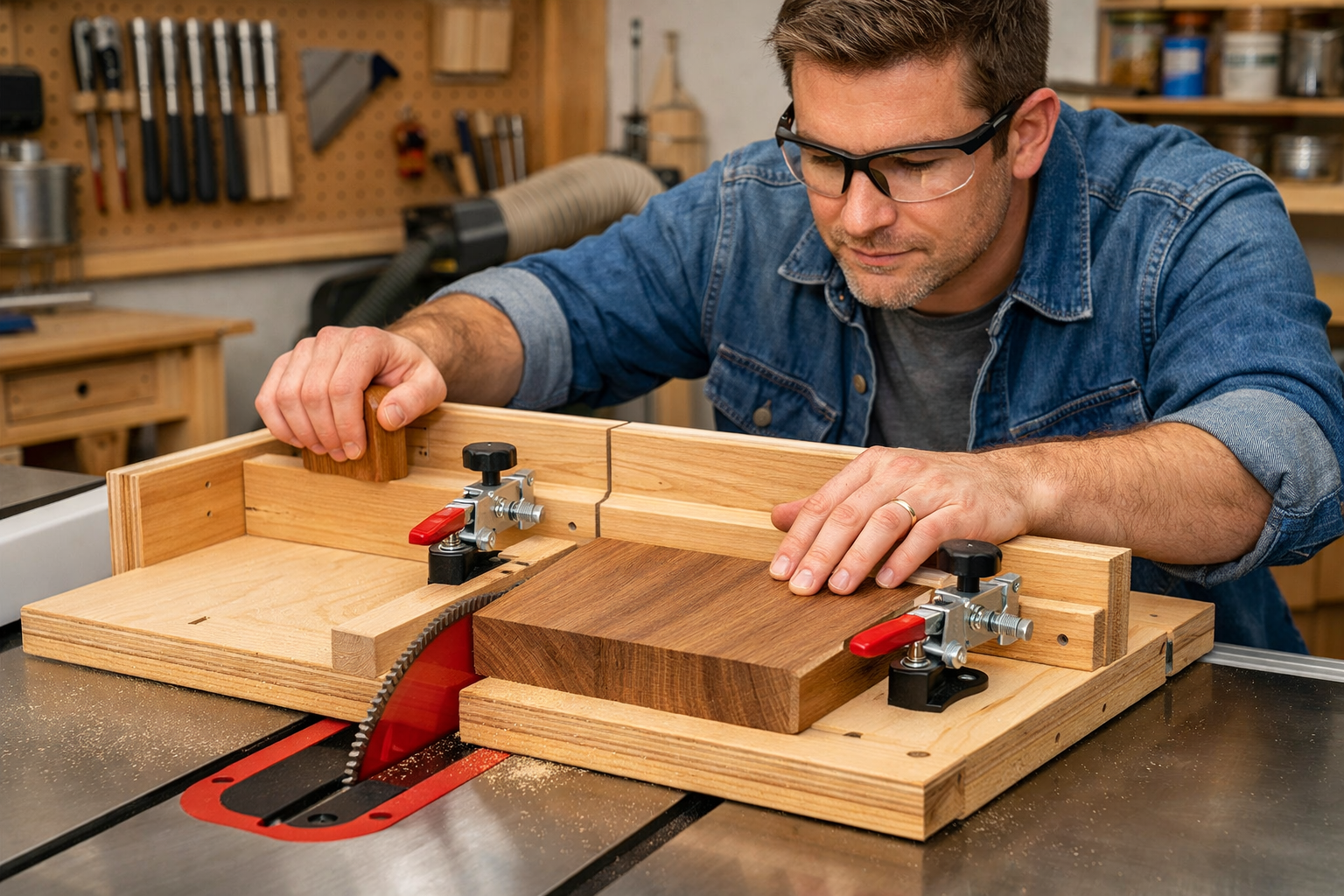
For instance, trying to cross-cut a wide panel on a table saw freehand is not only dangerous due to potential kickback but will almost certainly result in an imprecise, non-square cut. A cross-cut sled, however, transforms this risky operation into a safe, square, and repeatable task. Similarly, achieving perfectly uniform tapers on furniture legs without a dedicated tapering jig is a recipe for frustration and uneven results.
The primary benefits of incorporating jigs into your woodworking practice, especially for table saws and routers, are:
- Enhanced Accuracy: Jigs eliminate human error from holding angles or distances, ensuring every cut is identical.
- Superior Repeatability: When building multiple identical parts, a jig guarantees consistency from the first piece to the last.
- Significantly Improved Safety: Jigs keep your hands away from dangerous spinning blades and cutters, reduce the risk of kickback, and provide stable support for your workpiece.
- Time Savings: Once built, a jig makes repetitive tasks much faster to execute than setting up individual cuts each time.
- Expanded Capabilities: Jigs allow you to perform operations that would otherwise be difficult or impossible with the bare machine.
This “Beginner’s Guide to Essential Woodworking Jigs: Improving Accuracy and Safety on Table Saws and Routers” will focus on fundamental jigs that you can build yourself, providing immediate benefits to your workshop.

Essential Table Saw Jigs: Straight Cuts and Angles Made Easy
The table saw is often the heart of many woodworking shops, capable of ripping, cross-cutting, and grooving. However, its inherent power also necessitates careful handling. Jigs are paramount for making the table saw a safe and supremely accurate tool for beginners.
1. The Cross-Cut Sled
Perhaps the most fundamental table saw jig, a cross-cut sled is a game-changer for safety and accuracy. It’s essentially a flat platform that slides in the table saw’s miter slots, allowing you to make perfectly square (or angled) cross-cuts on boards too wide for the miter gauge, or to achieve far greater precision than a miter gauge alone.
Why it’s essential:
- Perfectly Square Cuts: Guarantees 90-degree cuts every time, critical for joinery.
- Enhanced Safety: The workpiece is clamped or held securely against a fence, keeping your hands well away from the blade.
- Reduced Tear-Out: A sacrificial backer board minimizes tear-out on the underside of your cut.
- Repeatability: Stop blocks can be added for identical length cuts.
How to build a simple cross-cut sled:
- Base: Use a piece of stable plywood or MDF (e.g., 1/2″ or 3/4″ thick) slightly larger than your typical cross-cut needs.
- Runners: Cut two hardwood runners (e.g., maple, oak) to fit snugly into your table saw’s miter slots. Attach them to the underside of the sled base with screws.
- Front and Back Fences: Attach a sturdy front and back fence, ensuring the back fence is perfectly square to the blade. A common method is to attach it slightly off-square, make a cut, then micro-adjust and re-screw until it’s perfect. The back fence should extend past the blade to provide tear-out support.
- Safety Stop: Add a small block to the front fence to prevent the sled from traveling too far past the blade.
For precise squareness, consider using the 5-cut method to dial in your fence. This method involves making a series of cuts and measuring the error over multiple passes to achieve extreme accuracy.
2. The Tapering Jig
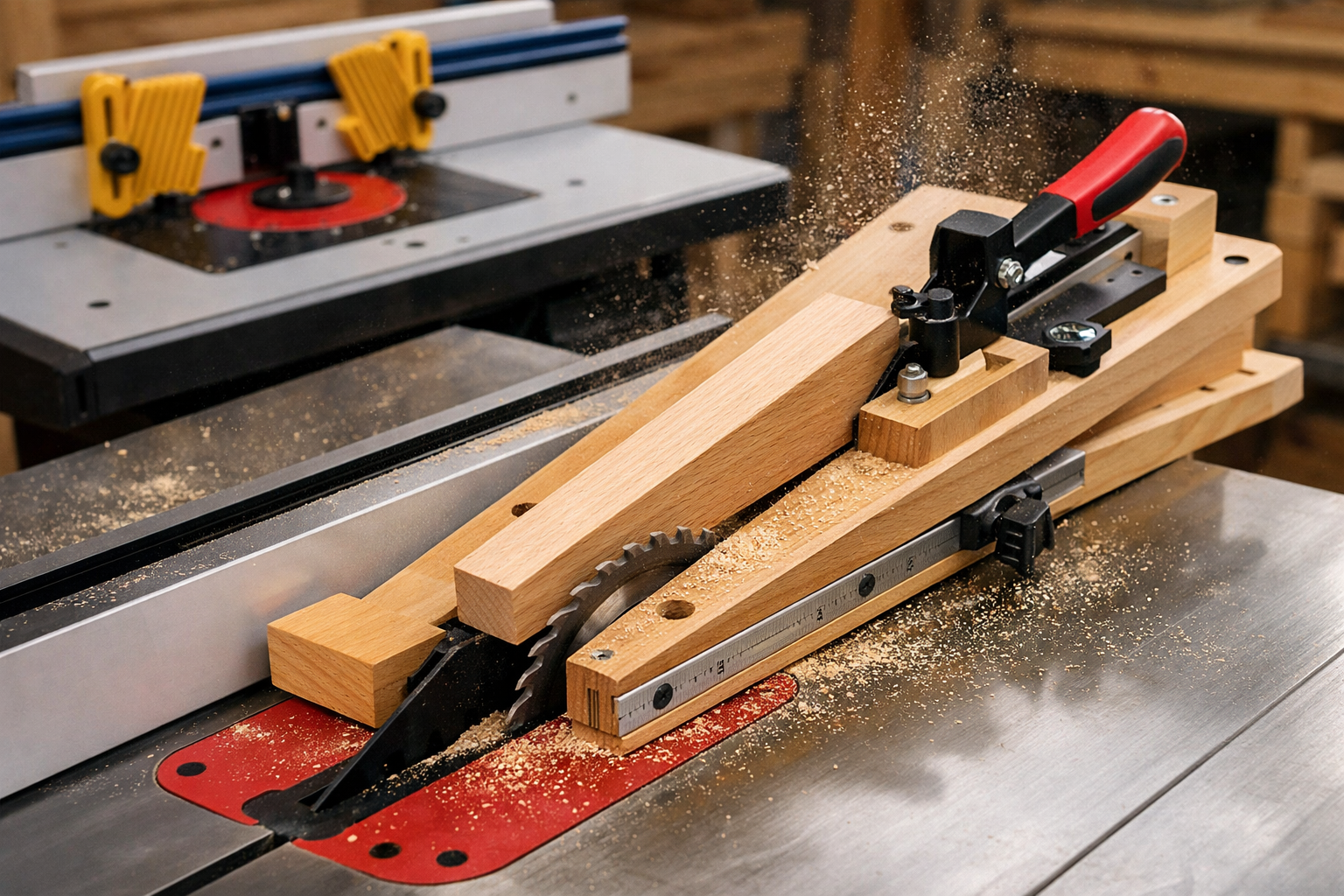
Creating tapered legs for tables or chairs adds a touch of elegance to furniture, but doing so safely and consistently on a table saw requires a tapering jig. This jig holds the workpiece at the desired angle and guides it past the blade.
Why it’s essential:
- Consistent Taperting: Ensures all four legs of a project have identical tapers.
- Safe Operation: Securely holds the workpiece, preventing it from shifting or kicking back.
- Adjustable Angles: Most designs allow for quick adjustments to the taper angle.
How to build a basic tapering jig:
- Base: A long, flat piece of plywood or MDF.
- Fixed Fence: A straight fence attached to one edge of the base.
- Adjustable Fence: Another fence attached with a pivot point at one end and an adjustable stop/clamp at the other to set the taper angle.
- Clamping: Incorporate toggle clamps or F-clamps to hold the workpiece securely against the adjustable fence.
This jig guides the workpiece safely along the saw fence, allowing you to achieve beautiful, uniform tapers with confidence.

Router Jigs: Unlocking Precision Joinery and Edge Profiling
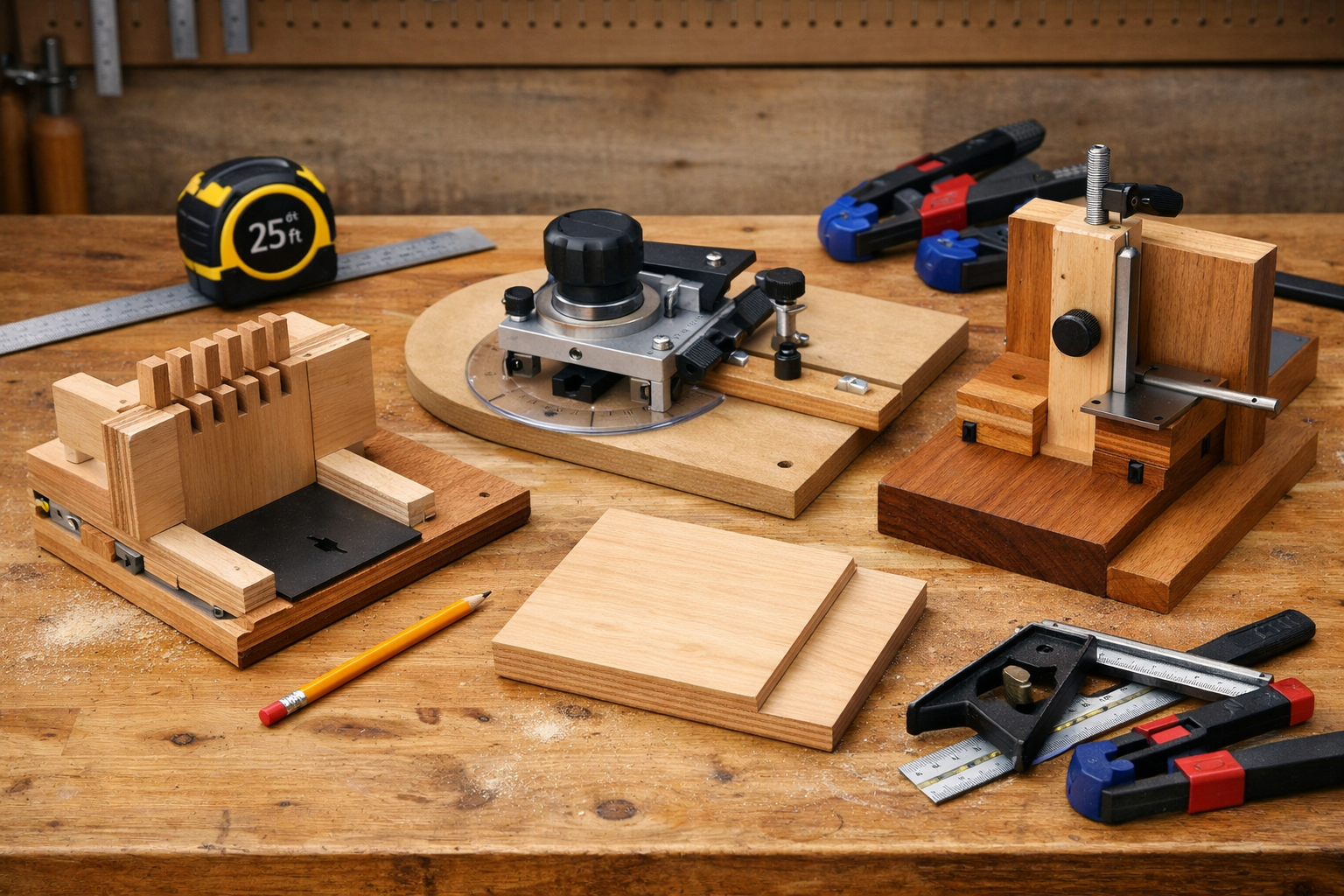
Routers are incredibly versatile tools, perfect for decorative edges, dadoes, rabbets, and various joinery. However, holding a router freehand for precise cuts can be challenging. Router jigs, especially when paired with a router table, transform this tool into a powerhouse of accuracy. For more information on setting up your router for advanced techniques, consider reading our guide on Mastering the Router Table: Essential Jigs, Safety, and Advanced.
1. Router Table Fence
While many router tables come with a fence, building a custom one, or enhancing a basic one, can significantly improve its functionality. A good fence is the backbone of precise router table operations, from making perfect dadoes to profiling edges.
Why it’s essential:
- Straight Cuts: Guides the workpiece for perfectly straight dadoes, rabbets, and flutes.
- Edge Profiling: Ensures consistent depth and clean edges when using edge-profiling bits.
- Dust Collection: A custom fence can often incorporate better dust collection ports.
- Joinery: Critical for various joinery techniques, including half-laps, tongue and groove, and even some dovetails (with specific router bits).
Key features of an effective router table fence:
- Straightness: Absolutely critical for accurate cuts.
- Adjustability: Should easily move forward and backward to control cut depth.
- Split Fence: Ideally, the fence should be split, allowing for shimming to accommodate different bit diameters for flush trimming or jointing.
- Dust Port: An integrated dust port dramatically improves chip extraction.
Building a robust router table fence, often from plywood or MDF, is a rewarding project that elevates your router’s capabilities. Remember to choose the right router bits for your project.
2. Circle Cutting Jig
Cutting perfect circles with a router can seem daunting, but a simple circle-cutting jig makes it incredibly straightforward and precise. This jig attaches to your router and pivots around a central point, allowing the router bit to scribe a perfect arc.
Why it’s essential:
- Perfect Circles: Guarantees smooth, clean, and perfectly round cuts of any diameter.
- Repeatability: Easy to reproduce the same circle size multiple times.
- Safety: Keeps the router stable and controlled during the cut.
How to build a basic circle-cutting jig:
- Base Plate: Use a piece of clear acrylic or thin plywood that attaches to your router’s base.
- Arm: A long, straight piece of plywood extends from this base plate.
- Pivot Point: Drill a small hole at the end of the arm, into which a pivot pin (a nail or screw) can be inserted into the center of your workpiece.
- Adjustment: Mark measurements along the arm to easily set the radius of your cut.
This jig is perfect for crafting round table tops, clock faces, or even decorative elements. For more on maximizing the use of your router, explore our guide on Choosing and Using Router Tables: Maximizing Precision and Safety for.
Other Notable Jigs for Table Saws and Routers
While the above are essential for beginners, many other jigs can expand your woodworking horizons:
- Box Joint Jig (Router Table): For creating strong, decorative box joints. Check out our guide on Mastering Dovetail Drawers for Cabinets: Hand-Cut and Router for related joinery.
- Tenoning Jig (Table Saw): For safely and accurately cutting tenons for mortise and tenon joints.
- Dado Sled (Table Saw): Similar to a cross-cut sled, but designed for cutting precise dadoes across wide panels.
- Dovetail Jigs: Commercial or homemade jigs that simplify cutting dovetails with a router.
Remember, the beauty of jigs is that they empower you to achieve results that might otherwise seem out of reach. Building them also helps you understand the mechanics of your tools better.

Conclusion: Elevate Your Craft with Essential Jigs
Embarking on the journey of woodworking in 2026 is an exciting endeavor, and the path to precision and safety is paved with essential woodworking jigs. From the critical cross-cut sled that ensures perfectly square table saw cuts to the versatile router table fence that unlocks intricate joinery, these simple shop-made aids are indispensable for any beginner.
By understanding how to build and properly utilize fundamental jigs, you will not only improve the accuracy and repeatability of your projects but also significantly enhance your safety when working with powerful machines like table saws and routers. The confidence gained from making perfect cuts consistently will propel your woodworking skills forward, allowing you to tackle more complex projects with greater ease and enjoyment.
Don’t view building jigs as a chore, but rather as an investment in your woodworking future. Each jig you construct and master is a step towards becoming a more skilled, safer, and more efficient woodworker. Start with the basics, practice diligently, and watch your craftsmanship flourish. Your projects will thank you, and your workshop will be a safer, more productive space.