
The market for custom, character-rich furniture, particularly pieces featuring live edge slabs and robust beams, has surged dramatically in 2026. This growing demand presents a significant opportunity for furniture makers, even those operating within the confines of a compact space. The common misconception is that such substantial projects require vast square footage and an arsenal of industrial machinery. However, with strategic planning, a discerning selection of essential tools, and an understanding of workflow, a small workshop can be incredibly productive for even the most ambitious live edge and beam projects. This article will guide you through creating an efficient Small Workshop Setup for Furniture Makers: Essential Tools and Space Planning for Live Edge and Beam Projects, ensuring you can tackle large-scale woodworking with precision and profitability.
Key Takeaways
- Effective space planning is paramount in a small workshop; prioritize mobility and multi-functional tools.
- Invest in specialized power tools like wide slab planers, track saws, and large bandsaws tailored for live edge and beam work.
- Hand tools play a critical role in refining organic shapes and detailing large timber.
- Robust dust collection and efficient lumber storage are non-negotiable for safety and productivity in a compact area.
- Optimize workflow for material handling, from rough milling to finishing, to maximize efficiency and minimize physical strain.
Smart Space Planning and Layout for Compact Live Edge & Beam Work
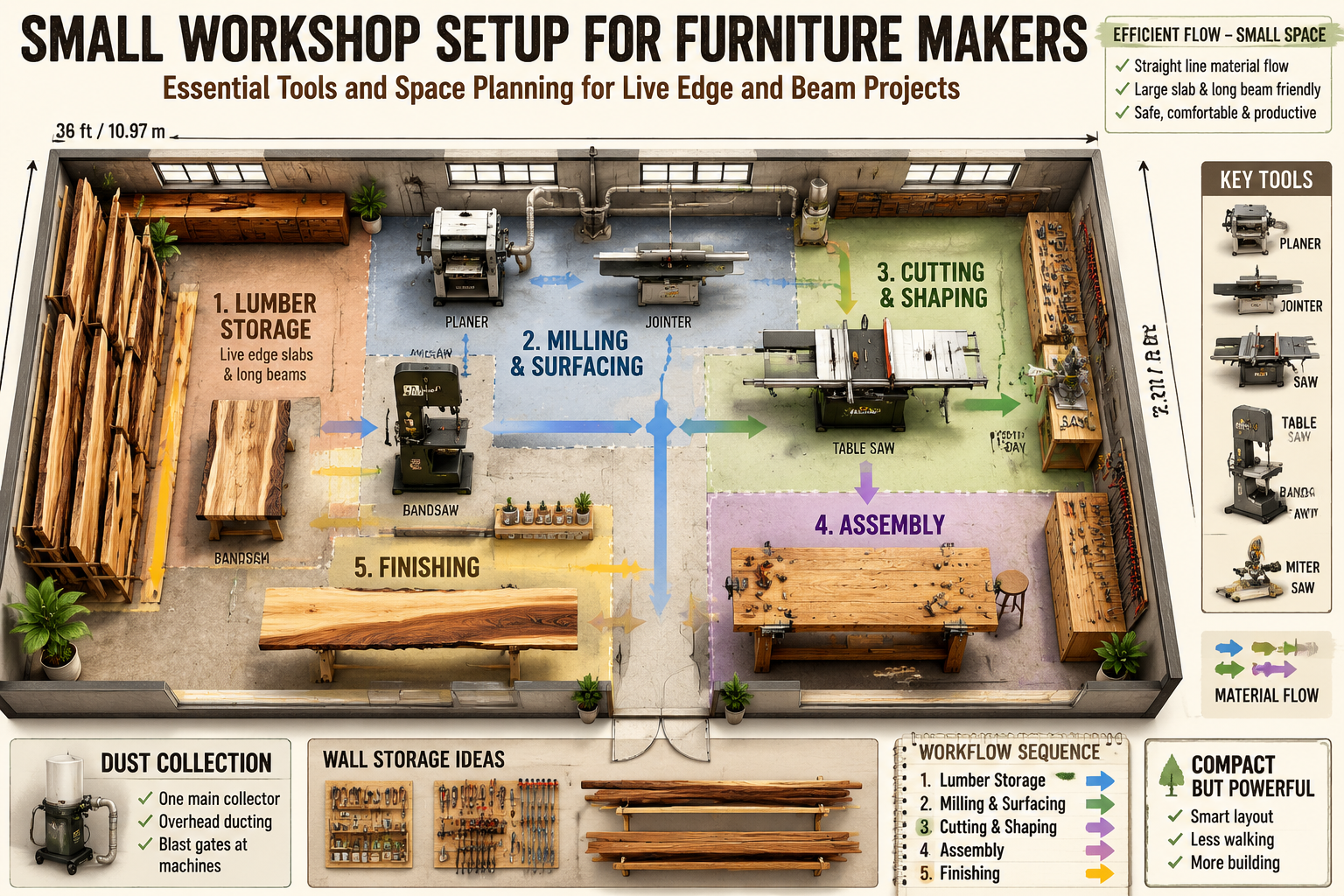
Maximizing a limited footprint isn’t just about fitting tools; it’s about creating a logical flow that accommodates oversized materials. For a Small Workshop Setup for Furniture Makers: Essential Tools and Space Planning for Live Edge and Beam Projects, the core principle is flexibility. Your layout must allow for the movement and processing of long, heavy slabs and beams, which often exceed the dimensions of your shop itself.
Consider the entire workflow:
- Material Infeed/Outfeed: Where will raw slabs and beams enter and exit the shop? Can you leverage exterior space (like a driveway or garage door opening) for initial milling or temporary storage?
- Rough Milling Zone: This area requires the most space for large machinery like a jointer, planer, and bandsaw. Tools should be placed to allow for long passes, potentially through doorways or into an adjacent space. Mobile bases are crucial here.
- Breakdown/Sizing Zone: Typically, your table saw or track saw area. While a table saw is central for many tasks, a track saw offers unparalleled versatility for breaking down wide slabs and beams precisely, often with less space requirement than a full-size panel saw.
- Assembly Zone: A robust workbench is the heart of this area. It should be heavy-duty, stable, and ideally on locking casters for repositioning. Building a custom workbench can significantly improve ergonomics and efficiency. See our guide on Creating Ergonomic Workshop Furniture: Building Custom Workbenches.
- Finishing Zone: This area needs good ventilation and cleanliness. It might overlap with the assembly area but requires dedicated space for sanding, oiling, and curing.
- Storage: Vertical storage is your best friend. Lumber racks for various sizes of stock, including dedicated spaces for smaller live edge pieces, are essential. Tool storage should keep frequently used items accessible and specialized tools protected.
| Zone | Key Considerations | Recommended Tools/Equipment |
|---|---|---|
| Material Handling | Clear pathways, access to exterior, heavy-duty dollies/carts. | Engine hoist (for very large slabs), heavy-duty shop carts, lumber dollies. |
| Rough Milling | Ample infeed/outfeed room, strong dust collection integration. | Wide slab planer, jointer (or sleds for planer), large bandsaw, mobile bases. |
| Breakdown/Sizing | Precision and stability. Ability to handle long cuts. | Track saw with long rails, dedicated table saw with outfeed support (if space allows), crosscut sled. |
| Assembly | Sturdy, level surface. Ability to clamp large pieces. | Heavy-duty workbench (mobile), various clamps (bar, pipe, F-style), assembly table. |
| Finishing | Ventilation, dust-free environment, good lighting. | Dedicated finishing table (can be the workbench), drying rack, ventilation fan, respirators. |
| Storage | Vertical optimization, clear labeling, accessibility. | Cantilever lumber racks, cabinet storage for hand tools, wall-mounted organizers. |
One effective strategy is creating “zones” that can be reconfigured. For instance, the rough milling zone might be centered around a large mobile planer, which is then rolled out of the way for assembly. Outfeed tables can be collapsible or double as general workspaces. This flexibility is crucial for a productive Small Workshop Setup for Furniture Makers.
Essential Tools for Live Edge and Beam Projects in a Small Workshop
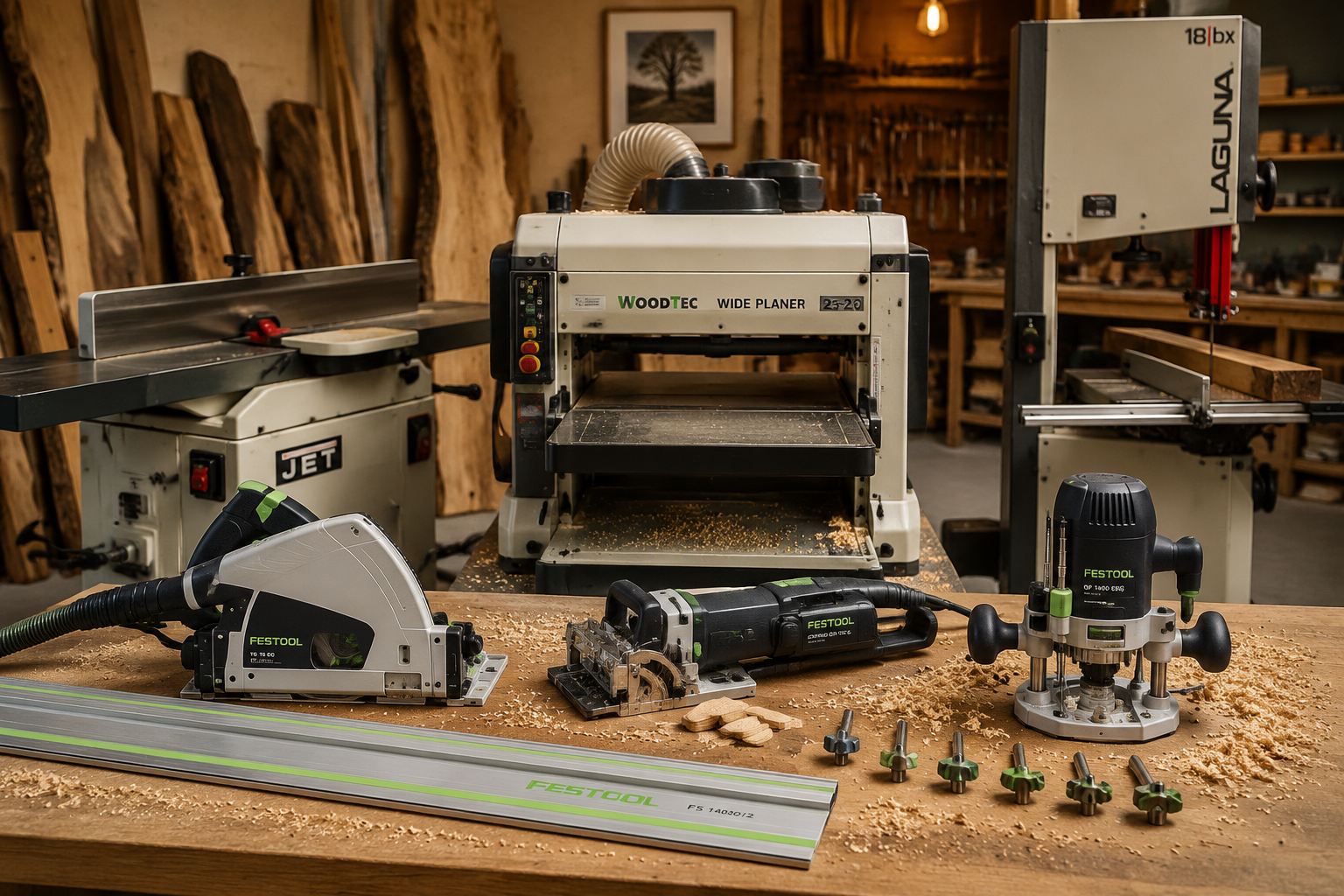
The right tools are fundamental for a Small Workshop Setup for Furniture Makers, especially when dealing with the unique challenges of live edge slabs and heavy beams. Focus on versatility and capability over sheer quantity.
Power Tools
- Wide Slab Planer: This is non-negotiable for flattening large, irregular live edge slabs. Many standard planers have limited width, so investing in a wider model (e.g., 20″ or more) or a planer sled system for narrower machines is critical.
- Large Bandsaw: Essential for resawing thick beams, shaping curved live edges, and creating unique profiles. A bandsaw with ample resaw capacity (12″+) is highly recommended.
- Track Saw: A game-changer for breaking down wide slabs and beams with precision. It’s more space-efficient than a large table saw for these tasks and offers excellent portability. This is a primary tool for accurate initial cuts.
- Router (and Router Table): Indispensable for flattening slabs with a router sled, creating joinery, shaping edges, and preparing pieces for epoxy pours. A good router table expands its capabilities significantly. Learn more about Beginner’s Guide to CNC Routers for Small Woodshops for more advanced shaping.
- Orbital Sander (Random Orbit Sander): For efficient stock removal and achieving smooth finishes on both flat surfaces and the organic curves of live edges. Invest in a quality model with good dust extraction.
- Domino or Mortise and Tenon Joiner: For robust joinery in heavy beam construction or attaching bases to thick slabs. A Domino joiner offers incredible speed and strength. For traditionalists, mastering Hand Tool Joinery for Visible Wood Joints is also valuable.
Hand Tools
While power tools handle the heavy lifting, hand tools provide finesse, especially when working with the unique contours of live edge wood.
- Chisels and Mallet: For cleaning up joinery, squaring corners, and fine carving details.
- Block Plane and Spokeshave: Excellent for smoothing curved edges, chamfering, and refining details where power sanders might be too aggressive or cumbersome.
- Card Scrapers: Perfect for removing milling marks, glue squeeze-out, and achieving an incredibly smooth surface before finishing, especially on highly figured grain.
- Measuring and Marking Tools: High-quality squares, marking gauges, rules, and calipers are essential for precision.
- Clamps: A wide assortment of clamps is vital – bar clamps for wide glue-ups, F-clamps, and spring clamps for various holding tasks. For very wide slabs, pipe clamps offer an economical solution.
Finishing, Dust Management, and Material Handling

The final aspects of a Small Workshop Setup for Furniture Makers: Essential Tools and Space Planning for Live Edge and Beam Projects are often overlooked but are crucial for safety, efficiency, and the quality of your finished product.
Dust Collection
Working with large slabs and beams generates an enormous amount of dust and shavings. A robust dust collection system is not just about cleanliness; it’s about health and safety.
- Main Collector: Invest in a powerful dust collector (1.5 HP or more) with a good filtration system.
- Ducting: Design your ducting to minimize turns and maximize airflow to your main machines. Consider flexible hose drops for portable tools.
- Shop Vacuum: Essential for cleaning up around individual tools, for sanding operations, and for general shop clean-up.
- Air Filtration: An ambient air filter helps capture fine dust particles that escape the main collector, improving overall air quality.
- Personal Protective Equipment (PPE): Always use a respirator, safety glasses, and hearing protection.
For more on managing dust, explore Building a DIY Smart Workshop Dust Collection System.
Material Handling
Moving heavy, awkward slabs and beams safely and efficiently in a small space requires thoughtful solutions.
- Mobile Bases: Put as many of your stationary power tools as possible on heavy-duty mobile bases. This allows you to reconfigure your shop for different operations and store tools against walls when not in use.
- Roller Stands/Support Tables: Essential for managing long stock on a table saw, bandsaw, or jointer. Outfeed support is critical for both safety and accuracy.
- Heavy-Duty Workbench/Assembly Table: A sturdy workbench that can withstand the weight of large pieces is a must. Consider building one with integrated storage and clamping options. Read about Building a Custom Wood Workbench.
- Lumber Rack: A wall-mounted or freestanding cantilever lumber rack can efficiently store various sizes of wood vertically, freeing up floor space. Ensure it can handle the weight of heavy timbers.
- Slab Cart/Dolly: A specialized cart designed to move wide, heavy slabs is invaluable, reducing strain and preventing damage.
Finishing Supplies
The finish is what brings out the character of live edge and beam projects.
- Sanding Supplies: A wide range of sandpaper grits (from 80 to 400+) for different stages of sanding. Consider a sanding block for hand-sanding curves.
- Finishing Oils/Varnishes: Determine your preferred finishes. For live edge, penetrating oils often highlight the natural grain beautifully. For beams, durable varnishes or polyurethanes might be more appropriate.
- Applicators: Brushes, rags, foam applicators.
- Cleaners/Solvents: For tool cleanup and surface preparation.
Proper preparation of live edge slabs is critical before finishing. Refer to our guide on Live Edge Slab Selection and Preparation: From Raw Material for detailed steps.
Conclusion
Establishing an efficient Small Workshop Setup for Furniture Makers: Essential Tools and Space Planning for Live Edge and Beam Projects is entirely achievable with careful planning and smart investments. By prioritizing versatile tools, optimizing your space for material flow, and implementing robust dust management and material handling solutions, you can create a highly productive environment. The key lies in understanding the unique demands of live edge and beam work and tailoring your shop to meet those challenges, turning limited space into a significant asset.
Next Steps:
- Assess Your Space: Measure your workshop thoroughly and sketch out potential layouts, prioritizing material movement.
- Inventory Your Tools: Identify gaps in your current toolset, focusing on the specialized items mentioned for live edge and beam projects.
- Invest Wisely: Prioritize tools that offer maximum versatility and capacity for the types of projects you plan to undertake.
- Plan for Dust: Research and plan your dust collection system, considering both stationary and portable tool integration.
- Build Smart: Construct or acquire mobile bases, roller stands, and a sturdy workbench to enhance your shop’s adaptability.
SEO Meta Title: Small Workshop Setup: Essential Tools for Live Edge & Beams SEO Meta Description: Master your small workshop for live edge and beam furniture. Discover essential tools, smart space planning, and workflow tips for 2026 success.